SUPPORTED EMPLOYMENT SERVICES PROVIDER IN VERMONT
By Fatumata Kaba · 2026-04-09 · 5 min read
Supported Employment services in Vermont provide essential, individualized job support for individuals with intellectual and developmental disabilities, acquired brain injuries, and physical impairments to secure and retain competitive, integrated employment. These services are delivered through Vermont’s Home and Community-Based Services (HCBS) Medicaid Waivers, ensuring that participants have the professional guidance necessary to achieve long-term career success and independence within their communities.
Understanding the Governance and Regulatory Framework
The delivery of Supported Employment in Vermont is a collaborative effort involving state oversight agencies and local service providers. The Vermont Department of Disabilities, Aging and Independent Living (DAIL) serves as the primary regulatory body, establishing the framework for waiver programs and ensuring that Individual Support Plans (ISPs) effectively align with measurable employment outcomes. Providers must maintain strict compliance with DAIL’s standards to ensure participants receive high-quality, person-centered support.
Financial management and provider legitimacy are handled by the Department of Vermont Health Access (DVHA), which oversees Medicaid enrollment and the reimbursement of services. On a localized level, Designated Agencies (DAs) and Specialized Services Agencies (SSAs) act as the primary coordinators for service planning. These agencies authorize services through the participant’s ISP and monitor the ongoing progress of individuals to ensure their employment goals remain relevant and attainable.
- Vermont Department of Disabilities, Aging and Independent Living (DAIL): Oversees waiver programs, approves provider qualifications, and ensures ISP alignment.
- Department of Vermont Health Access (DVHA): Manages Medicaid provider enrollment and reimbursement for Supported Employment services.
- Designated Agencies (DAs) / Specialized Services Agencies (SSAs): Coordinate service planning, monitor employment progress, and authorize services.
Core Components of Supported Employment Services
Supported Employment is rooted in the "Employment First" philosophy, which prioritizes competitive, integrated work as the primary objective for all participants. These services are not one-size-fits-all; they are highly individualized, focusing on the specific strengths, preferences, and long-term career goals defined within the participant’s ISP. By utilizing a blend of pre-vocational discovery and on-the-job support, providers facilitate a seamless transition into the workforce.
Service delivery encompasses a wide range of activities tailored to the needs of the individual. This includes initial job discovery, where specialists identify career interests, followed by active job development and employer outreach. Once a position is secured, services transition toward on-the-job coaching, skill building, and the implementation of necessary workplace accommodations. Furthermore, the support structure includes ongoing retention services to help the employee navigate career advancement or adjust to workplace changes over time.
The Provider Enrollment and Launch Roadmap
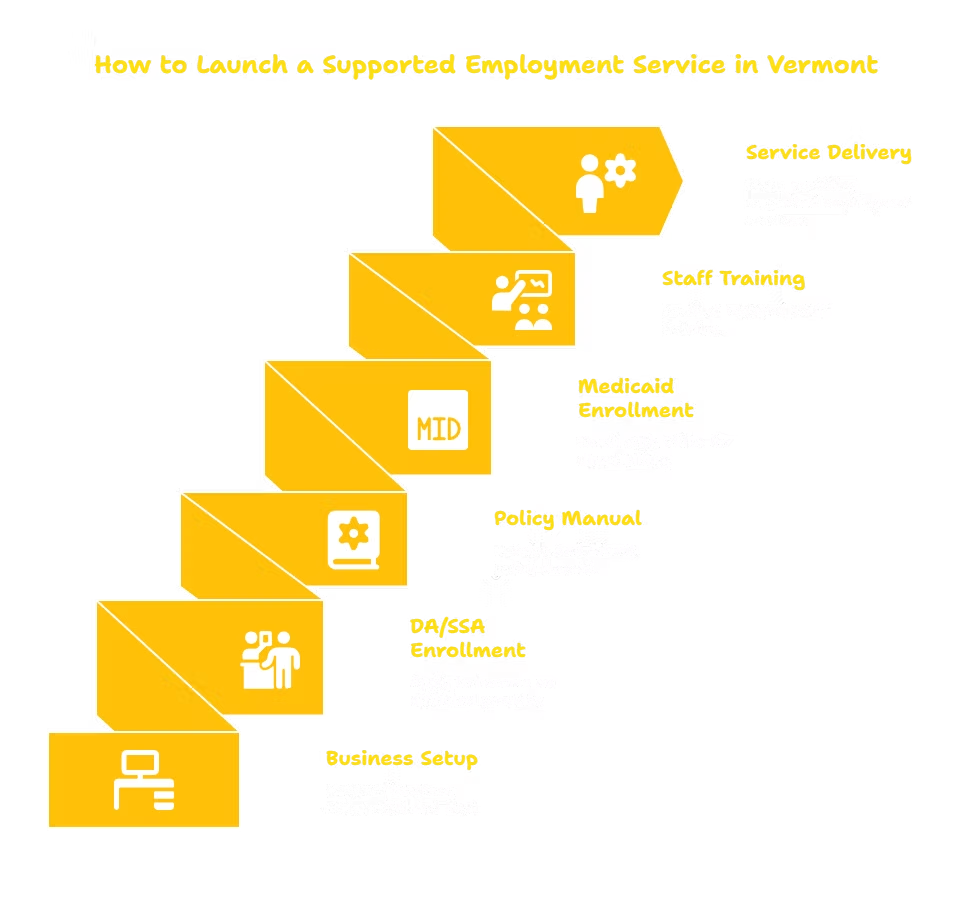
Launching a Supported Employment practice requires a systematic approach to business registration and agency alignment. Founders must first ensure their business is properly registered with the Vermont Secretary of State, obtain a federal EIN, and secure a Type 2 NPI. Because Supported Employment is a waiver-based service, obtaining an independent provider contract with a local DA or SSA is a critical prerequisite to service delivery and eventual billing.
The timeline for launching is generally structured in four phases. Following business setup, providers must dedicate one to two months to navigate DA/SSA enrollment and DVHA registration. During this time, the agency must develop a comprehensive Policy & Procedure Manual, which must be submitted for review. Final steps involve rigorous staff training in person-centered documentation and workplace safety protocols, culminating in the formal authorization of services for each participant.
- Phase 1: Business Setup & Policy Manual Development (2–4 weeks)
- Phase 2: DA/SSA Enrollment & Medicaid Provider Registration (1–2 months)
- Phase 3: Staff Hiring, Training & Credentialing (2–3 weeks)
- Phase 4: Begin Service Delivery (Upon authorization)
Establishing Mandatory Policies and Documentation
A robust administrative foundation is non-negotiable for Medicaid-reimbursed services. Providers must maintain a formal Supported Employment Policy & Procedure Manual that serves as the blueprint for agency operations. This document must clearly articulate the protocols for job development, client rights, and HIPAA-compliant data management. It should also include templates for progress notes, employment plans, and time-tracking logs, as these are the primary records audited by state agencies.
Beyond internal operations, the manual must address risk management and safety. Because staff operate in varied work environments, the agency needs clear protocols for employer communication, workplace incident reporting, and emergency procedures. Ensuring that all documentation is tied directly to the goals outlined in the participant's ISP is essential for maintaining compliance during annual reviews and quality assurance audits conducted by the state.
Staffing, Training, and Professional Standards
The quality of Supported Employment services is highly dependent on the competence of the Employment Specialist or Job Coach. While a high school diploma is the baseline, a Bachelor’s degree is often preferred, along with prior experience in workforce development. Every staff member must undergo thorough background check clearance before interacting with participants. It is highly recommended that staff pursue specialized certifications, such as those provided by ACRE or APSE, to ensure best practices are being applied.
Ongoing staff development is a central requirement. The agency must ensure all staff are trained in "Employment First" principles, person-centered planning, and the specific documentation requirements necessary for Medicaid billing. Furthermore, training must cover HIPAA regulations and formal grievance protocols. Whether an agency employs a full-time Program Supervisor or relies on lead staff, a consistent approach to QA monitoring and continuing education is required to maintain licensure and contract eligibility.
Frequently Asked Questions
Which Medicaid waivers cover Supported Employment services?
Supported Employment is primarily covered under the Developmental Disabilities Services Waiver (DDSW) for individuals with ID/DD. It is also available through the Brain Injury Program, which emphasizes skill redevelopment, and in limited, specialized circumstances within the Choices for Care (CFC) program. Pediatric transition programs may also include these services for youth preparing for adult employment.
Is coordination with Vocational Rehabilitation (VR) mandatory?
Yes. Because the state utilizes multiple funding streams for employment, it is critical that services are coordinated with the Vermont Division of Vocational Rehabilitation (VR) when applicable to prevent duplication of services and to ensure the participant receives the most comprehensive support possible.
What happens if a provider fails to meet documentation standards?
Failure to maintain accurate progress notes, time-tracking logs, or ISP-aligned documentation can lead to the denial of Medicaid claims, clawbacks of previously reimbursed funds, or the termination of the provider contract with the local DA/SSA. Consistent internal auditing is the best defense against these risks.
Key Takeaway
Success as a Supported Employment provider in Vermont relies on balancing clinical person-centered planning with the strict administrative requirements of DAIL and local Designated Agencies. By formalizing your operations, investing in qualified staff training, and maintaining rigorous, ISP-driven documentation, providers can effectively promote economic independence for the individuals they serve while ensuring the long-term sustainability of their practice.
Last verified: 2024. The information contained in this article is for educational purposes only and does not constitute legal or professional advice. Readers should consult directly with the Vermont Department of Disabilities, Aging and Independent Living (DAIL) and local Designated Agencies for the most current rules, regulations, and provider requirements.