SUPPORTED EMPLOYMENT SERVICES PROVIDER IN UTAH
By Fatumata Kaba · 2026-04-01 · 5 min read
Empowering individuals with disabilities to achieve competitive, integrated employment through person-centered supports is the core mission of Supported Employment providers in Utah. These services are vital for helping individuals with intellectual, developmental, or physical disabilities find and maintain meaningful work in the community, promoting independence, community inclusion, and long-term economic self-sufficiency.
Supported Employment is an authorized service under Utah’s HCBS Medicaid Waivers, coordinated primarily by the Division of Services for People with Disabilities (DSPD). As a provider, your role involves delivering tailored job development, expert coaching, and sustained retention supports that align with an individual’s unique skills, preferences, and long-term career goals.
How Do Governing Agencies Regulate Supported Employment in Utah?
Operating a Supported Employment agency requires navigating a multi-agency regulatory landscape. The Utah Department of Health and Human Services (DHHS), specifically the Division of Services for People with Disabilities (DSPD), serves as the primary governing body. DSPD manages HCBS waiver programs, oversees contracts with employment providers, and authorizes Supported Employment services as a critical component of a participant's Individual Support Plan (ISP).
Beyond DSPD, the Utah Division of Integrated Healthcare (DIH) is responsible for overseeing Medicaid provider enrollment and managing the reimbursement processes for authorized waiver services. Additionally, providers often engage with the Utah State Office of Rehabilitation (USOR). This agency collaborates with DSPD to ensure a seamless transition for individuals receiving time-limited pre-employment supports via Vocational Rehabilitation (VR) programs before they transition into long-term waiver-funded supports.
What Are the Core Service Components of Supported Employment?
Supported Employment services are built upon a foundation of person-centered planning. The goal is to help individuals identify their professional aspirations through discovery and career profiling. Once a career path is determined, the provider assists in developing job readiness, securing competitive employment in integrated settings, and providing the necessary coaching to ensure long-term success.
Key service types that providers must be prepared to deliver include:
- Job Development & Placement: Identifying potential employers, preparing résumés, and facilitating interviews.
- Job Coaching: Providing one-on-one support during the onboarding phase and initial skill acquisition.
- Employment Retention Supports: Implementing long-term strategies to ensure job sustainability.
- Self-Employment Assistance: Offering specialized support with microenterprise development on a case-by-case basis.
What Are the Prerequisites for Provider Approval and Enrollment?
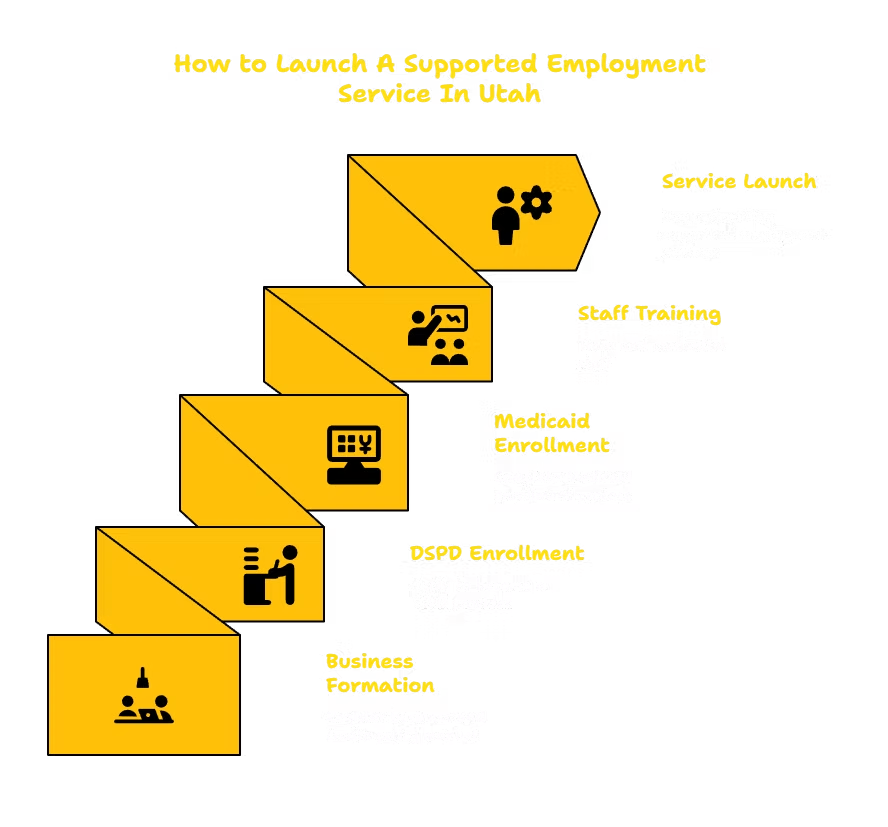
The pathway to becoming an approved provider begins with establishing a formal business structure and meeting stringent state requirements. You must register your business entity with the Utah Division of Corporations, obtain an Employer Identification Number (EIN), and secure a Type 2 National Provider Identifier (NPI). These foundational steps allow you to enter the Medicaid ecosystem formally.
Following business registration, you must submit a provider application through DSPD, specifically identifying the service codes you intend to offer. Throughout this process, you must maintain general liability insurance and ensure that all internal policies adhere to background clearance protocols. The final step involves enrolling as a Medicaid provider via the Utah Provider Enrollment Portal, ensuring your agency is ready for billing once contracts and service authorizations are in place.
How Must Providers Structure Their Policy and Staffing Protocols?
A comprehensive Supported Employment Services Policy & Procedure Manual is the cornerstone of a compliant agency. This document must detail your job development processes, job coaching protocols, and staff supervision standards. It must also articulate how your agency manages individualized service planning, data collection, shift notes, and billing logs. Furthermore, the manual must outline clear procedures for client rights, grievance resolution, and confidentiality, ensuring full HIPAA compliance.
Staffing requirements emphasize both competence and safety. Employment Specialists and Job Coaches should generally hold a high school diploma or GED, though specific contracts may necessitate a college degree. All staff must undergo thorough background checks, receive CPR/First Aid training, and participate in ongoing competency verification. It is recommended that staff receive training in recognized Supported Employment best practices, such as those provided by ACRE or APSE, to ensure high-quality service delivery.
Which Medicaid Waiver Programs Include Supported Employment?
Supported Employment is a designated service under several Utah Medicaid waivers, each catering to specific populations. The Community Supports Waiver (CSW) serves as the primary waiver for adults with intellectual and developmental disabilities. Other relevant programs include the Acquired Brain Injury (ABI) Waiver, the Physical Disabilities Waiver (PDW) on a limited basis, and the New Choices Waiver (NCW) for those transitioning out of institutional care settings.
Regardless of the waiver program, all service delivery must be explicitly included in the participant's Individual Support Plan (ISP). Providers must coordinate closely with the assigned case manager to ensure that every hour of service billed is authorized and directly linked to the specific goals outlined in the participant's plan.
Frequently Asked Questions
What is the typical timeline to launch a Supported Employment agency?
The timeline varies but typically spans several months. Business formation and policy development take approximately 2–3 weeks, followed by 1–3 months for DSPD and Medicaid enrollment. Staff training and credentialing usually require an additional 2–4 weeks. Service delivery begins only after full DSPD approval and ISP authorization.
What documentation is required for the DSPD provider agreement?
Providers must maintain organized records, including business registration, EIN and NPI confirmation, and evidence of Medicaid enrollment. Documentation must also include your approved Policy & Procedure Manual, staff training logs, and specific templates for job development, shift notes, and incident reporting.
Do staff require specialized certifications?
While specific degree requirements may vary by contract, all staff must complete annual refresher trainings, client-centered planning modules, and workplace safety protocols. Training in recognized Supported Employment best practices (e.g., ACRE or APSE) is strongly preferred and often necessary for maintaining high performance standards.
Key Takeaway: Successfully launching a Supported Employment agency in Utah requires rigorous attention to administrative compliance, robust staff training, and close coordination with DSPD and the Utah Medicaid system. By prioritizing person-centered documentation and adhering to the specific standards of Utah’s HCBS waiver programs, providers can build sustainable, impactful services that foster true community integration.
WAIVER CONSULTING GROUP’S START-UP ASSISTANCE SERVICE — UTAH SUPPORTED EMPLOYMENT PROVIDER. WCG equips agencies with the tools to launch effective Supported Employment programs that are waiver-compliant, person-centered, and workforce-ready. Scope of Work includes DSPD and Medicaid provider enrollment support, Supported Employment P&P Manual development, ISP goal documentation templates, job coaching and service note forms, incident tracking and client rights documentation, and training plans for Employment Specialists and program staff.
Last verified: [Insert Date]. This article is for informational purposes and does not constitute legal or professional advice. Always verify current requirements with the Utah Division of Services for People with Disabilities (DSPD) and the Utah Division of Integrated Healthcare (DIH) before making business decisions.