SUPPORTED EMPLOYMENT SERVICES PROVIDER IN TEXAS
By Fatumata Kaba · 2026-03-30 · 6 min read
Understanding Supported Employment Services in Texas
Supported Employment Services in Texas represent a critical component of the state’s Home and Community-Based Services (HCBS) framework, designed to empower individuals with intellectual and developmental disabilities (IDD), behavioral health needs, or physical disabilities to secure and maintain competitive, integrated employment. These services are essential for transitioning individuals from traditional day programs into meaningful community-based work, ensuring that participants earn at least minimum wage in settings where they interact with employees who do not have disabilities.
Operating as a Medicaid-funded provider requires a sophisticated understanding of both state-level regulatory expectations and federal HCBS settings rules. By facilitating job development, intensive on-site coaching, and long-term retention supports, providers play a pivotal role in the "Employment First" philosophy currently championed by the Texas Health and Human Services Commission (HHSC) and the Texas Workforce Commission (TWC). Compliance with these standards is not merely a legal requirement; it is the foundation for sustainable service delivery and positive participant outcomes.
Navigating the Regulatory Landscape and Agency Oversight
Successful program administration requires coordination across several governing bodies, each serving a distinct function in the service delivery lifecycle. The Texas Health and Human Services Commission (HHSC) is the primary regulatory authority for Medicaid waiver programs, responsible for issuing provider approvals, overseeing contract compliance, and ensuring that individual service authorizations align with the person’s identified needs.
Concurrently, providers must often collaborate with the Texas Workforce Commission (TWC), which manages vocational rehabilitation services. While the Medicaid waiver programs provide long-term, ongoing supports, TWC often handles the initial assessment and placement phases. Finally, the Centers for Medicare & Medicaid Services (CMS) maintains the overarching federal compliance framework, ensuring that all Texas HCBS programs adhere to federal laws regarding service settings, conflict-free case management, and person-centered planning.
- HHSC: Administers waiver programs and monitors compliance.
- TWC: Coordinates vocational rehabilitation to assist in initial job placement.
- CMS: Establishes federal HCBS guidelines and quality assurance mandates.
The Two Pillars of Supported Employment: Development and Coaching
Supported Employment services are bifurcated into two essential phases that ensure a participant can successfully enter and remain in the workforce. The first phase, Job Development, is proactive and strategic. It involves deep collaboration with the individual to define career goals, craft resumes, identify potential employers, and practice interview techniques. During this stage, providers act as advocates, helping participants navigate the complexities of applications and negotiating reasonable workplace accommodations under the Americans with Disabilities Act (ADA).
The second phase, Job Coaching and Ongoing Supports, focuses on stability. Once a participant is hired, a job coach provides on-site assistance to ensure the individual learns the duties of the position, understands workplace social norms, and masters specific tasks through systematic instruction or prompts. This phase is not time-limited; it is designed to evolve as the participant gains independence, eventually shifting toward long-term follow-up to ensure job retention and consistent, high-quality performance.
Establishing Your Agency: Licensing and Enrollment Prerequisites
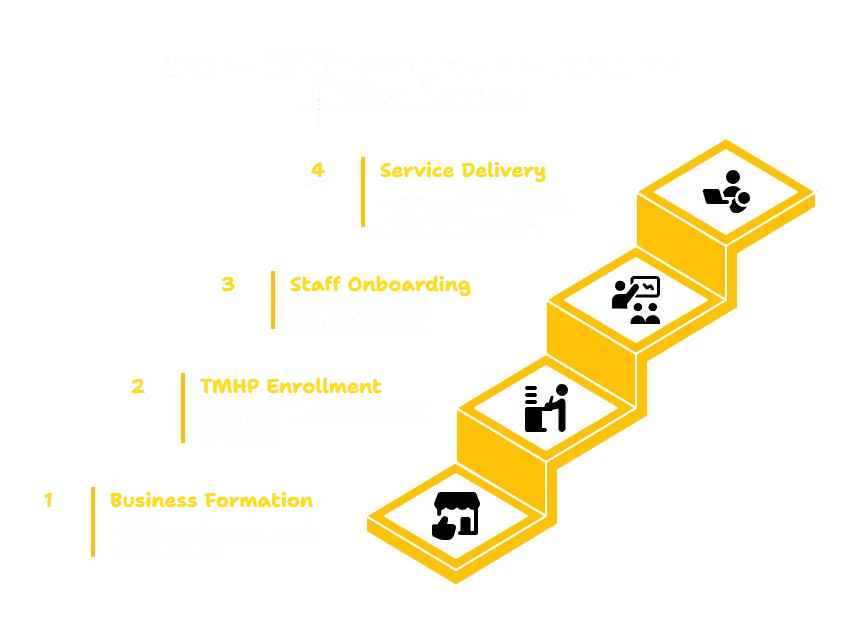
Launching a Supported Employment program requires a systematic approach to business entity formation and Medicaid enrollment. Before a provider can be authorized to deliver services under waivers such as HCS, CLASS, TxHmL, or DBMD, the agency must be legally established with the Texas Secretary of State. Once the business entity is formal, the agency must secure a Federal Employer Identification Number (EIN) and a Type 2 National Provider Identifier (NPI) to function within the healthcare billing system.
The enrollment journey proceeds through the Texas Medicaid & Healthcare Partnership (TMHP). Providers must successfully register with TMHP and subsequently apply for specific HHSC waiver contracts. A critical component of this phase is the development of a comprehensive Supported Employment Policy & Procedure Manual. This document serves as the regulatory roadmap for the agency, detailing how services will be documented, how staff will be trained, and how quality assurance will be maintained to meet HHSC expectations during audits.
Compliance and Essential Documentation Requirements
Documentation is the primary mechanism through which providers demonstrate the necessity and efficacy of supported employment services. Every intervention, whether it is a job development session or an hour of on-site coaching, must be meticulously recorded. This documentation must explicitly link to the participant’s Person-Directed Plan (PDP) or Individual Plan of Care (IPC), proving that the services are not only provided but are individualized to the specific support needs of the participant.
Providers are required to maintain a robust record-keeping system that includes contact logs with employers, service verification templates, and billing logs. Beyond clinical and service data, agencies must maintain evidence of operational compliance, such as current certificates of general liability and worker’s compensation insurance. Maintaining these records in a manner that ensures HIPAA compliance and employment confidentiality is a mandatory standard for any agency participating in Texas Medicaid waiver programs.
- Service Alignment: Linking every task to the PDP/IPC.
- Clinical Documentation: Maintaining logs of job coaching hours and progress notes.
- Administrative Records: Keeping up-to-date insurance and HIPAA confidentiality forms.
Staffing and Professional Development Standards
The quality of a Supported Employment program is directly tied to the competency of its staff. Employment Specialists and Job Coaches are the frontline representatives of the agency; therefore, they must meet specific baseline requirements, including a high school diploma, successful background checks, and active certifications in CPR and First Aid. While these are the minimums, successful agencies often prioritize staff with a background in social services or vocational training.
In addition to basic credentials, all staff members must complete mandatory training on the "Employment First" philosophy and person-centered planning. Agencies must ensure their workforce is trained on disability accommodation strategies, workplace safety protocols, and incident reporting procedures. Because this is a Medicaid-funded service, staff must also be rigorously trained in documentation standards, ensuring they understand the legal distinction between billable employment services and social companionship, which is not an allowable service under these programs.
Frequently Asked Questions
What is the difference between Job Development and Job Coaching?
Job Development focuses on the pre-employment phase, including career planning, resume building, and securing a position. Job Coaching occurs post-hire, focusing on teaching the individual how to perform job tasks and maintain social integration within the workplace.
Can I provide Supported Employment services if I am already an HCS provider?
Yes, providers can expand their service offerings under existing waivers like HCS, CLASS, or TxHmL by updating their contracts with HHSC to include Supported Employment and ensuring their policy manuals are updated to reflect the specific requirements of that service.
How long does the provider enrollment process typically take?
The timeline varies based on organizational readiness, but the entire process—from business formation and policy creation through TMHP enrollment and final HHSC contract approval—typically spans approximately 5 to 7 months.
Key Takeaways
Successfully operating a Supported Employment program in Texas requires a commitment to both administrative precision and the philosophy of person-centered care. Providers must align their service delivery with HHSC mandates, maintain rigorous documentation of all coaching activities, and ensure that staff are trained to foster independence for the individuals they serve. By integrating these services with TWC resources and adhering to the guidelines set forth by CMS and HHSC, agencies can build sustainable programs that significantly improve the quality of life and economic self-sufficiency of Texans with disabilities.
Last verified: May 2024. The information provided in this article is for educational purposes and is intended to assist agencies in understanding the general requirements for operating a Supported Employment program in Texas. Please refer to the official HHSC and TMHP websites for the most current regulatory updates and specific policy bulletins.