SUPPORTED EMPLOYMENT SERVICES PROVIDER IN PENNSYLVANIA
By Fatumata Kaba · 2025-10-08 · 5 min read
EMPOWERING INDIVIDUALS WITH DISABILITIES TO ACCESS MEANINGFUL WORK AND INTEGRATE INTO THE WORKFORCE THROUGH PERSON-CENTERED SUPPORTS
Supported Employment services in Pennsylvania represent a critical component of the state’s Home and Community-Based Services (HCBS) framework, designed to empower individuals with intellectual disabilities and autism to achieve competitive, integrated employment. By leveraging Medicaid-funded waiver programs through the Office of Developmental Programs (ODP), provider agencies serve as the bridge between personal career goals and long-term vocational success in the community.
What Are the Governing Structures and Agencies for Supported Employment?
The delivery of Supported Employment services in Pennsylvania is governed by a multi-layered regulatory environment. At the state level, the Department of Human Services (DHS) Office of Developmental Programs (ODP) holds primary responsibility for administering HCBS waivers and establishing the standards for provider enrollment, service delivery, and ongoing compliance. Coordination between state departments is frequent, particularly with the Office of Vocational Rehabilitation (OVR), which often handles short-term employment supports before a client transitions to long-term waiver-funded assistance.
Federal oversight is provided by the Centers for Medicare & Medicaid Services (CMS), which ensures that Pennsylvania’s programs adhere to the federal mandates regarding community integration and service quality. Additionally, all entities must comply with the Pennsylvania Department of State (DOS) regulations regarding business registration and legal entity formation, ensuring that every provider operates within the appropriate statutory framework for a business enterprise within the Commonwealth.
How Do Providers Define and Deliver Core Supported Employment Services?
Supported Employment is not a singular task but a comprehensive suite of individualized services. The goal is to move participants toward competitive employment in settings that foster inclusion and skill growth. Approved providers are responsible for delivering services that encompass the entire employment lifecycle, from initial career exploration to long-term retention support. This includes conducting career assessments to identify a participant’s unique strengths, preferences, and support needs, which are then used to build a person-centered employment plan.
Service delivery typically involves the following key components:
- Career Assessment & Discovery: Identifying vocational interests and support requirements.
- Job Development & Placement: Assisting with resume creation, interview preparation, and direct job matching.
- Job Coaching & Training: Providing on-site guidance to help participants master specific tasks and workplace social expectations.
- Follow-Along Supports: Offering ongoing, periodic monitoring and intervention to ensure long-term job stability.
- Self-Employment Support: Providing specialized assistance to those looking to launch or manage their own small business ventures.
- Benefits Counseling: Helping participants navigate the complexities of how earned income may impact existing public benefits.
What Are the Essential Requirements for Provider Approval?
Entering the Pennsylvania market as a Medicaid provider requires a structured approach to licensing and administrative readiness. Before a provider can begin offering services, the business must be formally recognized by the state, maintain a Type 2 NPI, and possess an active Employer Identification Number (EIN). Following registration, the provider must demonstrate the capacity to manage compliance through ODP’s Home and Community Services Information System (HCSIS) and the PROMISe™ Medicaid provider portal.
Beyond technical registration, providers are expected to establish a robust internal infrastructure. This includes developing a comprehensive Supported Employment Services Policy & Procedure Manual that mirrors ODP standards and CMS guidelines. Agencies must also ensure they carry appropriate liability and workers’ compensation insurance and that they are prepared to undergo the rigorous qualification process, which includes proving that their internal systems for documentation, incident management, and HIPAA compliance are fully operational.
What Are the Necessary Steps for Enrollment and Operational Launch?
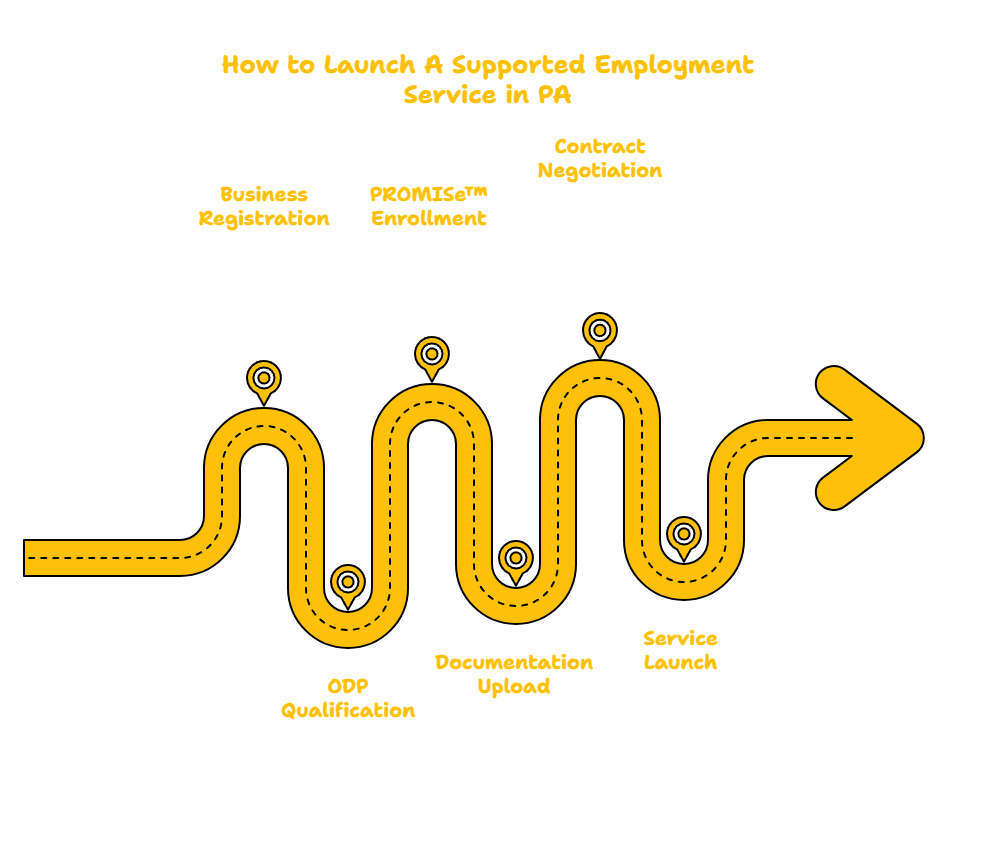
The timeline for becoming an active provider involves a sequential process of documentation, system entry, and credentialing. Founders should anticipate that the entire cycle—from initial business formation to receiving the first referral—will take several months of diligent effort. The process begins with securing the legal and tax credentials necessary for any business in Pennsylvania, followed by the specific task of qualifying the agency within HCSIS.
Once the agency is qualified, the focus shifts to the PROMISe™ Medicaid provider application. After these institutional hurdles are cleared, the agency must secure contracts with Supports Coordination Organizations (SCOs) and potentially the OVR. These contracts act as the primary referral pipeline, making active relationship-building with SCOs a critical operational phase. Throughout this, providers must ensure their staff training plans and policy manuals are not only written but actively integrated into daily agency operations.
How Must Providers Manage Staffing and Documentation?
The quality of Supported Employment services is highly dependent on the competence of the direct support staff. Employment Specialists and Job Coaches are required to possess specific qualifications, including a background check and a high school diploma or higher, along with documented experience in disability support or vocational services. Program Supervisors must go further, holding the responsibility for caseload oversight and the internal quality assurance audits that define a compliant agency.
Documentation is the backbone of Medicaid reimbursement. Providers must be meticulous in maintaining:
- Service Logs & Progress Notes: Detailed records of every support interaction, capturing progress toward the individual’s goals.
- Time Studies & Billing Records: Accurate, contemporaneous logs that align with ODP billing standards.
- Staff Training Records: Evidence that every employee has completed required ODP modules, person-centered thinking training, and abuse reporting protocols.
- Incident Reports: Documentation of any events requiring intervention or disclosure per state reporting standards.
Frequently Asked Questions
What is the primary role of the Office of Vocational Rehabilitation (OVR) in this process?
The OVR serves as a primary resource for short-term employment supports. It often initiates the vocational journey for an individual before they transition into the long-term, ongoing supports provided by ODP-funded HCBS waiver programs.
Is benefits counseling a mandatory service for providers?
Benefits counseling is an optional but highly recommended service component. If offered, the counselor must have valid certification through a Social Security Administration-approved program, such as the Community Work Incentives Coordinator (CWIC) program, to ensure accuracy in advising participants.
How often must staff receive training?
Beyond initial onboarding and ODP-required training modules, staff must participate in annual refresher courses and continuous professional development to ensure they remain current on person-centered planning techniques and regulatory changes.
Key Takeaway
Successfully operating as a Supported Employment provider in Pennsylvania requires an unwavering commitment to administrative precision and person-centered service. By systematically aligning business policies with ODP and CMS requirements—from initial HCSIS enrollment to the ongoing documentation of job coaching and follow-along supports—providers can create sustainable programs that effectively bridge the gap between individuals with disabilities and competitive integrated employment in their local communities.
Last verified: June 2024. This information is intended for educational purposes and does not constitute legal or professional advice. Requirements for Medicaid providers may be subject to change based on state and federal updates; always verify current standards with the Pennsylvania Department of Human Services and the Office of Developmental Programs.