SUPPORTED EMPLOYMENT SERVICES PROVIDER IN OREGON
By Fatumata Kaba · 2025-10-07 · 5 min read
Empowering individuals with disabilities to achieve meaningful, competitive employment through customized support requires a robust framework of Medicaid-funded and state-supported services. In Oregon, Supported Employment Services (SES) are designed to assist individuals with intellectual and developmental disabilities (IDD) in preparing for, securing, and maintaining integrated work environments, all coordinated through the Oregon Health Plan (OHP), Medicaid waivers, and partnerships with Vocational Rehabilitation (VR).
What is the Scope of Supported Employment Services in Oregon?
Supported Employment Services are person-centered, focusing on identifying the unique interests, strengths, and goals of each participant. These services aim to transition individuals from dependency into competitive, integrated employment, where they work alongside peers without disabilities and earn competitive wages. This model emphasizes that every individual, regardless of the severity of their disability, possesses the potential to contribute meaningfully to the workforce when provided with the appropriate, individualized supports.
Approved providers deliver a wide array of interventions, including Discovery and Career Exploration, which helps identify potential career paths, and Job Development, which covers resume building and interview coaching. Once an individual is hired, Job Coaching provides on-site assistance to ensure the participant can perform their duties effectively and adjust to the workplace environment. Ongoing support is maintained through periodic check-ins, ensuring that employment remains stable and that both the employee and employer are satisfied with the arrangement.
- Discovery & Career Exploration: Identifying client strengths, interests, and potential.
- Job Development & Placement: Resume building, job matching, and interview coaching.
- Job Coaching: On-site assistance to facilitate workplace integration.
- Ongoing Job Support: Regular interventions to maintain long-term employment.
- Small Group Supported Employment: Supervised group settings where appropriate.
- Self-Employment Support: Guidance for entrepreneurs developing micro-enterprises.
How Do Governing Agencies Regulate Supported Employment?
The regulatory environment for Oregon SES is multi-layered, involving both state and federal oversight to ensure compliance and quality of care. The Oregon Department of Human Services (ODHS), specifically the Office of Developmental Disabilities Services (ODDS), acts as the primary coordinator for long-term services for individuals with IDD. Local Community Developmental Disabilities Programs (CDDPs) play a crucial role in managing the delivery of these services at the county level.
Simultaneously, the Oregon Vocational Rehabilitation (VR) Services agency handles the short-term job readiness and placement phases. This partnership is vital, as individuals often start with VR support before transitioning to long-term ODDS-funded services. The Oregon Health Authority (OHA) oversees Medicaid provider enrollment, while the Centers for Medicare & Medicaid Services (CMS) maintains federal standards for the 1915(c) waivers and the 1915(k) Community First Choice Option that fund these vital programs.
What are the Prerequisites for Becoming an Authorized Provider?
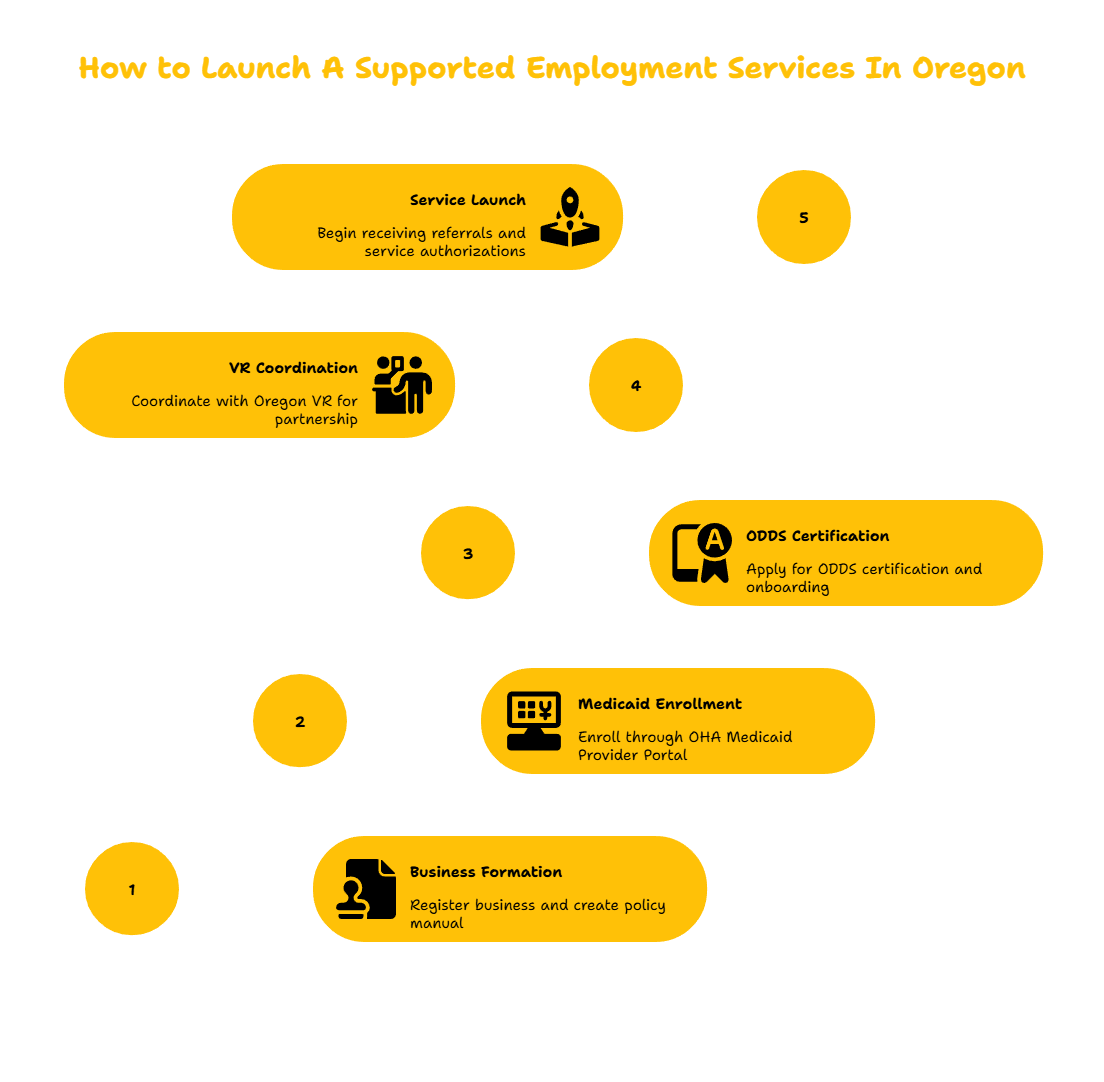
Launching a provider agency requires a systematic approach to business and clinical readiness. Before a provider can be authorized to deliver services, they must be legally established within the state, which involves registering with the Oregon Secretary of State (SOS). Following business formation, the provider must obtain a federal Employer Identification Number (EIN) and a Type 2 National Provider Identifier (NPI) to facilitate Medicaid billing.
Providers must then undergo a rigorous certification process through ODDS and coordinate with local CDDPs. This phase includes securing necessary general liability and workers’ compensation insurance, as well as drafting a comprehensive Policy & Procedure Manual. This document must align with the Oregon Employment First standards, ensuring that all services adhere to state-mandated quality metrics, HIPAA protections, and participant rights requirements.
- Register business entity with the Oregon Secretary of State.
- Obtain an EIN from the IRS and a Type 2 NPI.
- Enroll as a Medicaid provider through the Oregon Health Plan Provider Portal.
- Secure certification as a Supported Employment provider through ODDS/CDDP.
- Establish partnership agreements with Oregon VR.
- Implement a compliant Policy & Procedure Manual.
What Documentation is Required for Compliance and Audit Readiness?
Maintaining high-quality documentation is the cornerstone of a successful Supported Employment agency. Providers must be prepared to verify their operations through meticulous record-keeping. This includes maintaining Articles of Incorporation, business registration documents, and evidence of insurance. From a service perspective, providers must maintain detailed discovery logs, employment planning documents, and individual service plans (ISPs) that clearly articulate the participant’s progress toward their career goals.
Furthermore, providers must demonstrate fiscal and operational integrity through documented billing records, coaching logs, and employer engagement outreach. Every service interaction should be reflected in contemporaneous notes that detail the specific coaching provided, the outcome of the shift, and the progress made by the participant. These records are essential for both internal quality assurance and potential audits conducted by state or federal regulators.
How Do Staffing Requirements Impact Program Delivery?
The success of Supported Employment in Oregon relies heavily on the quality and training of the staff. An Employment Specialist or Job Coach is the primary point of contact for the participant and must be well-versed in person-centered employment planning and workforce development. These staff members are required to undergo thorough background checks and complete mandatory training related to the Employment First core competencies.
In addition to front-line coaches, the agency requires a Program Supervisor or Employment Coordinator to oversee service quality and data accuracy. Transition Specialists may also be employed to focus specifically on the complex needs of youth and school-aged individuals entering the workforce for the first time. All staff must regularly participate in ongoing professional development to stay current with billing practices, workplace safety protocols, and effective employer engagement strategies.
Frequently Asked Questions
How long does the provider enrollment process typically take?
The timeline varies by agency readiness, but generally, business formation and manual creation take 1–2 months, followed by 2–3 months for Medicaid and ODDS enrollment. Staff training and credentialing typically add another 30–60 days, with referrals beginning once authorization is granted by the CDDP.
What is the difference between VR and ODDS-funded services?
Oregon Vocational Rehabilitation (VR) primarily funds short-term, time-limited services focused on initial job preparation and placement. Once an individual secures a job, they often transition to long-term, ongoing supports funded through the ODDS waiver or the 1915(k) K Plan.
What does "Employment First" mean in Oregon?
Employment First is a policy initiative in Oregon that asserts that competitive, integrated employment is the first and preferred outcome for all individuals with intellectual and developmental disabilities. Providers are expected to base their service models on this philosophy, ensuring that employment plans focus on community-integrated settings rather than segregated programs.
Key Takeaway
Establishing an effective Supported Employment provider agency in Oregon requires a meticulous alignment of business administration, Medicaid regulatory compliance, and a commitment to person-centered outcomes. By bridging the gap between individuals with disabilities and the Oregon workforce through authorized Medicaid waivers and state partnerships, providers play a critical role in fostering community integration and economic independence for those they serve. Success is defined by the ability to maintain high clinical standards, robust documentation, and ongoing engagement with both the participants and the employers who drive the state's economy.
Last verified: 2024. This content is provided for informational purposes only. Readers are encouraged to verify current Oregon Administrative Rules (OAR) and Medicaid provider requirements directly through official Oregon Department of Human Services (ODHS) and Oregon Health Authority (OHA) websites before initiating the provider enrollment process.