SUPPORTED EMPLOYMENT SERVICES PROVIDER IN OHIO
By Fatumata Kaba · 2025-09-17 · 5 min read
Helping individuals with disabilities succeed in competitive, integrated employment
Supported Employment Services in Ohio are specialized Medicaid Home and Community-Based Services (HCBS) designed to help individuals with intellectual and developmental disabilities (IDD) and other qualifying conditions achieve independence through meaningful, paid work. By providing personalized support throughout the career lifecycle—from initial job exploration to long-term retention—these services ensure that individuals can participate fully in the competitive, integrated labor market while maintaining their health and benefits stability.
What is the Role of Ohio’s Governing Agencies in Supported Employment?
The delivery of Supported Employment services in Ohio is governed by a robust framework of state and federal oversight, ensuring that all programs adhere to strict quality and safety standards. The Ohio Department of Developmental Disabilities (DODD) acts as the primary agency responsible for the certification of providers and the direct oversight of employment services for individuals with developmental disabilities. Their role is central to ensuring that agencies provide services that are person-centered and compliant with state regulations.
Complementing this, the Ohio Department of Medicaid (ODM) manages the fiscal and eligibility side of the equation. ODM oversees the billing process, waiver enrollment, and the complex reimbursement structures that allow agencies to sustain their operations. Additionally, the Opportunities for Ohioans with Disabilities (OOD) often plays a vital role by providing funding for initial pre-employment and vocational assessments, while the federal Centers for Medicare & Medicaid Services (CMS) provides the overarching regulatory guidance to ensure all HCBS-funded activities meet national requirements for community integration.
How Can Agencies Provide Comprehensive Employment Support?
Approved providers must deliver services that prioritize the individual’s unique strengths, interests, and career goals. Supported employment is not a one-size-fits-all model; it requires a commitment to helping individuals navigate the complexities of the workplace, from the initial application phase to long-term career advancement. Providers are expected to maintain professional standards that foster inclusion and productivity.
- Job Development: Assisting individuals in identifying their career goals and securing competitive job opportunities.
- Job Coaching: Providing hands-on, one-on-one support during the critical onboarding and initial training phases.
- On-the-Job Support: Delivering ongoing reinforcement of work tasks and professional social skills to ensure long-term success.
- Workplace Accommodation Assistance: Collaborating with employers to coordinate assistive technology or modified tasks as needed.
- Transportation Coordination: Organizing safe and reliable travel arrangements to and from the worksite.
- Job Retention and Benefits Counseling: Monitoring performance, solving workplace problems, and ensuring the individual understands how income affects their SSI, SSDI, and Medicaid benefits.
What are the Requirements for Provider Approval and Licensing?
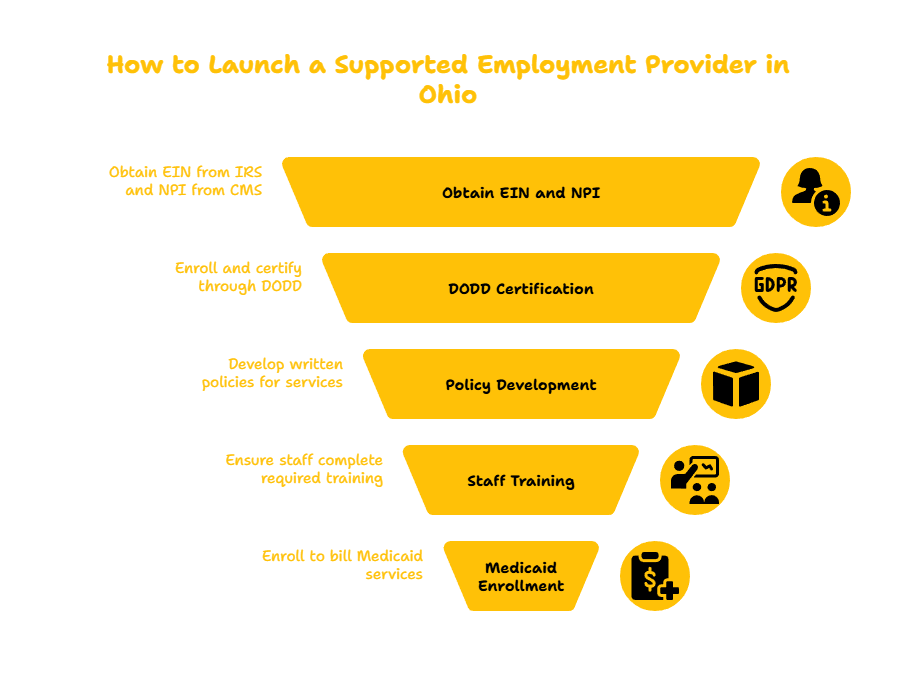
Becoming an authorized provider in Ohio is a multi-step process that begins with formal business registration. Founders must ensure their entity is correctly registered with the Ohio Secretary of State and possesses the necessary federal identifiers, including an Employer Identification Number (EIN) and a Type 2 National Provider Identifier (NPI). These foundational elements allow an organization to interact officially with state health and human services agencies.
Beyond the legal registration, providers must be certified through the DODD Provider Certification Wizard. This process involves a rigorous review of organizational readiness, which includes maintaining adequate general and professional liability insurance. Agencies must also demonstrate they have established comprehensive written policies regarding person-centered employment planning, safety protocols for job coaching, and adherence to HIPAA requirements regarding participant privacy.
How Do Agencies Manage the Enrollment and Compliance Timeline?
The transition from a business idea to an active, Medicaid-reimbursable agency typically follows a structured timeline. Initial application efforts should focus on the DODD Provider Certification Portal, where the applicant selects the appropriate service designations, such as "Supported Employment – Individual" or "Group." During this phase, it is essential to prepare all required documentation, including articles of incorporation, staff credentials, and detailed service manuals for compliance review.
Agencies should anticipate a methodical review process, which may include interviews or on-site assessments to determine the provider's ability to deliver high-quality support. The following estimate outlines the typical phases for launching operations:
- Business Formation & Credentialing: 1–2 months for registration and initial document preparation.
- Staff Hiring & Training: 2–3 months for recruitment and ensuring staff complete mandatory DODD-approved training.
- DODD Certification & Medicaid Enrollment: 60–90 days for state-level review and provider number issuance.
- Billing Setup & Service Launch: 30–45 days to finalize systems and begin service delivery.
What Staffing and Documentation Standards Must Be Met?
Maintaining high-quality employment services depends on a qualified workforce. The Program Manager typically requires a background in vocational rehabilitation, social work, or education, along with proven supervisory experience. Job Coaches and Employment Specialists, who represent the agency at the workplace, must also meet specific experience requirements in employer relations and undergo mandatory DODD training, background checks, and annual continuing education.
Documentation is the backbone of Medicaid reimbursement. Every interaction—whether it is coaching, job development, or team meetings—must be meticulously tracked. Agencies must maintain up-to-date logs that record hours worked, progress toward individualized goals, and feedback from employers. Failure to keep precise records can jeopardize reimbursement eligibility and compliance status with the Ohio Department of Developmental Disabilities.
Frequently Asked Questions
Which Medicaid waiver programs support these services?
Supported Employment services are authorized under the Individual Options (IO) Waiver, the Level One Waiver (which offers limited support), and the SELF Waiver. It is common for agencies to coordinate with OOD for initial job development funding before transitioning the participant to waiver-funded long-term supports.
What must be included in an agency’s Policy & Procedure Manual?
A comprehensive manual must contain detailed procedures for career planning, job coaching, transportation coordination, and safety planning. It must also include specific protocols for HIPAA compliance, participant rights, documentation standards for Medicaid billing, and strategies for employer engagement.
Are there ongoing training requirements for staff?
Yes. All staff must complete DODD-approved training in Employment First principles, participant rights, and documentation practices. Additionally, staff must maintain current CPR/First Aid certification where applicable and engage in annual continuing education to keep pace with evolving policy changes and best practices in the disability employment field.
Waiver Consulting Group provides professional assistance to organizations looking to navigate the complexities of the DODD certification and Medicaid billing landscape. Our services include the development of person-centered policy manuals, staff training frameworks, compliance tracking systems, and administrative guidance to help agencies establish and scale their operations effectively.
Key Takeaway: Successful Supported Employment providers in Ohio bridge the gap between individual capabilities and community needs by strictly adhering to DODD certification requirements, maintaining thorough documentation for Medicaid billing, and fostering strong, person-centered partnerships with both job seekers and local employers.
Last verified: October 2023. This information is for educational purposes only and does not constitute legal or financial advice. Readers should consult directly with the Ohio Department of Developmental Disabilities (DODD) or the Ohio Department of Medicaid (ODM) for the most current rules, fee schedules, and policy updates specific to their agency’s certification status.