SUPPORTED EMPLOYMENT SERVICES PROVIDER IN NEW YORK
By Fatumata Kaba · 2025-09-02 · 6 min read
Supported Employment Services in New York are specialized Medicaid Home and Community-Based Services (HCBS) designed to empower individuals with disabilities by providing the necessary tools to secure, retain, and advance in competitive, integrated employment. Authorized agencies assist participants in developing vocational skills, navigating the job market, and maintaining long-term workplace success through highly personalized, person-centered support models.
For entrepreneurs and existing healthcare organizations, becoming an approved provider involves navigating a rigorous regulatory landscape overseen by the New York State Department of Health (NYSDOH), the Office for People With Developmental Disabilities (OPWDD), and the Office of Mental Health (OMH). This guide outlines the essential framework for establishing a compliant, high-quality supported employment program that meets federal and state standards for service delivery and reimbursement.
What Are the Core Responsibilities of Regulatory Agencies?
The successful operation of a Supported Employment program in New York is contingent upon maintaining adherence to the guidelines established by several key state and federal entities. These agencies collectively ensure that participants receive high-quality, safe, and effective vocational support that aligns with Medicaid waiver requirements.
The New York State Department of Health (NYSDOH) serves as the primary administrator of Medicaid waiver funding. They hold the ultimate authority regarding provider enrollment, the authorization of specific services, and the final oversight of reimbursement processes. Simultaneously, the Office for People With Developmental Disabilities (OPWDD) and the Office of Mental Health (OMH) provide specialized oversight for their respective populations, ensuring that service delivery models are tailored to the unique behavioral and developmental needs of the individuals being served.
On the federal level, the Centers for Medicare & Medicaid Services (CMS) sets the standards for quality, safety, and person-centered care. Compliance with CMS regulations is non-negotiable, as these standards form the backbone of the Medicaid program and ensure that state-run waivers provide equitable and effective care. Providers must align their internal policies with the requirements set by these bodies to maintain eligibility for billing and ongoing program participation.
Which Services Are Included in the Supported Employment Scope?
Supported Employment providers must offer a comprehensive suite of services designed to bridge the gap between unemployment and career sustainability. These services are rarely "one-size-fits-all"; rather, they must be tailored to the individual’s strengths, vocational preferences, and specific barriers to employment. Providers are expected to document every stage of this journey, from the initial assessment to ongoing career coaching.
Approved providers generally offer the following essential components within their service menu:
- Job Development: Proactively identifying opportunities that match the participant’s skill set.
- Employment Assessment: Evaluating readiness, vocational preferences, and areas for professional growth.
- Job Placement: Providing direct assistance with the application and interview processes.
- Job Coaching: Delivering intensive, one-on-one on-the-job training.
- Skills Training: Instructing participants in workplace soft skills such as communication, punctuality, and problem-solving.
- Workplace Accommodation Support: Working with employers to ensure environments are accessible and supportive.
- Follow-Along Services: Maintaining long-term contact to ensure job retention and client satisfaction.
How Do Providers Navigate the Licensing and Enrollment Process?
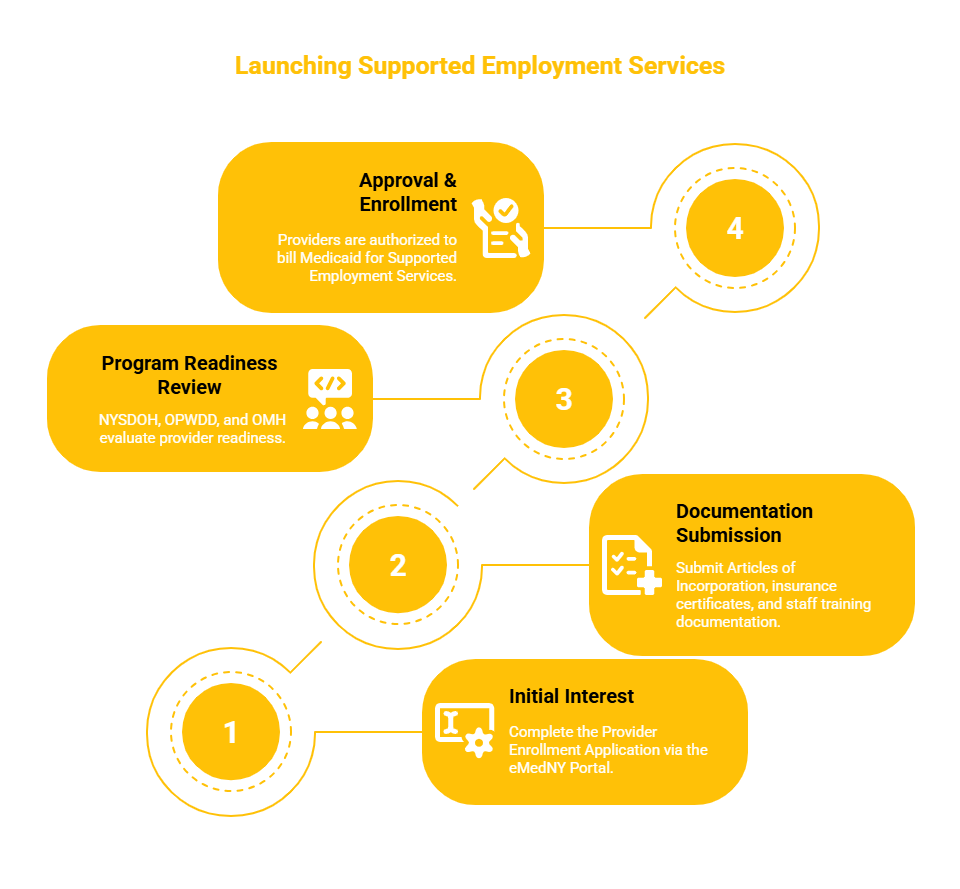
Establishing a Supported Employment agency requires a methodical approach to business formation and regulatory compliance. Before attempting to enroll with the state, an organization must be properly registered as a legal entity with the New York Department of State and possess a valid Federal Employer Identification Number (EIN) and a Type 2 National Provider Identifier (NPI).
Once the business foundation is secured, the organization must navigate the New York Medicaid Provider Enrollment Portal (eMedNY). This process involves submitting extensive documentation, including proof of insurance, detailed policy manuals, and evidence of staff qualifications. The readiness review phase is critical; during this time, the NYSDOH, OPWDD, or OMH will evaluate the provider’s operational protocols to ensure they are prepared to deliver high-quality services in accordance with state expectations.
Following approval, agencies must ensure their billing systems are aligned with the designated Medicaid codes for Supported Employment. Maintaining this status requires ongoing commitment to documentation, as accurate record-keeping is the primary evidence used by state auditors to verify that the services billed were actually provided to the participant according to their individualized service plan.
What Are the Essential Staffing and Credentialing Requirements?
The quality of a Supported Employment program is defined by the expertise and training of its staff. Agencies are responsible for hiring personnel who possess the right mix of vocational experience and interpersonal skills. The Program Director, for instance, typically requires a Bachelor’s or Master’s degree in a human services or vocational field, coupled with significant experience in workforce development.
Employment Specialists and Job Coaches represent the frontline of service delivery. These roles often require specific certifications in job coaching or vocational training. Furthermore, agencies must ensure that all staff—regardless of their specific role—undergo rigorous onboarding. This includes training in HIPAA compliance, participant rights, crisis management, and the specific documentation standards required for Medicaid reimbursement.
- Supported Employment Program Director: Must have relevant degree and management experience.
- Employment Specialists: Require specialized certification and advocacy experience.
- Vocational Rehabilitation Counselors: Generally require a Master’s degree and state licensure.
- Compliance Training: Includes annual competency checks, safety drills, and ongoing professional development.
What Is the Realistic Timeline to Launch?
Launching a Medicaid-funded agency is a structured process that generally spans several months. Providers should plan for a timeline that prioritizes quality and compliance over speed, as premature enrollment attempts can lead to delays or denials.
Business formation and the drafting of initial compliance manuals typically take one to two months. The subsequent phase, involving hiring and training staff, requires two to three months to ensure that every team member is fully credentialed and prepared for the field. The formal Medicaid enrollment and readiness review process often takes 60 to 90 days. Finally, setting up billing systems and launching the first phase of service delivery usually requires an additional 30 to 45 days. This gradual approach allows for the development of robust internal systems that can withstand the scrutiny of state audits.
Frequently Asked Questions
What waivers in New York include Supported Employment?
Supported Employment Services are integrated into several Medicaid waiver programs, including the OPWDD Comprehensive Waiver, the general Home and Community-Based Services (HCBS) Waiver, the Nursing Home Transition and Diversion (NHTD) Waiver, the Traumatic Brain Injury (TBI) Waiver, and the Children’s Waiver.
What does the "Readiness Review" entail?
The Readiness Review is a critical evaluation conducted by NYSDOH, OPWDD, or OMH. During this period, the state examines the provider’s operational policies, job development and coaching procedures, and staff training records to ensure the agency is fully equipped to meet the needs of waiver participants.
How does a provider ensure their documentation is audit-proof?
Audit-proof documentation relies on strict adherence to Medicaid record-keeping standards. This includes maintaining detailed progress notes for every session, documenting specific outcomes related to the participant’s employment goals, and ensuring that all services provided match the specific billing codes and authorization levels outlined in the individual’s service plan.
Key Takeaway
Becoming a successful Supported Employment provider in New York requires a deep commitment to regulatory compliance and person-centered service delivery. By strictly adhering to the requirements set by the NYSDOH, OPWDD, and OMH, and by investing in a highly qualified, well-trained staff, agencies can build sustainable programs that provide life-changing vocational opportunities for individuals with disabilities.
Last verified: October 2023. Disclaimer: This information is for educational purposes only and does not constitute legal or professional advice. Always consult with the New York State Department of Health or the relevant regulatory agency for the most current rules and requirements specific to your practice.