SUPPORTED EMPLOYMENT SERVICES PROVIDER IN NEW MEXICO
By Fatumata Kaba · 2025-09-05 · 6 min read
Empowering Individuals Through Vocational Support and Community Integration
Supported Employment Services in New Mexico provide essential vocational assistance designed to help individuals with disabilities or chronic conditions secure and maintain competitive, integrated employment. By bridging the gap between clinical support and workplace success, these services—authorized under various New Mexico Medicaid Home and Community-Based Services (HCBS) waiver programs—enable participants to achieve greater independence, financial self-sufficiency, and community inclusion.
What Are the Governing Agencies Responsible for Supported Employment in New Mexico?
The delivery of Supported Employment Services is governed by a multi-layered regulatory framework. At the state level, the New Mexico Human Services Department (HSD) serves as the primary authority, administering Medicaid waiver funding and managing the essential processes of provider enrollment, service authorization, and reimbursement. Their oversight ensures that federal and state Medicaid dollars are utilized effectively to support vocational goals.
Complementing this, the Developmental Disabilities Supports Division (DDSD) acts as the quality assurance arm. The DDSD is responsible for ensuring that all services adhere to strict delivery standards, regulatory compliance, and the specific mandates of the HCBS waiver programs. Furthermore, the New Mexico Division of Vocational Rehabilitation (DVR) plays a critical role by providing specialized employment support and vocational training resources that often intersect with the services provided by Medicaid-enrolled agencies.
On a federal level, the Centers for Medicare & Medicaid Services (CMS) provides the overarching regulatory structure. CMS mandates that all state-funded Supported Employment Services remain strictly aligned with HCBS quality requirements, person-centered planning protocols, and fundamental participant protection standards. This collaborative regulatory structure ensures that providers maintain a high level of accountability and service excellence.
- Human Services Department (HSD): Oversees funding, enrollment, and reimbursement.
- Developmental Disabilities Supports Division (DDSD): Manages service quality, compliance, and clinical standards.
- Division of Vocational Rehabilitation (DVR): Coordinates vocational training and job-readiness resources.
- Centers for Medicare & Medicaid Services (CMS): Sets federal standards for HCBS compliance and participant safety.
What Core Services Do Supported Employment Providers Deliver?
Supported Employment Services are defined by a comprehensive, person-centered approach to vocational development. Providers act as advocates and facilitators, moving beyond simple job placement to ensure long-term career stability. Every service provided must be documented and delivered in strict accordance with the participant’s Individualized Service Plan (ISP) to ensure that specific vocational goals and support needs are addressed.
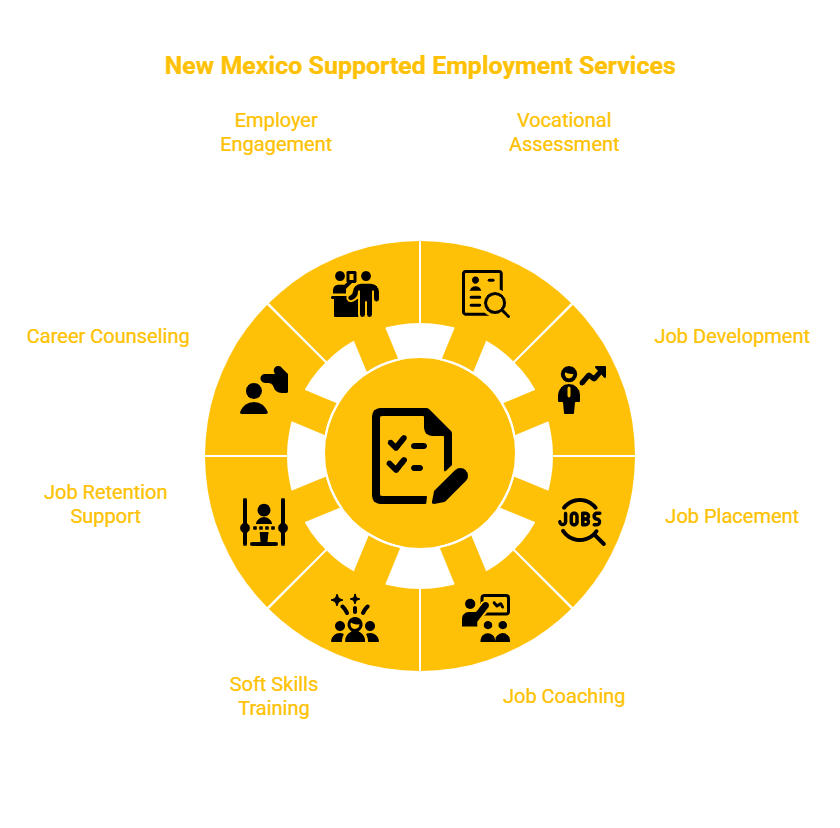
Providers are expected to offer a continuum of care that spans the entire employment lifecycle. This begins with an initial vocational assessment to identify a participant’s unique skills, interests, and barriers. Once goals are established, the provider assists in job development, matching the participant with competitive opportunities that align with their abilities. After placement, the focus shifts to job coaching, which involves on-site support to assist the individual in learning tasks, navigating workplace social dynamics, and meeting employer expectations.
The service model also encompasses ongoing support for long-term retention. This includes career counseling, regular follow-up and monitoring, and systematic employer engagement. By educating employers on reasonable accommodations and inclusive practices, providers help foster a sustainable and supportive work environment. Soft skills training—such as communication, problem-solving, and professional interpersonal behavior—remains a cornerstone of the service delivery model.
How Do Agencies Become Approved Medicaid Providers?
Transitioning into an approved Medicaid provider requires a structured commitment to compliance and operational readiness. Before initiating the formal enrollment process, an agency must ensure its business foundations are secure. This includes formal registration with the New Mexico Secretary of State, securing an Employer Identification Number (EIN) from the IRS, and obtaining a Type 2 National Provider Identifier (NPI). These are the fundamental administrative building blocks required to interact with the Medicaid system.
The enrollment journey begins via the New Mexico Medicaid Provider Enrollment Portal. Agencies must submit a comprehensive application, which includes proof of general and professional liability insurance and evidence of vocational certifications. Following the initial application, HSD, DDSD, and DVR undergo a program readiness review. This evaluation is critical, as regulators will assess the agency’s internal staff qualifications, vocational support protocols, and the robustness of their workplace safety measures. Only after a successful review and formal approval is an agency authorized to bill for services.
What Documentation and Compliance Standards Are Required?
Documentation serves as the backbone of accountability for any Medicaid-supported entity. A provider’s Policy and Procedure Manual is perhaps the most critical document, acting as the operational blueprint for the organization. This manual must explicitly cover vocational assessment, job placement procedures, and specific job coaching methodologies. Furthermore, it must demonstrate strict adherence to HIPAA regulations to ensure participant confidentiality and clearly outline participant rights and grievance procedures.
Beyond internal manuals, an agency must maintain rigorous record-keeping for staff and participants. This includes detailed files on staff credentialing, background checks, and documentation of ongoing training. Safety protocols—both for the office environment and for community-based work sites—must be documented and regularly reviewed. Quality assurance systems are also a requirement, as they demonstrate the agency’s ability to monitor its own performance, track billing accuracy, and implement corrective actions when necessary.
- Business Credentials: Secretary of State registration, EIN, and NPI documentation.
- Operational Manuals: Written procedures for assessment, coaching, and HIPAA compliance.
- Safety and QA: Documented workplace safety protocols and internal quality monitoring systems.
- Billing Integrity: Established systems for tracking services and ensuring compliance with Medicaid billing codes.
What Are the Necessary Staffing Qualifications and Training?
Effective Supported Employment programs rely on a highly trained workforce capable of providing nuanced, individualized support. At the administrative level, the Supported Employment Program Director must hold a bachelor’s degree in vocational rehabilitation, social work, or a related field, supplemented by documented supervisory experience. This role is essential for maintaining the clinical and administrative integrity of the program.
Direct service staff, including Job Coaches, Vocational Counselors, and Employment Specialists, are the primary point of contact for the participants. These roles require demonstrated experience in vocational support, rehabilitation, or community-based employment. Regardless of their role, all staff must undergo extensive training in job coaching strategies, soft skills development, and client safety. Furthermore, annual competency evaluations are mandatory to ensure that the staff remains updated on best practices and evolving regulatory standards.
Frequently Asked Questions
What is the typical timeline to launch a Supported Employment agency?
The launch process generally spans 6 to 10 months. This includes 1–2 months for business formation, 2–3 months for staffing and internal development, 60–90 days for the Medicaid enrollment and readiness review process, and an additional 30–45 days for final billing setup.
Which Medicaid waiver programs cover these services?
Supported Employment Services are authorized under several New Mexico waivers, including the Developmental Disabilities (DD) Waiver, the Mi Via Waiver, the Medically Fragile Waiver, the Supports Waiver, and the standard Home and Community-Based Services (HCBS) waiver framework.
What happens if my agency fails the readiness review?
If an agency does not meet the necessary readiness criteria during the review by HSD or DDSD, the reviewing agency will typically provide feedback on the areas of deficiency. The provider must then address these gaps—such as improving staff training documentation or updating policy manuals—before resubmitting for a follow-up review.
Key Takeaway
Launching a Supported Employment Services agency in New Mexico requires a disciplined approach to administrative compliance, staff training, and regulatory engagement. By meticulously adhering to the guidelines set forth by the Human Services Department and the Developmental Disabilities Supports Division, providers can establish a sustainable, high-quality operation that significantly improves the lives of individuals with disabilities through the power of community-based employment.
Last verified: October 2023. Disclaimer: This information is for educational purposes only and does not constitute legal or professional advice. Always verify current state regulations and waiver requirements directly through official government portals before initiating any business activities.