SUPPORTED EMPLOYMENT SERVICES PROVIDER IN NEW JERSEY
By Fatumata Kaba · 2025-09-05 · 5 min read
Becoming a Supported Employment Services provider in New Jersey requires navigating a multifaceted regulatory landscape overseen by the Department of Human Services (DHS). Organizations must align their service delivery models with Medicaid Home and Community-Based Services (HCBS) waiver standards to provide essential vocational training, job placement, and long-term job coaching to individuals with disabilities.
This article serves as a comprehensive guide for agency founders and administrators seeking to establish a compliant, high-quality supported employment program. By adhering to the guidelines set forth by the Division of Developmental Disabilities (DDD) and the Division of Vocational Rehabilitation Services (DVRS), providers can secure the necessary authorizations to foster community inclusion and vocational independence for New Jersey’s vulnerable populations.
Understanding the Governing Agency Landscape
The regulatory framework for Supported Employment in New Jersey is built upon a collaborative hierarchy between federal and state entities. The Centers for Medicare & Medicaid Services (CMS) provides the overarching federal oversight, ensuring that all Medicaid-funded services strictly adhere to person-centered planning and participant protection standards. This federal mandate is essential for maintaining the integrity of HCBS waiver programs across the state.
At the state level, the New Jersey Department of Human Services (DHS) acts as the primary administrator, managing the financial disbursements and the overarching provider enrollment lifecycle. Working in tandem with DHS, the Division of Vocational Rehabilitation Services (DVRS) specializes in facilitating access to employment, while the Division of Developmental Disabilities (DDD) holds responsibility for rigorous quality assurance and compliance monitoring. Prospective providers must ensure their operational policies are built to satisfy the specific audit requirements of these three state divisions.
Core Components of Supported Employment Service Delivery
Supported Employment Services are not merely job placement programs; they are holistic vocational support systems designed to help participants secure and maintain competitive employment. Effective service delivery requires an integrated approach that begins with a comprehensive vocational assessment. This assessment phase is critical, as it identifies the unique skills, interests, and potential barriers of each participant, forming the foundation of their Individualized Service Plan (ISP).
Once a participant is ready to enter the workforce, the provider’s role shifts to active job development and job coaching. Providers are expected to deliver a structured suite of services, including:
- Job Development and Placement: Proactively identifying suitable community-based job opportunities.
- Job Coaching: Delivering on-site support and skill development to ensure the participant succeeds in their specific role.
- Soft Skills Training: Coaching participants on essential workplace communication, teamwork, and problem-solving skills.
- Employer Engagement: Educating businesses on how to provide necessary accommodations for individuals with disabilities.
- Retention Monitoring: Providing ongoing follow-up to address workplace challenges and ensure long-term job stability.
The Provider Enrollment and Approval Pathway
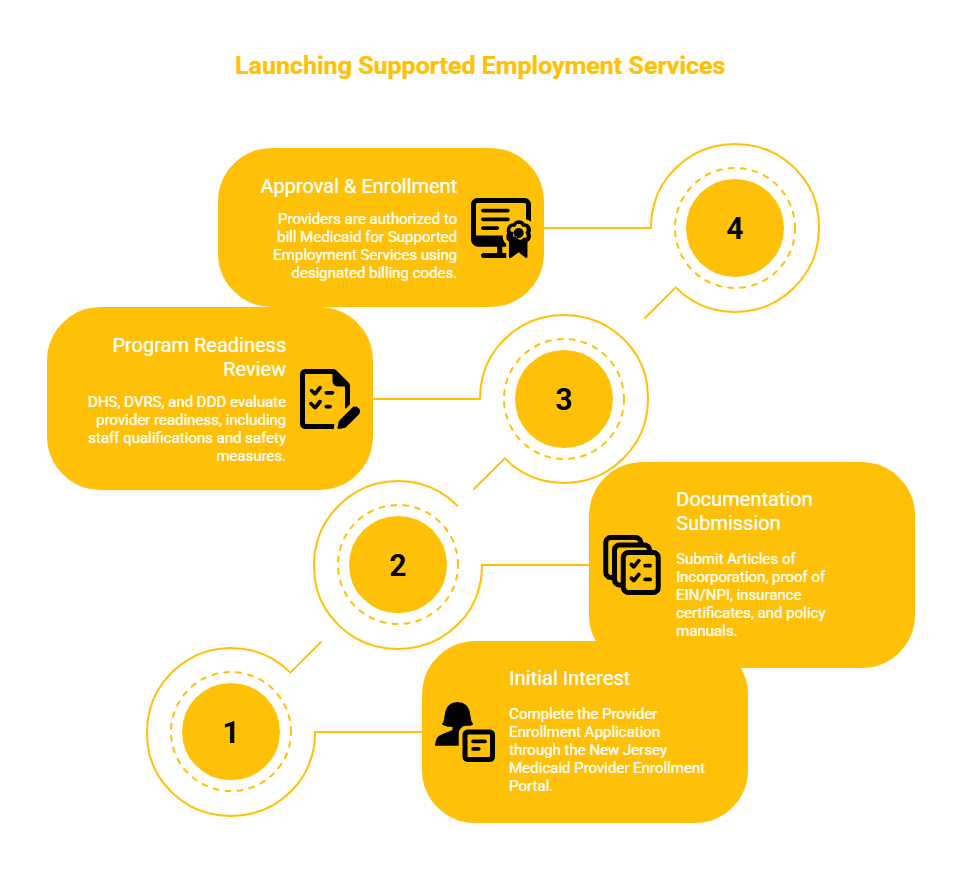
The road to becoming an approved provider begins with establishing the business entity within New Jersey and ensuring all tax and federal identifiers are in place. Agencies must register with the New Jersey Division of Revenue and Enterprise Services and secure both an IRS Employer Identification Number (EIN) and a Type 2 National Provider Identifier (NPI). These identifiers are non-negotiable prerequisites for the Medicaid enrollment portal.
Following business formation, the agency must navigate the New Jersey Medicaid Provider Enrollment Portal. The enrollment process includes a detailed program readiness review where DHS, DVRS, and DDD evaluate the provider’s internal infrastructure. This evaluation covers staff qualifications, the robustness of vocational protocols, and the adequacy of workplace safety measures. Only after a successful review and official Medicaid authorization may a provider begin billing for services using the designated codes.
Developing Comprehensive Policy and Documentation Standards
Regulatory compliance is heavily dependent on the quality of an agency’s Policy and Procedure Manual. This document must serve as the roadmap for all staff activities and must be available for audit at any time. A compliant manual must include clear procedures for vocational assessment, job placement, and coaching. Furthermore, it must detail the agency's internal systems for staff credentialing, background check verification, and ongoing professional development.
Beyond clinical and operational workflows, documentation must satisfy rigorous administrative and legal requirements. This includes robust protocols for HIPAA compliance, participant grievance handling, and safety measures for community-based work sites. Providers must demonstrate that they have a formalized system for tracking service delivery against the participant’s ISP, as this documentation is the primary evidence used during Medicaid billing audits to prove that services were rendered as required.
Staffing and Professional Development Requirements
The credibility and efficacy of a Supported Employment program rest on the qualifications of its staff. The Program Director must possess a bachelor’s degree in a relevant field, such as social work or vocational rehabilitation, complemented by direct supervisory experience in employment services. This leadership role is vital for maintaining the clinical standards required by state oversight agencies.
Direct service staff, including Job Coaches, Vocational Counselors, and Employment Specialists, must also meet strict criteria. All staff are required to undergo background clearances and receive specific training in community-based employment support strategies. To ensure high-quality care, agencies must mandate that all personnel complete:
- Ongoing Competency Evaluations: Annual assessments of vocational support and job retention strategies.
- Participant Rights and HIPAA Education: Mandatory training to ensure client privacy and autonomy.
- Safety and Soft Skills Training: Protocols that ensure both the physical safety of the participant and their ability to succeed in the workplace.
Frequently Asked Questions
What are the primary Medicaid waiver programs that cover Supported Employment in New Jersey?
Supported Employment Services are authorized under several HCBS waiver programs, including the Community Care Program for the Elderly and Disabled (CCPED), the Supports Program Waiver, the Acquired Brain Injury (ABI) Waiver, the Personal Care Assistant (PCA) Waiver, and the general Home and Community-Based Services (HCBS) Waiver.
How long does the typical enrollment process take for a new provider?
The timeline to launch is generally split into four phases. Business formation takes 1–2 months, followed by 2–3 months for staff hiring and development. The Medicaid provider enrollment and readiness review typically spans 60–90 days, with an additional 30–45 days required for final billing setup.
What must be included in the provider’s policy manual to ensure compliance?
The manual must include detailed procedures for vocational assessment, job placement, and coaching, along with staff credentialing records, HIPAA compliance protocols, participant rights, grievance procedures, and comprehensive safety measures for community-based job sites.
Waiver Consulting Group’s Start-Up Assistance Service
WCG supports agencies in launching Medicaid-compliant Supported Employment Services in New Jersey, offering expertise in business registration, Medicaid enrollment, and licensing assistance. The scope of work includes policy manual development for vocational support and job coaching, staff credentialing templates, and compliance documentation. Furthermore, WCG assists with Medicaid billing setup, audit-prepared financial management, branding, website development, and the design of quality assurance systems for job retention and client satisfaction.
Key Takeaway: Successfully operating as a Supported Employment provider in New Jersey requires a disciplined commitment to state-mandated documentation, qualified staffing, and ongoing adherence to HCBS waiver quality standards, ensuring that vocational outcomes are both measurable and sustainable.
Last verified: October 2023. Disclaimer: This guide is for informational purposes and does not constitute legal or professional medical advice. Always refer to the latest updates from the New Jersey Department of Human Services (DHS) and official CMS guidelines when establishing your agency.