SUPPORTED EMPLOYMENT SERVICES PROVIDER IN NEW HAMPSHIRE
By Fatumata Kaba · 2025-07-27 · 5 min read
How to Become a Supported Employment Services Provider in New Hampshire
Supported Employment Services in New Hampshire empower individuals with disabilities by providing the essential tools to secure, maintain, and thrive in competitive, community-based jobs. As an authorized provider under New Hampshire Medicaid Home and Community-Based Services (HCBS) waiver programs, your agency plays a critical role in fostering independence through vocational training, job coaching, and long-term career support.
To successfully launch this service, providers must navigate complex regulatory requirements set by the Department of Health and Human Services (DHHS) and ensure compliance with federal standards established by the Centers for Medicare & Medicaid Services (CMS). This guide outlines the operational, clinical, and administrative steps necessary to establish a compliant and effective Supported Employment program in the state.
Who Regulates Supported Employment Services in New Hampshire?
The delivery of Supported Employment Services is governed by a multi-tiered regulatory framework designed to ensure participant safety and service quality. At the state level, the New Hampshire Department of Health and Human Services (DHHS) serves as the primary authority, managing Medicaid waiver funding, provider enrollment, and the critical processes of service authorization and reimbursement.
Within DHHS, the Bureau of Elderly and Adult Services (BEAS) plays a central role in maintaining oversight. BEAS is responsible for ensuring that all providers adhere to strict quality standards and that the services delivered align with the specific needs of participants within the HCBS waiver framework. Concurrently, the federal Centers for Medicare & Medicaid Services (CMS) provides overarching guidance, mandating that all Medicaid-funded vocational services adhere to person-centered planning principles and participant protection requirements.
What Are the Core Components of Supported Employment Services?
Supported Employment Services are defined by their ability to provide individualized, community-based support that transitions with the participant throughout their career journey. Approved providers are expected to deliver a comprehensive suite of services that help individuals move from initial career assessment into long-term employment sustainability.
The scope of these services is expansive, requiring a balance between direct clinical support and community-based engagement. Providers must offer a structured approach to vocational success, which includes:
- Career Assessment: Identifying an individual’s unique skills, interests, and long-term vocational goals.
- Job Development: Actively identifying and securing job opportunities that match the participant’s abilities and aspirations.
- Job Coaching: Providing hands-on, on-the-job support to ensure tasks are performed correctly and safely.
- Workplace Accommodations: Assisting in the implementation of adaptive tools or environmental modifications.
- Social Skills Training: Educating participants on workplace behavior and professional interpersonal communication.
- Job Retention and Career Advancement: Providing ongoing monitoring to prevent job loss and supporting the participant in seeking promotions or new roles.
What Are the Requirements for Provider Approval?
Becoming an approved Medicaid provider in New Hampshire requires meticulous attention to both business infrastructure and clinical standards. Before initiating the application, an agency must be properly registered as a legal entity with the New Hampshire Secretary of State and possess a valid EIN from the IRS, along with an NPI (Type 2).
Beyond basic business registration, agencies must demonstrate operational readiness. This involves developing robust internal policies that govern job coaching methodologies, vocational planning, and workplace safety. Additionally, providers must maintain comprehensive liability insurance and establish a rigorous staff management system that ensures all employees undergo appropriate background checks, health screenings, and necessary vocational training before working with participants.
What Does the New Hampshire Provider Enrollment Process Entail?
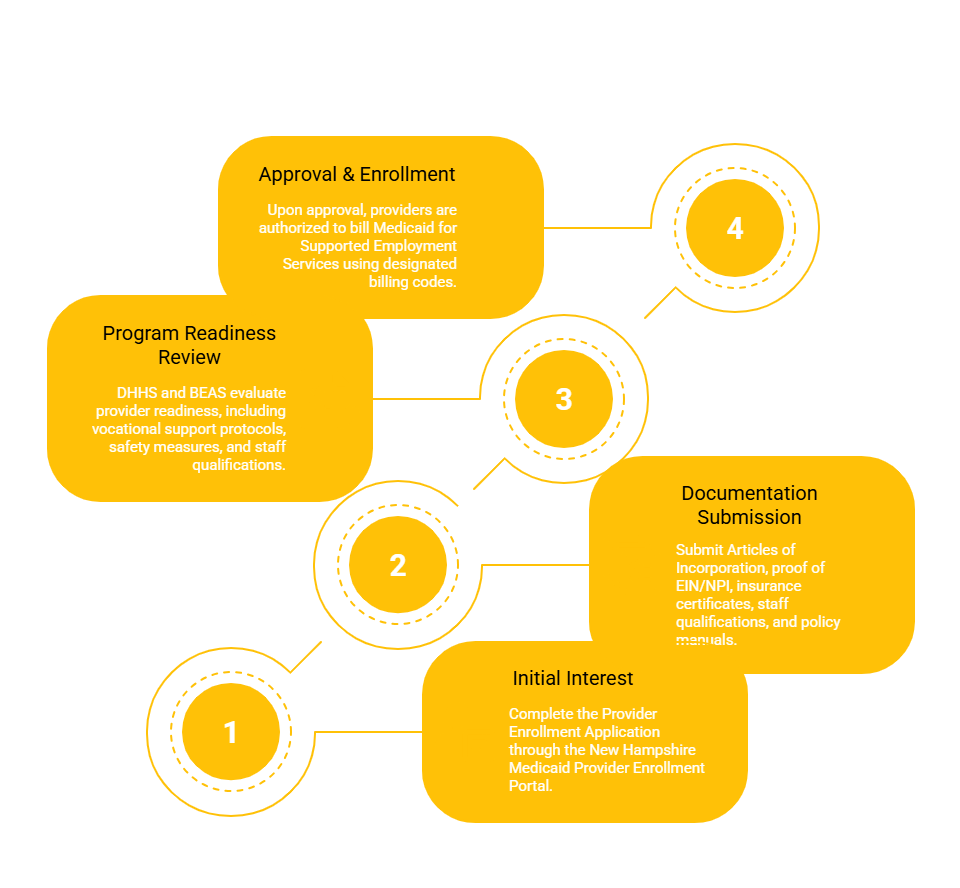
The enrollment journey is a multi-phase process managed through the New Hampshire Medicaid Provider Enrollment Portal. The initial step involves submitting a formal application specifically for Supported Employment Services under the relevant HCBS waivers. During this phase, applicants must provide extensive documentation, including articles of incorporation, proof of insurance, detailed staff qualification records, and comprehensive policy manuals.
Following the submission, the DHHS and BEAS conduct a program readiness review. This evaluation is critical, as it confirms that the agency possesses the necessary vocational support protocols, safety measures, and staff competency levels required to serve the Medicaid population. Only after this rigorous review is completed and the agency receives official approval can the provider begin billing Medicaid for services using the state-designated billing codes.
Which Staffing Credentials Are Necessary for Compliance?
The efficacy of a Supported Employment program rests on the caliber of its staff. The Program Director must typically hold a Bachelor’s degree in vocational rehabilitation, human services, or a related field, accompanied by verified experience in workforce development. This role is responsible for overseeing the clinical direction of the agency and ensuring that all vocational strategies are person-centered.
Employment Specialists, Job Coaches, and Vocational Rehabilitation Counselors must meet specific education and certification requirements, including background clearances and specialized training in job readiness and coaching. Furthermore, all staff must participate in ongoing professional development, HIPAA compliance education, and crisis management training to maintain the competencies required by the state and federal government.
Frequently Asked Questions
Which Medicaid Waivers Cover Supported Employment Services?
Supported Employment Services are authorized under several New Hampshire Medicaid waivers, including the Choices for Independence (CFI) Waiver, the Developmental Disabilities (DD) Waiver, the Acquired Brain Disorder (ABD) Waiver, the In-Home Support (IHS) Waiver for Children, and the general Home and Community-Based Services (HCBS) Waiver.
How long does the provider enrollment process typically take?
The entire process from business formation to the launch of billing usually takes between 6 to 10 months. This includes 1–2 months for business formation, 2–3 months for staff hiring and credentialing, 60–90 days for the official readiness review, and 30–45 days for final billing setup.
What must be included in the agency’s Policy and Procedure Manual?
Your manual must include protocols for career planning, job development, and coaching; workplace support and accommodation strategies; staff credentialing and training records; HIPAA compliance; client rights and grievance procedures; billing documentation standards; safety protocols; and quality assurance monitoring.
Key Takeaway
Launching a Supported Employment Services agency in New Hampshire requires a disciplined approach to regulatory compliance, staff training, and clinical documentation. By aligning your business practices with the specific standards of the DHHS, BEAS, and the relevant Medicaid waiver programs, you establish a foundation for delivering high-quality, person-centered vocational support that meets the critical needs of individuals with disabilities across the state.
Last verified: September 2024. This information is provided for educational purposes and does not constitute legal or professional advice. Always consult the New Hampshire Department of Health and Human Services directly for the most current regulatory updates and specific contractual obligations.