SUPPORTED EMPLOYMENT SERVICES PROVIDER IN NEVADA
By Fatumata Kaba · 2025-09-04 · 5 min read
Supported Employment Services in Nevada empower individuals with disabilities to secure and maintain competitive, integrated employment through specialized vocational assistance. By operating under various Nevada Medicaid Home and Community-Based Services (HCBS) waivers, provider agencies play a critical role in facilitating job readiness, ongoing coaching, and long-term career growth for participants.
For entrepreneurs and healthcare administrators, launching a Supported Employment agency requires navigating rigorous regulatory frameworks overseen by the Nevada Department of Health and Human Services (DHHS) and the Aging and Disability Services Division (ADSD). This guide outlines the essential requirements, operational standards, and administrative steps necessary to establish a compliant provider agency in the Silver State.
Understanding the Regulatory Landscape and Governing Agencies
The delivery of Supported Employment Services in Nevada is governed by a multi-tiered regulatory structure designed to ensure participant safety and the quality of vocational outcomes. At the federal level, the Centers for Medicare & Medicaid Services (CMS) sets the overarching standards for HCBS waivers, emphasizing person-centered planning, participant rights, and federal compliance. Providers must operate within these federal mandates while strictly adhering to state-specific policies.
At the state level, the Nevada Department of Health and Human Services (DHHS) serves as the primary authority, managing Medicaid waiver funding, provider enrollment protocols, and the reimbursement process. Working in tandem, the Aging and Disability Services Division (ADSD) is responsible for the ongoing oversight of service delivery, ensuring that providers maintain compliance with quality standards. Familiarity with the roles of these agencies is essential for any administrator seeking to navigate the Medicaid landscape effectively.
Defining the Scope of Supported Employment Services
Supported Employment Services are designed to provide a comprehensive continuum of care that addresses the unique vocational needs of individuals with disabilities. Rather than a one-size-fits-all approach, these services are highly personalized, documented through an Individualized Service Plan (ISP) that tracks progress toward specific career goals. Agencies approved to provide these services act as vital intermediaries between participants and the competitive labor market.
Approved providers are authorized to deliver a suite of services, including:
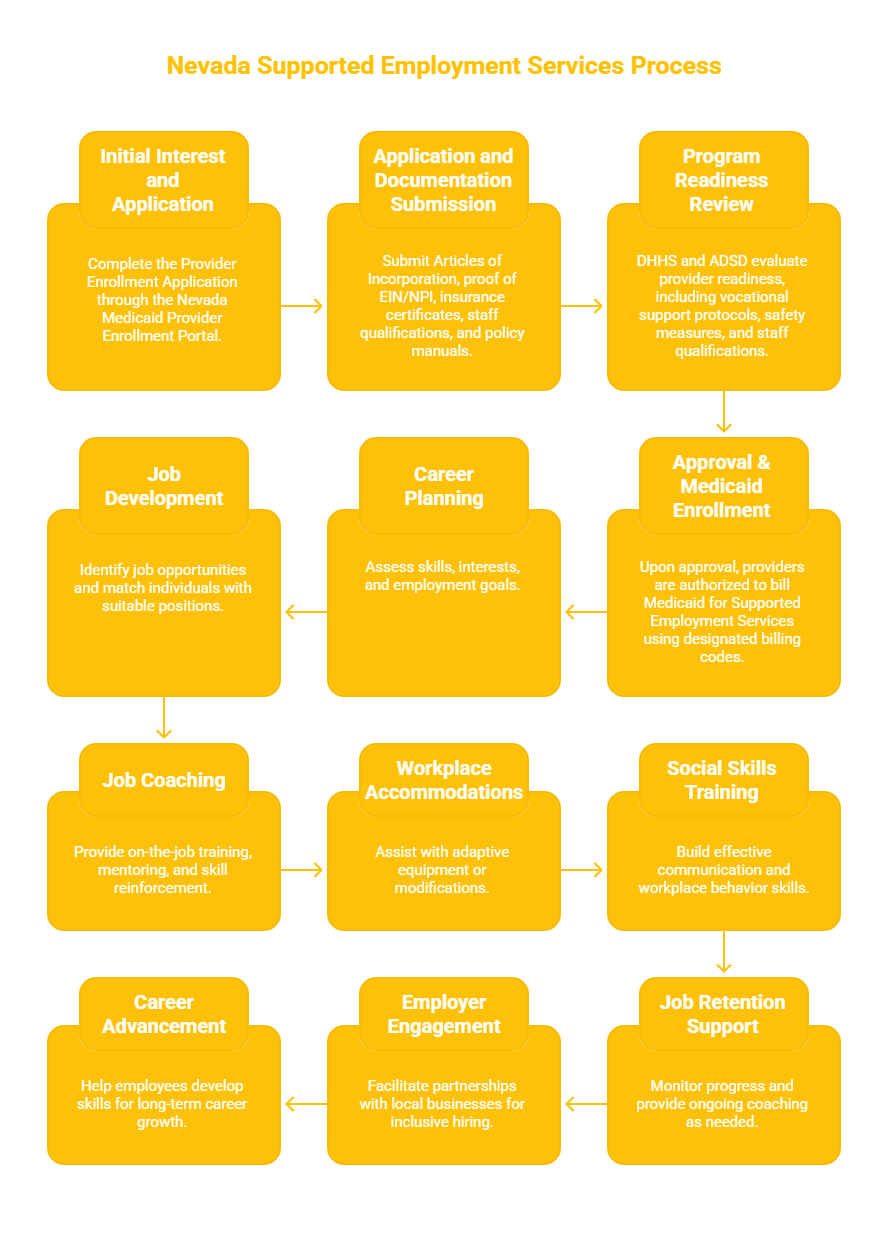
- Career Planning: Conducting in-depth assessments of individual skills, interests, and long-term employment goals.
- Job Development: Actively identifying inclusive job opportunities and matching participants with suitable roles.
- Job Coaching: Providing on-the-job training, mentoring, and reinforcement of essential workplace skills.
- Workplace Accommodations: Facilitating the integration of adaptive equipment or physical modifications to ensure a productive work environment.
- Job Retention and Advancement: Monitoring progress, providing ongoing coaching to ensure stability, and helping employees grow their careers.
Essential Requirements for Provider Licensure and Enrollment
Becoming an authorized provider in Nevada is a methodical process that demands significant administrative preparation. Before submitting an application, business entities must be properly registered with the Nevada Secretary of State. Once the legal entity is established, the provider must secure a federal Employer Identification Number (EIN) and a Type 2 National Provider Identifier (NPI) to distinguish the agency within the Medicaid billing system.
Operational readiness is a key factor in the approval process. Agencies must maintain comprehensive general and professional liability insurance and develop robust internal policies covering vocational planning, participant safety, and data privacy. Every provider must demonstrate that their staff members undergo rigorous background checks, health screenings, and specialized vocational support training, ensuring the agency is prepared to meet the high standards expected by DHHS and ADSD.
The Step-by-Step Nevada Provider Enrollment Process
The transition from a business entity to an active Medicaid provider involves several distinct phases, primarily managed through the Nevada Medicaid Provider Enrollment Portal. The process begins with the submission of an application specifically for Supported Employment Services under the designated HCBS waivers. During this phase, applicants must submit all foundational business documentation, including Articles of Incorporation and proof of insurance.
Following the initial submission, the program enters a Readiness Review stage. During this period, DHHS and ADSD officials evaluate the agency’s vocational support protocols and internal safety measures to ensure they align with state regulations. Once the agency passes this review and receives approval, it is officially enrolled and assigned the necessary billing codes to begin service delivery. This sequence typically spans several months, necessitating careful project management.
Staffing Standards and Vocational Competency
The quality of Supported Employment Services relies heavily on the qualifications and training of the agency's personnel. The Supported Employment Program Director serves as the administrative lead, ideally holding a bachelor’s degree in vocational rehabilitation or a related field, alongside prior experience in managing employment support programs. This role is responsible for ensuring that all services adhere to regulatory requirements and that the agency maintains a high level of operational integrity.
Direct support staff, including Job Coaches and Employment Specialists, are the frontline facilitators of participant success. Requirements include a high school diploma or GED, combined with specific training in job readiness and coaching methodologies. All staff must participate in ongoing professional development, HIPAA education, and annual competency evaluations to ensure that their skills remain sharp and their practices remain compliant with current state policies and safety protocols.
Frequently Asked Questions
What specific Nevada Medicaid waivers include Supported Employment Services?
Supported Employment Services are available under several programs, including the HCBS Waiver for Persons with Intellectual and Developmental Disabilities (HCBS-IDD), the Frail Elderly (FE) Waiver, the Physical Disabilities Waiver, the Traumatic Brain Injury (TBI) Waiver, and the Aged and Disabled (AD) Waiver.
How long does the typical enrollment process take for a new provider?
The timeline varies based on the completeness of documentation and the readiness of the agency, but the enrollment and review phases generally take between 60 and 90 days. Including business formation and staff training, the entire launch process often spans 5 to 7 months.
What documentation is required to pass the Readiness Review?
Providers must present a comprehensive Policy & Procedure Manual. This must include protocols for vocational assessment, job coaching, HIPAA compliance, incident management, staff training records, and clear procedures for maintaining participant rights and grievance handling.
Key Takeaways for Prospective Providers
Launching a Supported Employment agency in Nevada is a significant undertaking that requires meticulous attention to both business administration and clinical quality standards. By focusing on compliant policy development, hiring qualified vocational specialists, and maintaining a transparent relationship with the DHHS and ADSD, agencies can establish a sustainable model that significantly improves the lives of individuals with disabilities in their communities. Success in this field is rooted in the consistent delivery of high-quality, person-centered support that meets all state and federal regulatory benchmarks.
WCG supports agencies in launching Medicaid-compliant Supported Employment Services in Nevada, offering: business registration, Medicaid enrollment, and licensing assistance; policy manual development for vocational planning and job support; staff credentialing, training program templates, and compliance documentation; Medicaid billing setup and audit-prepared financial management; branding, website development, and community outreach strategies; quality assurance systems for job coaching and employment retention; and collaboration with local businesses for inclusive hiring practices.
Last verified: October 2023. This information is intended for educational purposes only and does not constitute legal or professional advice. Requirements for Medicaid provider enrollment are subject to change. Please consult the official Nevada Medicaid Provider Enrollment Portal and relevant state agency guidelines for the most current regulatory updates.