SUPPORTED EMPLOYMENT SERVICES PROVIDER IN MICHIGAN
By Fatumata Kaba · 2025-07-27 · 5 min read
Empowering individuals with disabilities through vocational support in Michigan requires a structured approach to meeting both state and federal HCBS compliance standards. As a provider, you play a critical role in facilitating gainful employment for participants in Michigan’s Home and Community-Based Services (HCBS) waiver programs by delivering specialized services authorized by the Michigan Department of Health and Human Services (MDHHS).
What Are Supported Employment Services Under Michigan Medicaid Waivers?
Supported Employment Services are person-centered interventions designed to help individuals with disabilities obtain, maintain, and advance in competitive, integrated employment. Unlike traditional vocational training, these services are integrated directly into the participant’s life, focusing on real-world work settings and community inclusion. The goal is to maximize the participant’s independence by providing the necessary support structure to overcome vocational barriers.
Approved providers are responsible for delivering a continuum of care that spans from initial career exploration to long-term job retention. This requires a deep understanding of the Michigan HCBS landscape, as services must be tailored to the specific needs of individuals enrolled in programs such as the MI Choice Waiver, the Habilitation Supports Waiver, and the Children’s Waiver Program. The primary focus remains on fostering independence through high-quality, individualized employment support.
- Job readiness training and comprehensive skill assessment
- Assistance with targeted job searches and navigation of application processes
- Direct job coaching and on-the-job support at the workplace
- Worksite assessments and development of necessary job modifications
- Career planning, vocational counseling, and long-term retention support
How Do Governing Agencies Regulate Supported Employment Providers?
Compliance is the cornerstone of any Medicaid HCBS provider agency in Michigan. The Michigan Department of Health and Human Services (MDHHS) acts as the primary regulatory body, overseeing the complex process of provider enrollment, service authorization, and ongoing Medicaid compliance. Every service provided must align with the specific mandates outlined in the state’s approved waiver applications to ensure federal financial participation.
At the federal level, the Centers for Medicare & Medicaid Services (CMS) maintains oversight to ensure that Michigan’s HCBS programs adhere to the federal settings rule, which emphasizes community integration. Providers must demonstrate that they are not just delivering services, but are doing so in a manner that honors the rights of the participants and integrates them into the broader workforce. Failure to adhere to these regulatory requirements can result in loss of enrollment status or reimbursement delays.
What Are the Essential Requirements for Provider Approval?
Before an agency can begin billing for Supported Employment Services, it must establish a formal business entity and satisfy all state-specific operational prerequisites. This starts with registering the business with the Michigan Department of Licensing and Regulatory Affairs (LARA) and securing the necessary federal identifiers, including an Employer Identification Number (EIN) and a Type 2 National Provider Identifier (NPI). A physical office location within the state of Michigan is mandatory to support local service delivery and operational oversight.
Beyond administrative setup, prospective providers must demonstrate a high degree of expertise in vocational rehabilitation. This involves developing a robust service delivery model that includes documented protocols for client skill assessment, employer engagement, and job site modifications. Agencies must verify that their operational infrastructure is capable of handling the reporting and documentation standards required for Medicaid reimbursement, ensuring that every service hour is both defensible and compliant with MDHHS standards.
- Formal registration with LARA and documentation of an active business status
- Securing an EIN from the IRS and a Type 2 NPI for billing purposes
- Maintaining a physical office presence that meets Michigan state requirements
- Developing comprehensive internal protocols for job coaching and employer outreach
- Ensuring all administrative staff have the capacity to manage Medicaid documentation
What Is the Enrollment Process for New Providers?
The enrollment process is a multi-phased journey that requires precision and attention to detail. Initially, a provider must request the official Supported Employment Provider Application Packet from MDHHS. This submission must include a detailed business and service plan that articulates how the agency intends to conduct vocational support, manage caseloads, and perform outreach to potential employers. The depth of this plan is a primary factor in the approval timeline.
Once the application is submitted, the agency will move into the background check and credentialing phase. All staff members who have direct contact with participants must undergo rigorous background checks to ensure client safety. Furthermore, the agency must provide proof of vocational qualifications and evidence of ongoing training in supported employment best practices. A Program Readiness Review may be conducted to confirm that the agency can handle diverse vocational needs before final authorization is granted.
How Must Staffing and Documentation Be Managed?
Staffing requirements are designed to ensure that participants receive professional support from qualified personnel. Key roles include the Employment Program Manager, who oversees strategy; Job Coaches, who provide daily, on-site support; and Career Counselors, who manage vocational planning. Every employee must complete the mandatory MDHHS orientation, HCBS Waiver training, and ongoing education regarding ethics, client rights, and best practices in the vocational field.
Documentation is the primary proof of service delivery and must be maintained with meticulous care. Providers are required to keep detailed logs of job readiness training, job coaching sessions, and client progress reports. Additionally, financial tracking and employment logs must be stored securely to comply with Medicaid audit requirements. A well-constructed Policy & Procedure Manual—covering everything from client admission to job modification standards—is essential for internal quality control and regulatory success.
Frequently Asked Questions
What waivers authorize Supported Employment Services in Michigan?
Supported Employment Services are authorized under the MI Choice Waiver, the Habilitation Supports Waiver, and the Children’s Waiver Program. Providers must ensure their enrollment and billing processes are aligned with the specific requirements of these respective programs.
What is the typical timeline for becoming a provider?
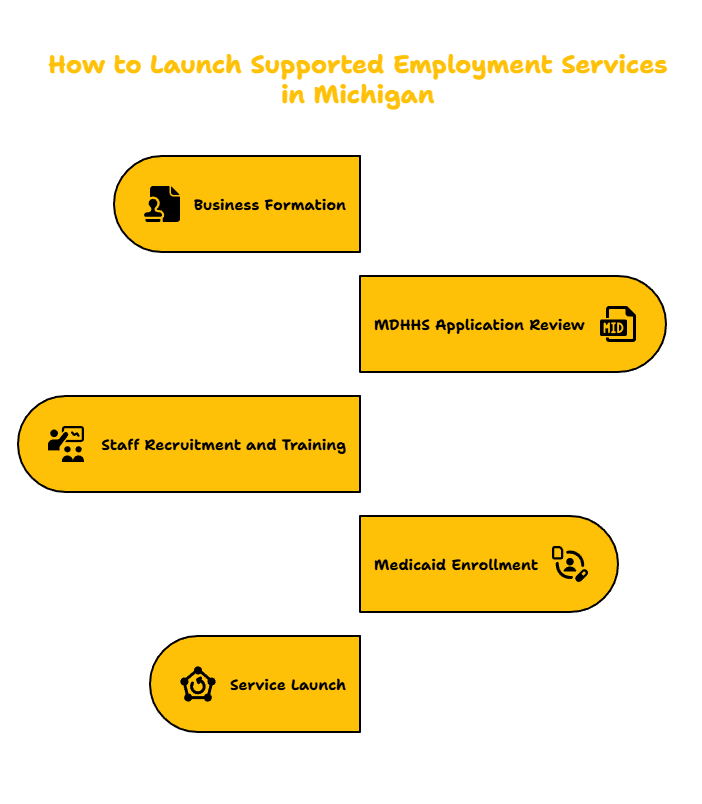
The process generally spans several months, including 0–1 week for business formation, 60–90 days for MDHHS application review, 30–60 days for staff recruitment and training, and an additional 60–90 days for final Medicaid enrollment and system setup.
What qualifications are needed for job coaches?
Job coaches must possess specific training in job readiness, employment support, and client interaction. They are required to undergo MDHHS orientation and complete annual training on employment best practices, ethics, and the protection of client rights.
Key Takeaway: Successfully launching a Supported Employment Services agency in Michigan requires a disciplined commitment to MDHHS regulatory protocols, comprehensive staff training, and the meticulous documentation of client progress. By prioritizing compliance and quality of care, providers can effectively bridge the gap between participants and meaningful, integrated employment.
Last verified: 2024. This article is for informational purposes only and does not constitute legal or professional advice. Always consult directly with the Michigan Department of Health and Human Services (MDHHS) or a qualified Medicaid consultant regarding the specific requirements for your provider agency and the current state of waiver regulations.