SUPPORTED EMPLOYMENT SERVICES PROVIDER IN MASSACHUSETTS
By Fatumata Kaba · 2025-08-08 · 6 min read
Supported Employment Services in Massachusetts enable individuals with intellectual, developmental, or physical disabilities to secure and maintain competitive, integrated employment through specialized, person-centered support. These services are delivered by qualified providers and funded through various MassHealth Home and Community-Based Services (HCBS) waivers, as well as programs managed by the Department of Developmental Services (DDS) and the Massachusetts Rehabilitation Commission (MRC).
For organizations looking to enter this field, success requires a deep understanding of state-specific regulatory requirements, a robust internal compliance framework, and active coordination with the governing agencies responsible for individual service authorizations. This guide outlines the essential steps and structural requirements for becoming a recognized provider of these vital community services in the Commonwealth of Massachusetts.
What Are the Governing Agencies and Regulatory Roles in Massachusetts?
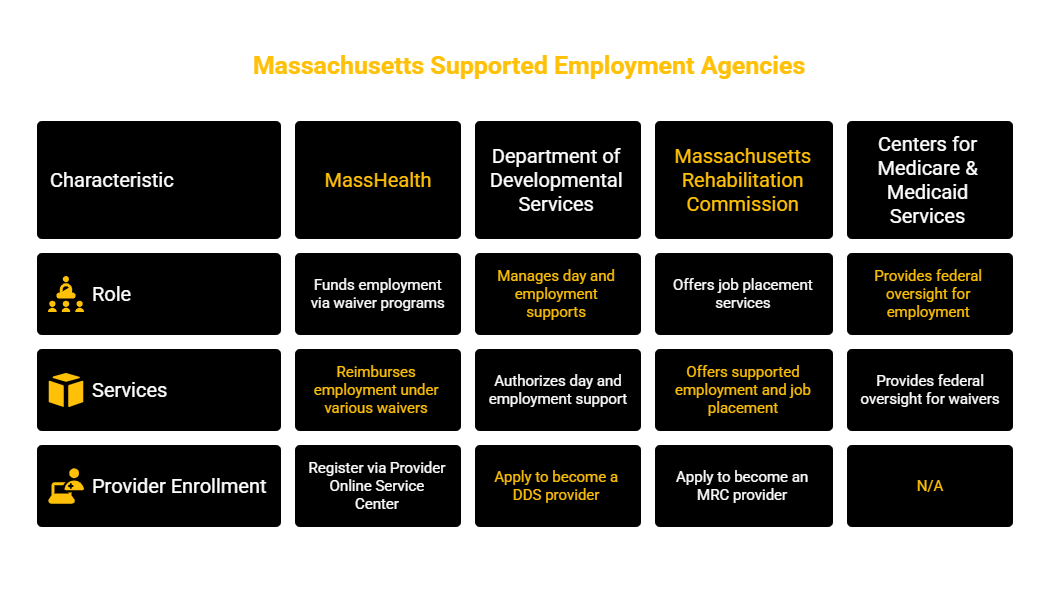
The landscape of Supported Employment in Massachusetts is collaborative, involving several state and federal bodies. MassHealth (Medicaid) acts as the primary funding vehicle for these supports, utilizing various HCBS waiver programs to ensure that individuals have access to inclusive work environments. Federal oversight for these waiver-funded activities is provided by the Centers for Medicare & Medicaid Services (CMS), which ensures that services align with national standards for home and community-based care.
At the state level, the Department of Developmental Services (DDS) serves as the key entity for managing and authorizing day and employment supports specifically for individuals with intellectual and developmental disabilities. Simultaneously, the Massachusetts Rehabilitation Commission (MRC) plays a critical role by offering specialized Supported Employment and job placement services, frequently focusing on individuals with physical disabilities, post-rehab needs, or mental health conditions. Understanding the distinct jurisdictional focus of each agency is essential for any provider seeking to build a sustainable service model.
- MassHealth (Medicaid): Funds Supported Employment through waivers such as DDS, ABI, and MFP.
- Department of Developmental Services (DDS): Manages and authorizes support for developmental disabilities.
- Massachusetts Rehabilitation Commission (MRC): Provides support for physical disabilities or complex health conditions.
- Centers for Medicare & Medicaid Services (CMS): Provides federal oversight for waiver-funded employment programs.
How Do Providers Establish a Supported Employment Program?
Establishing a service agency requires a structured approach to business formation and regulatory compliance. Initially, providers must register their business with the Massachusetts Secretary of the Commonwealth and secure essential federal identifiers, including an IRS Employer Identification Number (EIN) and a Type 2 National Provider Identifier (NPI). Financial and operational stability must be demonstrated through the procurement of general liability insurance and workers’ compensation, ensuring the agency is adequately prepared to operate in a community-based, professional environment.
Beyond legal registration, the core of the provider’s operational success lies in the development of a comprehensive Supported Employment Services Policy & Procedure Manual. This document must codify the organization’s adherence to HIPAA regulations and ADA employment standards. Ensuring that the agency is structured to meet the specific documentation needs of both DDS and MRC is a fundamental prerequisite for moving from the planning phase to active service delivery.
What Is the Required Enrollment Process for MassHealth and State Agencies?
The pathway to becoming an active provider involves a multi-step enrollment sequence. The process begins with MassHealth through the Provider Online Service Center (POSC). Once MassHealth enrollment is initiated, prospective providers must separately apply to the relevant state departments—specifically DDS or MRC—to become an authorized employment provider. This application process requires the submission of organizational credentials, detailed staff qualifications, and a clear description of the services to be delivered.
Once credentials are established, the provider moves into the service planning and authorization phase. This involves close coordination with local DDS area offices or MRC employment teams to integrate the agency’s services into the Individual Service Plan (ISP) or Plan of Care (POC) for each participant. Success in this phase is predicated on the provider's ability to demonstrate how their proposed coaching strategies and employment outcomes align with the specific needs outlined in the participant's plan.
What Documentation Is Essential for Compliance and Audits?
Maintaining rigorous documentation is the primary requirement for ongoing participation in Massachusetts waiver programs. Providers must keep meticulous records that demonstrate not only the delivery of services but also the quality and necessity of those services. Every interaction, from the initial vocational assessment to ongoing job coaching sessions, must be documented according to the standards set forth by the authorizing agency. This includes clear records of job development, placement logs, and employer engagement efforts.
Audit readiness is a constant requirement. An effective compliance system will feature robust templates for progress reports, staff training logs, and billing documentation. By ensuring that these records are digitized and easily accessible, providers can ensure that their services remain fully reimbursable and that they remain in good standing with both MassHealth and the state departments overseeing their contracts.
- Intake and Assessment: Initial vocational readiness and goal-setting forms.
- Service Delivery: Consistent logs for job coaching, soft skills training, and onsite support.
- Administrative: Updated staff training credentials and proof of insurance.
- Financial: Audit-ready billing records aligned with ISP authorizations.
What Are the Staffing and Training Mandates for Employment Specialists?
The quality of a Supported Employment program is determined by the competence and training of its personnel. Employment Specialists and Job Coaches are typically expected to hold a Bachelor’s degree or possess equivalent experience in the vocational rehabilitation or human services sectors. A thorough knowledge of disability employment rights, such as those governed by the ADA, is mandatory. Additionally, all staff must undergo standard background checks to ensure the safety and security of the participants they support.
Beyond baseline qualifications, agencies are responsible for providing specialized training in person-centered planning, motivational interviewing, and effective employer engagement. This ensures that job coaches are equipped to act as professional liaisons between the participant and the workplace, facilitating necessary accommodations while fostering independence. Ongoing oversight by a Program Manager or Employment Services Coordinator is required to ensure that staff practices remain consistent with state policy and quality assurance standards.
Frequently Asked Questions
Does becoming a Supported Employment provider require clinical licensing?
No, there is no specific clinical license required to become a Supported Employment provider in Massachusetts. However, extensive experience in vocational rehabilitation, human services, or workforce development is strongly recommended to meet the expectations of DDS and MRC.
What is the typical timeline for launching a new agency?
The timeline varies based on organizational readiness, but the full process generally spans 4 to 7 months. This includes 2–4 weeks for business registration, 1–2 months for MassHealth and agency enrollment, and approximately 1 month to finalize policy manuals and staff training. Referral networking continues indefinitely following approval.
What types of employment services are reimbursable under the waivers?
Providers may be reimbursed for various services including individualized placement and support (IPS), group-supported employment in integrated settings, career exploration, pre-vocational training, and long-term stabilization support to ensure job retention.
WCG supports disability-focused organizations and employment specialists in launching waiver-compliant Supported Employment services across Massachusetts. Our scope of work includes business registration, Medicaid enrollment, DDS/MRC credentialing, Policy & Procedure Manual creation, and staff onboarding systems. By aligning your operational framework with state requirements and best practices, your organization can effectively contribute to the goal of inclusive, competitive employment for all.
Key Takeaway: Successfully launching a Supported Employment agency in Massachusetts requires a diligent, two-pronged approach: meeting the technical requirements of the MassHealth Provider Online Service Center and establishing the service-delivery infrastructure necessary to satisfy the specific oversight of the Department of Developmental Services or the Massachusetts Rehabilitation Commission.
Last verified: October 2023. This information is for educational purposes only and does not constitute legal or financial advice. Please consult with the Massachusetts Executive Office of Health and Human Services and relevant state agencies for the most current regulatory guidance and policy updates.