SUPPORTED EMPLOYMENT SERVICES PROVIDER IN MARYLAND
By Fatumata Kaba · 2025-09-03 · 5 min read
Understanding Supported Employment Services in Maryland
Supported Employment Services in Maryland are specialized Medicaid waiver interventions designed to assist individuals with intellectual and developmental disabilities (IDD) in securing and maintaining competitive, integrated employment. Delivered through the Maryland Developmental Disabilities Administration (DDA), these services empower participants by providing individualized job development, one-on-one coaching, and long-term career supports that facilitate independence in the community.
These services operate under the mandates of the Community Pathways Waiver, Community Supports Waiver, and the Family Supports Waiver for transition-aged youth. By prioritizing competitive, integrated employment—defined as work paying at least minimum wage in typical community settings—providers play a critical role in fulfilling Maryland's “Employment First” policy framework, which assumes that every individual with a disability is capable of working when provided with appropriate supports.
Who Governs and Regulates Employment Services?
The delivery of Supported Employment in Maryland is a multi-agency effort requiring strict adherence to state and federal regulations. Oversight begins with the Maryland Department of Health (MDH), which serves as the umbrella agency for Medicaid and waiver-based initiatives. The Developmental Disabilities Administration (DDA) functions as the primary regulatory body, monitoring service delivery, evaluating provider performance, and managing the approval process for agencies seeking to provide employment supports.
In addition to the DDA, providers must maintain a functional relationship with the Division of Rehabilitation Services (DORS) within the Maryland Department of Education. DORS often provides the initial, short-term employment support for individuals, and DDA-funded services are frequently designed to pick up where DORS services conclude. Finally, all operations must align with the Centers for Medicare & Medicaid Services (CMS) requirements, which dictate federal Home and Community-Based Services (HCBS) rules regarding participant choice, community integration, and conflict-free service delivery.
- Maryland Department of Health (MDH): Governs Medicaid waiver programs and statewide health policy.
- Developmental Disabilities Administration (DDA): Authorizes and monitors waiver service delivery and provider status.
- Division of Rehabilitation Services (DORS): Manages vocational rehabilitation services and initial job placement supports.
- Centers for Medicare & Medicaid Services (CMS): Enforces federal compliance and Employment First mandates.
How Are Supported Employment Services Structured?
Supported Employment services are highly individualized, ensuring that each participant’s unique interests, abilities, and career goals are addressed. The service framework is built on the foundation of the Person-Centered Plan (PCP), which dictates the specific level of support an individual requires. Services are not "one-size-fits-all" but are instead tiered to address different stages of the career lifecycle, from initial discovery to long-term retention.
Core components include Discovery and Job Development, where specialists help participants identify career interests and assist with resume building and employer matching. Once a position is secured, Job Coaching provides the intensive on-site support necessary for training and role transition. Ongoing supports are then utilized to ensure long-term retention through regular check-ins, effective communication with employers, and navigating workplace culture.
- Discovery & Job Development: Identifying aptitudes and building necessary vocational tools.
- Job Coaching: Providing hands-on, on-site training to promote workplace mastery.
- Ongoing Supports: Sustaining employment through career advancement coaching and retention strategies.
- Self-Employment Support: Providing specialized guidance for participants interested in business ownership, including planning and budgeting.
What Are the Steps to Becoming a DDA-Approved Provider?
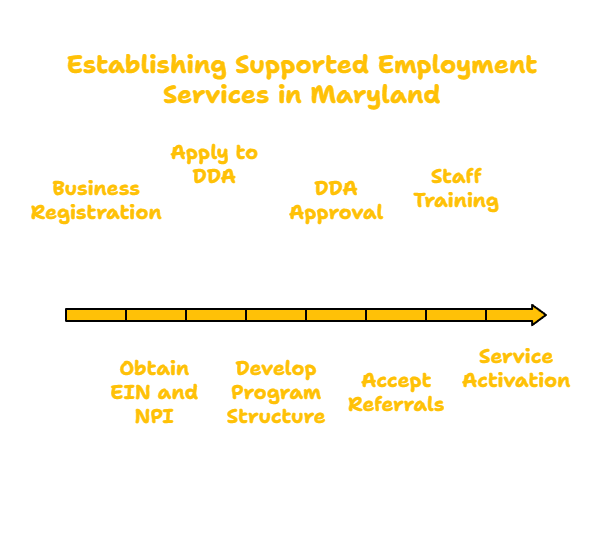
The path to becoming a provider begins with formal business organization and adherence to Maryland’s specific registration requirements. Before applying, organizations must register with the Maryland Department of Assessments and Taxation (SDAT) and obtain all necessary business identification, including an Employer Identification Number (EIN) and a Type 2 National Provider Identifier (NPI). These credentials serve as the building blocks for the provider’s legitimacy in the Medicaid billing system.
Once the business entity is established, prospective providers must navigate the DDA Provider Application Portal. The application requires comprehensive documentation, including a detailed staffing plan, clear service descriptions, robust outcome tracking protocols, and internal organizational policies. Because Maryland emphasizes conflict-free case management, agencies must demonstrate that their employment service delivery remains independent from other case management functions. Approval relies on the ability to demonstrate a commitment to, and understanding of, the Employment First model.
- Business Formation: Registering with SDAT and securing tax and provider identifiers.
- Portal Submission: Uploading the DDA application and required supporting organizational documentation.
- Service Authorization: Establishing systems to accept referrals through Coordination of Community Services (CCS) agencies.
- Operational Readiness: Ensuring internal policies are prepared for initial state audits.
Managing Staffing and Operational Documentation
Operational success in Supported Employment is contingent upon maintaining a highly trained workforce and rigorous documentation. Each Employment Specialist or Job Coach must hold at least a high school diploma, with a preference for higher education in fields related to disability support or human services. Furthermore, all staff must undergo mandatory DDA orientation, background checks, and specific Employment Core Competency training to ensure they can effectively translate the PCP into actionable workplace support.
Providers are required to maintain a comprehensive policy and procedure manual that covers every aspect of service delivery. This includes incident reporting, grievance procedures, and HIPAA-compliant data management systems. Proper documentation is not merely an administrative hurdle; it is a clinical requirement. Every service interaction, from discovery sessions to ongoing employer check-ins, must be logged in a format that satisfies state auditors and ensures the sustainability of Medicaid reimbursement.
Frequently Asked Questions
What is the difference between DORS and DDA employment services?
DORS typically provides short-term, time-limited vocational rehabilitation services to assist an individual in obtaining employment. DDA waiver services, such as Supported Employment, are generally designed to provide the long-term, ongoing supports necessary to maintain that employment once the initial DORS-funded services conclude or if the individual requires permanent ongoing support.
Are all DDA waiver programs the same for employment support?
No, the waivers differ in scope. The Community Pathways Waiver offers a comprehensive suite of employment and day services, while the Community Supports Waiver provides more limited hours of job support. The Family Supports Waiver is specifically targeted toward transition-aged youth under the age of 21 to help them prepare for their future workforce entry.
How long does the provider enrollment process take?
The timeline for becoming a DDA-approved provider generally spans several months. Business registration and initial hiring usually take 1–2 weeks, followed by 2–3 weeks for policy development. The formal DDA provider application and approval process typically ranges between 4–8 weeks, depending on the completeness of the submission and the volume of applications being processed by the DDA.
Key Takeaway
Establishing a Supported Employment agency in Maryland requires meticulous attention to regulatory compliance, a deep understanding of the DDA service architecture, and a commitment to person-centered vocational outcomes. By aligning business operations with the specific requirements of the MDH, DDA, and DORS, providers can create sustainable programs that effectively bridge the gap between individuals with disabilities and competitive, integrated employment opportunities in their communities.
Last verified: October 2023. This information is intended for educational purposes and does not constitute legal or financial advice. Readers should consult the official Maryland Developmental Disabilities Administration (DDA) and Maryland Department of Health (MDH) resources for the most current regulatory guidance and application requirements.