SUPPORTED EMPLOYMENT SERVICES PROVIDER IN MAINE
By Fatumata Kaba · 2025-08-12 · 5 min read
Supported Employment Services in Maine are specialized, person-centered programs designed to assist individuals with intellectual and developmental disabilities, autism, and other functional limitations in securing and maintaining competitive, integrated employment. These services are primarily funded through MaineCare’s Home and Community-Based Services (HCBS) Waivers—specifically Section 21 and Section 29—and are essential for fostering independence, self-sufficiency, and community inclusion for participants across the state.
Launching a provider agency in this space requires a rigorous commitment to administrative compliance, clinical documentation standards, and the "Employment First" philosophy. This guide outlines the essential regulatory, operational, and structural requirements for organizations looking to become approved Medicaid providers of supported employment services in Maine.
Navigating the Regulatory Landscape and Oversight Agencies
The delivery of supported employment services in Maine is governed by a multi-agency framework. Understanding the specific role of each agency is the first step in ensuring regulatory compliance and effective program administration. The Department of Health and Human Services (DHHS) serves as the overarching authority, while the Office of Aging and Disability Services (OADS) manages the policy framework for HCBS Waivers, including the service definitions for supported employment.
Operational success requires coordination with the Office of MaineCare Services (OMS), which oversees provider enrollment and the Medicaid claims process. Furthermore, the Maine Department of Labor’s Division of Vocational Rehabilitation (VR) plays a critical role in the initial phases of an individual’s career journey. Many participants utilize VR funding for initial job exploration and placement before transitioning to long-term waiver supports. Providers must ensure their service delivery models align with federal requirements established by the Centers for Medicare & Medicaid Services (CMS), specifically focusing on person-centered planning and competitive, integrated work environments.
- DHHS: Oversees statewide disability employment initiatives.
- OADS: Administers Sections 21 and 29 waivers and sets service outcomes.
- OMS: Manages Medicaid provider enrollment and billing systems.
- Maine Division of Vocational Rehabilitation (VR): Coordinates pre-employment and initial placement.
- CMS: Ensures adherence to federal person-centered planning and inclusion standards.
Core Components of Supported Employment Service Delivery
Supported employment is not a one-size-fits-all model; it is an individualized pathway that evolves as the participant gains experience. Providers are responsible for facilitating a range of services that move from discovery to long-term maintenance. Effective programs emphasize the participant’s unique interests, strengths, and career goals, ensuring that every service provided is documented within the Individual Support Plan (ISP).
The scope of service includes rigorous job development, where staff actively cultivate relationships with local employers to find competitive placements. Once a job is secured, the service transitions to on-the-job coaching, where staff provide the necessary scaffolding to help the individual learn tasks, integrate into the workplace culture, and maintain long-term employment. These services are dynamic, allowing for transitions between jobs or advancement within a chosen career field.
Establishing Your Agency: Licensing and Provider Approval
To operate as a Medicaid provider, your business must meet specific administrative and structural prerequisites. This process begins with formal business registration via the Maine Secretary of State, followed by the acquisition of a federal Employer Identification Number (EIN) and a Type 2 National Provider Identifier (NPI). These identifiers are the foundation upon which your MaineCare enrollment application is built.
Beyond basic business registration, agencies must demonstrate their capacity to deliver high-quality services. This involves submitting detailed service descriptions, robust staff qualification standards, and clear outcome-tracking methodologies to OADS. Potential providers must show they have the infrastructure to establish and sustain relationships with the business community, as employer outreach is a critical component of successful job placement and retention.
Managing MaineCare Enrollment and Service Authorization
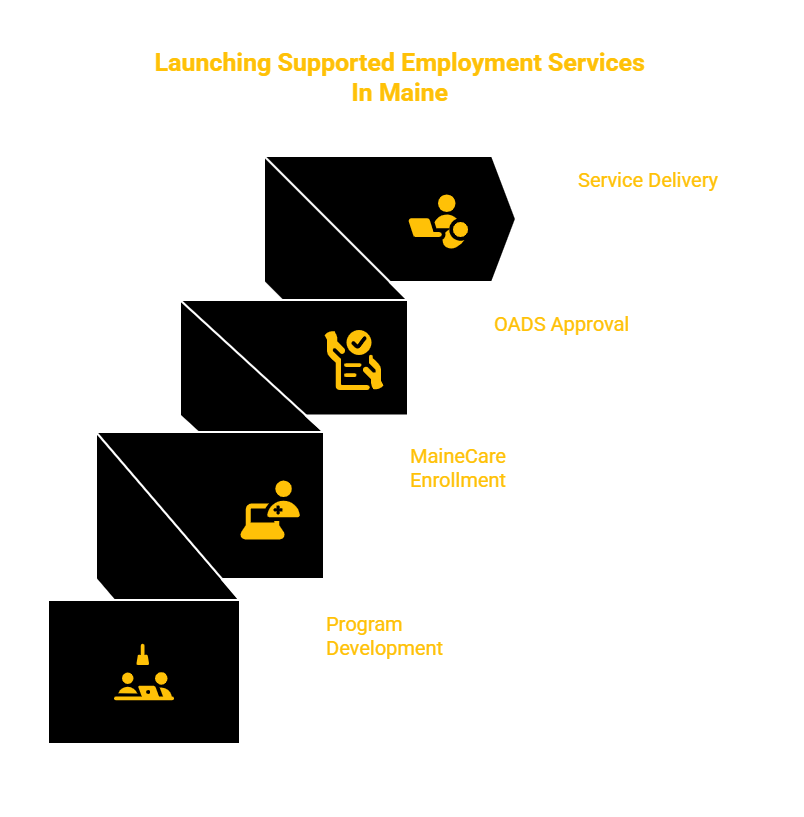
The pathway to becoming a Medicaid-authorized provider follows a structured, multi-phase sequence. Organizations must first define their service models—determining whether they will offer specialized job discovery, intensive coaching, or long-term follow-along supports. Once the program design is finalized, the organization must navigate the Health PAS Online portal to complete the provider enrollment process for Section 21 and/or Section 29 waivers.
Following enrollment, the focus shifts to OADS approval. The agency must submit comprehensive documentation, including staff training plans and quality assurance protocols. Upon final approval, the provider can begin accepting referrals from case managers and VR counselors. Success at this stage relies on maintaining clear communication with the participant’s care team and tracking progress toward employment goals with transparency and accuracy.
Documentation, Staffing, and Professional Standards
Compliance is driven by meticulous record-keeping. A provider’s policy and procedure manual must be comprehensive, covering intake assessments, job development strategies, daily coaching logs, and incident response protocols. Every staff interaction, particularly those involving on-the-job support, must be documented in alignment with state billing requirements to ensure audit readiness.
Staffing requirements are equally stringent to ensure the safety and success of the individuals served. Employment specialists and job coaches must possess at least a high school diploma, relevant experience in disability services, and a commitment to Employment First principles. Employment services coordinators, who provide oversight, generally require a bachelor’s degree. All staff must undergo comprehensive onboarding and annual professional development training, covering ethics, boundaries, workplace safety, and person-centered documentation techniques.
Frequently Asked Questions
What is the difference between Section 21 and Section 29 waivers regarding employment?
Both sections authorize supported employment, but they serve different populations based on the intensity of support needs. Section 21 is designed as a comprehensive waiver for adults with intellectual disabilities or autism, while Section 29 acts as a support waiver. Providers should be familiar with the billing codes and service caps specific to each section.
How does the Division of Vocational Rehabilitation (VR) interact with Medicaid waivers?
VR is often the starting point for employment services. They provide funding for the initial phases of the job search, such as discovery and placement. Once the participant transitions to ongoing, long-term support to maintain that job, the funding typically shifts to the Medicaid waiver (Section 21 or 29).
What defines "Competitive Integrated Employment"?
Competitive integrated employment refers to work performed on a full-time or part-time basis for which an individual is compensated at or above the minimum wage, but not less than the customary wage paid by the employer for the same or similar work performed by employees without disabilities. It involves interaction with employees without disabilities to the same extent that employees without disabilities in comparable positions interact with other persons.
Key Takeaway
Building a successful supported employment agency in Maine requires a balance of administrative rigor, adherence to Medicaid regulatory standards, and a deep, sustained commitment to the principles of person-centered care. By carefully aligning your agency’s operational policies with OADS, OMS, and VR requirements, you ensure the long-term sustainability of your services while directly contributing to the independence and professional growth of individuals with disabilities in your community.
Last verified: September 2023. This information is provided for educational purposes only and does not constitute legal or professional regulatory advice. Always consult the latest bulletins and policy manuals from the Maine Department of Health and Human Services (DHHS) and the Centers for Medicare & Medicaid Services (CMS) for the most current program requirements.