SUPPORTED EMPLOYMENT SERVICES PROVIDER IN LOUISIANA
By Fatumata Kaba · 2025-08-12 · 5 min read
EMPOWERING INDIVIDUALS WITH DISABILITIES TO FIND, OBTAIN, AND MAINTAIN COMPETITIVE INTEGRATED EMPLOYMENT
Supported Employment Services in Louisiana provide essential pathways for individuals with disabilities to secure meaningful, competitive, and integrated work within their local communities. By leveraging Home and Community-Based Services (HCBS) waivers in tandem with state vocational rehabilitation programs, provider agencies deliver the necessary job development, training, and long-term coaching required to ensure participant success in the modern workforce.
Understanding the Governing Framework for Louisiana Supported Employment
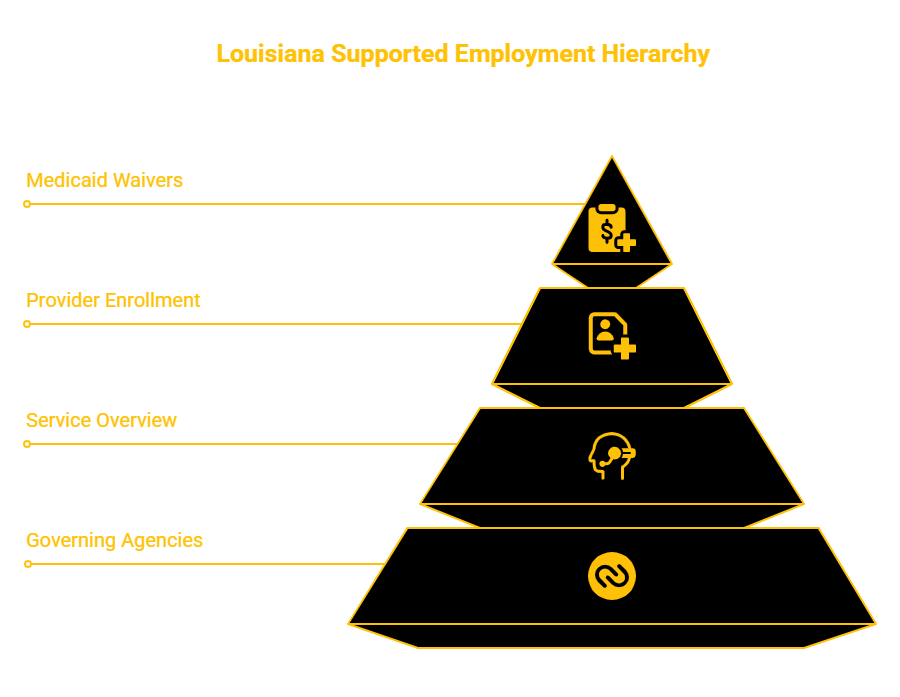
The delivery of Supported Employment services in Louisiana is governed by a multi-agency framework designed to ensure quality, safety, and adherence to federal standards. At the state level, the Louisiana Department of Health (LDH), specifically the Office for Citizens with Developmental Disabilities (OCDD), establishes the service standards for waiver participants and maintains oversight of provider compliance. Their role is to ensure that all services remain person-centered and align with the state’s commitment to community integration.
Complementing this, Louisiana Rehabilitation Services (LRS) under the Louisiana Workforce Commission provides critical vocational evaluations and initial job development. Because LRS often handles the preliminary phases of employment readiness, providers must establish a formal coordination process with them to bridge the gap between initial assessment and long-term waiver-funded support. Nationally, the Centers for Medicare & Medicaid Services (CMS) oversees the HCBS waiver structure, ensuring that all Louisiana programs meet the regulatory requirements for person-centered planning and community-based inclusion.
Core Components of Supported Employment Service Delivery
Supported Employment is defined by individualized, outcome-focused interventions that empower participants to transition into and sustain competitive employment. These services are not one-size-fits-all; they are tailored to the specific career goals, skills, and support needs of each participant. By focusing on competitive integrated employment—where the individual works alongside non-disabled peers and earns prevailing wages—providers help move participants toward greater independence and financial self-sufficiency.
The scope of service includes a robust suite of supports designed to address both the logistics and the soft skills required for workplace success. Providers are expected to deliver:
- Person-centered career planning that identifies specific professional interests and goals.
- Active job development, including employer outreach, negotiation, and job matching.
- On-site job coaching and systematic task training to ensure mastery of workplace expectations.
- Transportation coordination to facilitate reliable attendance.
- Long-term follow-along support, advocacy, and proactive workplace problem-solving to ensure long-term retention.
Licensing and Enrollment for Prospective Providers
Becoming an approved Supported Employment provider requires strict adherence to both business and programmatic requirements. Prospective agencies must first establish a legal business entity with the Louisiana Secretary of State and obtain an IRS EIN and a Type 2 NPI. Following these foundational steps, the agency must enroll with Louisiana Medicaid via the official Provider Enrollment Portal. This step is critical, as it establishes the provider's eligibility to bill for services rendered under various Medicaid waiver programs.
Once enrolled with Medicaid, the provider must obtain OCDD-specific approval for Supported Employment services. This process involves a thorough review of the provider’s operational readiness, including the submission of staffing qualifications, training curricula, and sample service documentation. Additionally, providers must demonstrate the capacity to collaborate with LRS and maintain the mandatory liability and workers’ compensation insurance coverage necessary to operate in the community health space.
Essential Documentation and Operational Compliance
Successful program administration hinges on maintaining comprehensive, audit-ready documentation. A provider’s records must clearly articulate the progress of each participant, demonstrating the efficacy of the coaching provided and the achievement of specific employment milestones. This documentation not only justifies Medicaid billing but also provides a roadmap for the participant’s professional development.
Agencies are required to maintain a detailed Supported Employment Policy & Procedure Manual, which must contain:
- Person-centered employment planning templates for documenting individual career paths.
- Job development logs that track employer contacts and negotiations.
- Daily job coaching notes and follow-up tracking to record specific tasks learned or issues resolved.
- Clear protocols for critical incidents, workplace safety, and informed consent.
- Structured staff training logs verifying that all employees meet ongoing competency requirements.
- Medicaid billing logs that correlate directly with hours of service and verifiable wage documentation.
Staffing, Training, and Professional Standards
The effectiveness of a Supported Employment program is directly tied to the quality of its staff. Whether serving in the role of Employment Specialist, Job Coach, or Program Supervisor, personnel must possess a blend of vocational experience and a commitment to disability advocacy. A high school diploma is the minimum requirement for job coaches, though a bachelor’s degree in rehabilitation, education, or social work is strongly preferred, along with at least one year of relevant vocational experience.
Beyond baseline qualifications, all staff must undergo rigorous training to maintain service standards. This includes mandatory instruction on HIPAA compliance, the Americans with Disabilities Act (ADA) and workplace accommodations, and the principles of positive behavior support. Supervisors are responsible for ensuring that all team members are fully trained in safety procedures, emergency response, and the specific documentation requirements necessary for waiver compliance.
Frequently Asked Questions
Which Medicaid waivers cover Supported Employment services in Louisiana?
Supported Employment is primarily reimbursed through the Residential Options Waiver (ROW), the Supports Waiver, and the New Opportunities Waiver (NOW). Additionally, the Children’s Choice Waiver provides limited employment supports, and Money Follows the Person (MFP) may cover transitional work support for qualified individuals.
How does a provider establish a working relationship with Louisiana Rehabilitation Services (LRS)?
Providers must establish a written agreement or a defined process for referral collaboration with LRS. This coordination is vital because LRS often provides the short-term vocational readiness and initial job development that leads into the long-term, ongoing support provided by the waiver agency.
What is the typical timeline for launching a Supported Employment program?
The launch process generally takes several months to complete. Business registration and initial training typically require 1–2 months, followed by a 60–90 day period for Medicaid enrollment and OCDD approval. Once established, the hiring of staff and the configuration of internal documentation systems generally take an additional 2–4 weeks before participant referrals can begin.
WAIVER CONSULTING GROUP’S START-UP ASSISTANCE SERVICE — LOUISIANA SUPPORTED EMPLOYMENT PROVIDER
Waiver Consulting Group assists disability service agencies, employment coaches, and community rehab providers in launching Medicaid-compliant Supported Employment programs throughout Louisiana. Our scope of work includes business registration, Medicaid and waiver enrollment, the development of comprehensive Policy & Procedure Manuals, and the creation of standardized tools for intake, job placement, and audit-ready documentation.
Key Takeaway: The successful launch and operation of a Louisiana Supported Employment program depend on the rigorous integration of state-level oversight, documented adherence to waiver-specific service definitions, and proactive coordination with vocational rehabilitation partners to ensure participants receive seamless, high-quality support.
Last verified: August 2024. This information is provided for educational purposes and does not constitute legal or financial advice. Regulations regarding HCBS waivers and Medicaid enrollment are subject to change; always refer to the official Louisiana Department of Health (LDH) and Medicaid provider portals for the most current statutory requirements and policy updates.