SUPPORTED EMPLOYMENT SERVICES PROVIDER IN KENTUCKY
By Fatumata Kaba · 2025-07-25 · 5 min read
Supported Employment Services in Kentucky provide essential vocational support to individuals with intellectual/developmental disabilities (ID/DD) or brain injuries, enabling them to secure and maintain competitive, integrated employment. These services are authorized under specific Kentucky Medicaid Home and Community-Based Services (HCBS) waivers and are governed by a framework that emphasizes workforce inclusion, individualized coaching, and long-term career success.
By leveraging Medicaid funding, provider agencies play a critical role in facilitating the transition from traditional day programs to the competitive labor market. This article outlines the regulatory requirements, operational steps, and administrative standards necessary to become a certified Supported Employment provider in the Commonwealth of Kentucky.
What Are the Governing Agencies and Regulatory Roles in Kentucky?
The delivery of Supported Employment Services in Kentucky is overseen by a multi-layered regulatory structure designed to ensure high standards of care and compliance. The Kentucky Cabinet for Health and Family Services (CHFS), through the Department for Medicaid Services (DMS), acts as the primary authority for Medicaid reimbursement, provider enrollment, and regulatory adherence.
Operational quality assurance is managed by the Kentucky Department for Behavioral Health, Developmental and Intellectual Disabilities (DBHDID), which monitors service delivery under the Supports for Community Living (SCL), Michelle P. Waiver (MPW), and Acquired Brain Injury (ABI & ABI-LTC) programs. Simultaneously, service authorizations and claims management are handled by Managed Care Organizations (MCOs), which serve as the point of contact for participant-specific care coordination. Additionally, providers must navigate the "Employment First" framework by collaborating with the Office of Vocational Rehabilitation (OVR) when those services are available to the participant.
How Do Providers Deliver Core Supported Employment Services?
Service delivery must be person-centered, aligning strictly with the participant’s Person-Centered Service Plan (PCSP). Providers are expected to facilitate employment in community-based settings where the participant earns at least minimum wage and interacts with coworkers who do not have disabilities. This integration ensures that the employment experience is authentic and meaningful.
Authorized services typically cover the full life cycle of employment, from initial discovery to long-term stabilization. These include:
- Job exploration, career planning, and vocational discovery.
- Job development, customized matching, and employer outreach.
- On-the-job coaching, training, and workplace accommodation support.
- Transportation coordination for travel to and from the job site.
- Benefits counseling to help individuals understand the impact of income on their benefits.
- Ongoing follow-along support to ensure long-term job retention and career growth.
What Are the Necessary Steps for Provider Enrollment and Credentialing?
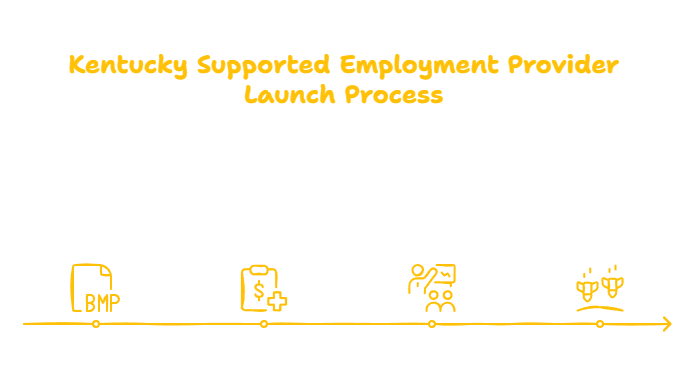
The process of becoming a Medicaid-approved provider is a methodical journey that begins with establishing the business entity. Prospective providers must be registered with the Kentucky Secretary of State and obtain an IRS Employer Identification Number (EIN) and a Type 2 National Provider Identifier (NPI). These foundational steps are prerequisites for interacting with the Medicaid system.
Once the business is legally established, providers must navigate the Medicaid Partner Portal Application (MPPA) to enroll as a formal Medicaid provider. Following state-level enrollment, providers must complete credentialing with the various MCOs operating within the state. This credentialing process verifies that the agency possesses the infrastructure, insurance coverage, and staffing qualifications required to provide services safely and effectively.
What Documentation Is Required for Compliance and Audit Readiness?
Maintaining a comprehensive, audit-ready documentation system is mandatory for all Supported Employment agencies. This begins with the development of a formal Policy and Procedure Manual, which serves as the agency's operational roadmap. This manual must be updated regularly to reflect changes in Medicaid guidance and internal best practices.
Essential documentation includes intake forms, employment readiness assessments, and meticulous activity logs. Providers must track every intervention, including job development contacts, coaching sessions, and instances of coordination with natural supports or OVR counselors. Furthermore, HIPAA-compliant storage of these records is non-negotiable to protect participant privacy, and billing systems must be capable of generating precise records that correspond directly to approved services provided under the PCSP.
How Are Staffing and Training Requirements Managed?
The quality of Supported Employment services is highly dependent on the competence of the Employment Specialists and Job Coaches. While a high school diploma or equivalent is the baseline requirement, a Bachelor’s degree and prior experience in vocational rehabilitation are strongly preferred. Agencies are responsible for ensuring that all staff undergo thorough background checks and hold valid driver’s licenses, particularly when transportation assistance is part of the service package.
Beyond technical qualifications, staff must complete mandated training modules to ensure they are equipped to support individuals with diverse needs. This curriculum typically includes:
- Person-centered planning and Employment First philosophy.
- HIPAA compliance and confidentiality protocols.
- Mandatory reporting and prevention of abuse, neglect, and exploitation.
- Emergency preparedness and transportation safety standards.
- Ongoing professional development in workforce integration and disability-related accommodations.
Frequently Asked Questions
What waivers cover Supported Employment in Kentucky?
Supported Employment services are currently authorized under the Supports for Community Living (SCL) Waiver, the Michelle P. Waiver (MPW), and the Acquired Brain Injury (ABI & ABI-LTC) Waivers.
Is coordination with the Office of Vocational Rehabilitation required?
Yes, providers are expected to coordinate with the Office of Vocational Rehabilitation (OVR) whenever those services are available. This ensures that the participant receives the most appropriate and non-duplicative support while following the state's Employment First framework.
How long does the provider enrollment process typically take?
The timeline varies, but generally, business registration and manual development take 1–2 months, followed by 2–3 months for MPPA enrollment and MCO credentialing. Staff onboarding and employer outreach usually require an additional 1–2 months before services can be fully launched.
Key Takeaways for Provider Success
Launching a Supported Employment program in Kentucky requires a rigorous focus on administrative compliance, staff training, and the establishment of robust, collaborative relationships with both OVR and MCOs. By focusing on person-centered outcomes, documenting every service delivery, and adhering to the guidelines set forth by the Department for Medicaid Services, agencies can ensure they remain sustainable and effective in helping individuals with disabilities achieve long-term career success. Success in this sector is built upon the dual commitment to operational integrity and the empowerment of the participants served.
Last verified: 2024. This content is for informational purposes only and does not constitute legal or professional medical advice. Always consult with the Kentucky Cabinet for Health and Family Services and relevant Managed Care Organizations for the most current regulatory requirements.