SUPPORTED EMPLOYMENT SERVICES PROVIDER IN IOWA
By Fatumata Kaba · 2025-07-22 · 5 min read
HELPING INDIVIDUALS FIND AND MAINTAIN COMPETITIVE EMPLOYMENT THROUGH ONGOING JOB SUPPORTS
Supported Employment Services in Iowa provide individualized assistance to help individuals with disabilities prepare for, obtain, and sustain meaningful employment in integrated community settings. These services are authorized under Iowa’s Home and Community-Based Services (HCBS) waiver programs and the Habilitation Services program, and they are specifically designed to promote independence, inclusion, and economic self-sufficiency for participants across the state.
What Are the Governing Agencies for Iowa Supported Employment?
The regulatory framework for Supported Employment in Iowa is a multi-tiered system involving state and federal oversight to ensure service quality and fiscal integrity. The Iowa Department of Health and Human Services (HHS), specifically through the Iowa Medicaid Enterprise (IME), serves as the primary body responsible for administering waiver funding, managing service authorizations, and conducting rigorous provider compliance monitoring.
In addition to state-level oversight, Managed Care Organizations (MCOs) play a vital role in the delivery system by authorizing services and reimbursing providers through Medicaid managed care plans. Finally, the Centers for Medicare & Medicaid Services (CMS) provides the overarching federal framework, ensuring that all Supported Employment services adhere to strict Medicaid standards and the federal HCBS Settings Rule, which mandates that individuals receive support in the most integrated settings possible.
- Iowa Department of Health and Human Services (HHS) — Iowa Medicaid Enterprise (IME): Oversees policy and provider compliance.
- Managed Care Organizations (MCOs): Handle service authorization and provider reimbursement.
- Centers for Medicare & Medicaid Services (CMS): Ensures federal standards and HCBS Settings Rule alignment.
What Does the Supported Employment Service Model Entail?
Supported Employment Services are holistically designed to assist individuals with disabilities in achieving competitive, integrated employment that aligns with their personal strengths, interests, and long-term career goals. Unlike traditional vocational models, this service focuses on the intersection of individual preference and community-based opportunity, ensuring that participants are not merely placed in jobs, but are supported in sustaining them over time.
Approved providers must deliver a comprehensive suite of services that evolve with the participant's needs. All interventions must be explicitly aligned with the participant’s Individualized Service Plan (ISP) and documented as a central component of their person-centered employment strategy. By maintaining this focus, providers help ensure that every service hour contributes directly to the participant's professional growth and independence.
- Job exploration and career planning.
- Job development and placement in community settings.
- Job coaching and on-the-job support.
- Benefits education and planning assistance.
- Soft skill development (e.g., punctuality, communication, workplace behavior).
- Coordination with employers to ensure reasonable accommodations.
- Ongoing support to sustain long-term employment.
- Assistance with transitioning from facility-based to community-based employment.
What Are the Licensing and Provider Approval Requirements?
Establishing an agency to provide Supported Employment in Iowa requires a structured approach to administrative and operational compliance. Before engaging with the Medicaid system, providers must establish a legal business entity, register with the Iowa Secretary of State, and obtain a federal Employer Identification Number (EIN) along with a Type 2 National Provider Identifier (NPI). These foundational steps are necessary to initiate the Medicaid enrollment process through the Iowa Medicaid Provider Portal (IMPA).
Operational readiness is equally critical. Providers are expected to maintain comprehensive general and professional liability insurance and develop robust internal policies covering employment support delivery, employer engagement, transportation safety, and mandatory incident reporting. Furthermore, agencies must demonstrate that all staff members have completed required training in person-centered planning, HCBS requirements, and best practices for supporting individuals in the workplace.
How Do You Navigate the Iowa Provider Enrollment Process?
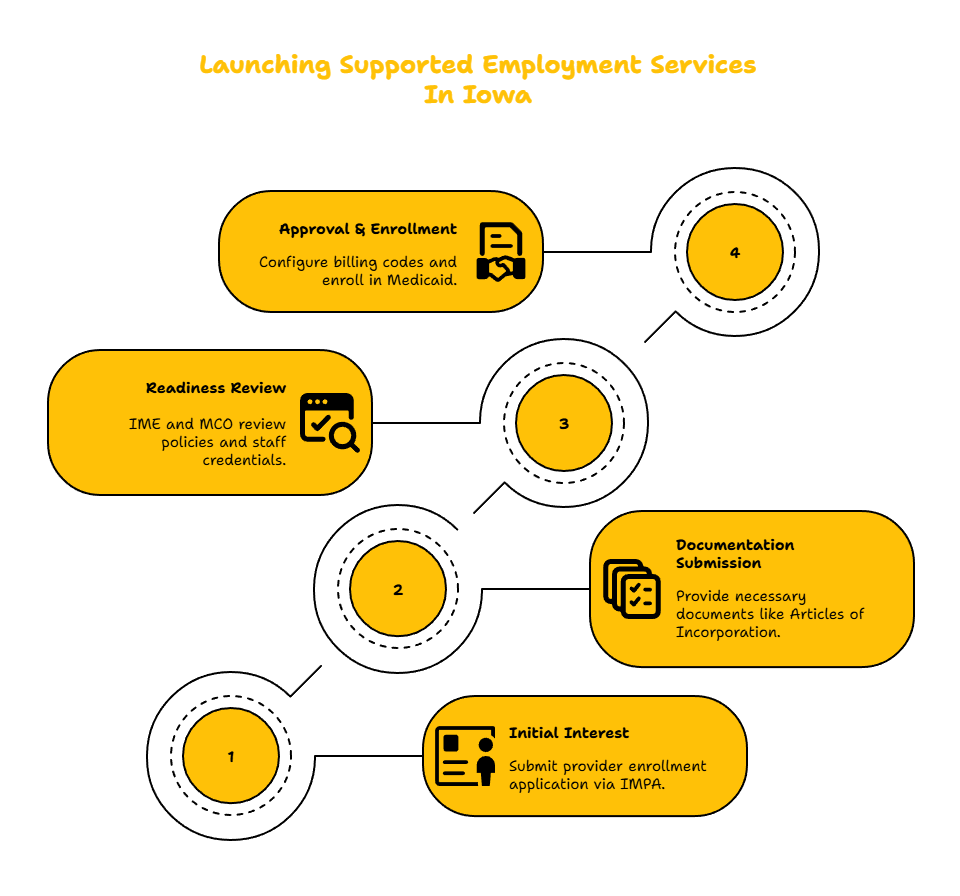
The enrollment journey is a multi-phase process that moves from initial business formation to full operational readiness. Providers begin by submitting an application via the IMPA for Supported Employment under the relevant HCBS Waivers or Habilitation Services program. During this phase, applicants must provide thorough documentation, including Articles of Incorporation, proof of NPI/EIN, comprehensive policy manuals, and evidence of staff training systems.
Following the submission of these materials, the IME and the relevant MCOs conduct a readiness review. This review is intended to evaluate whether the provider is prepared to deliver individualized community-based supports in compliance with state standards. Once the agency achieves approval, the final step involves configuring specific billing codes for job development, individual employment support, and long-term job coaching. These services are typically billed in 15-minute or hourly increments depending on the specific waiver and service definition.
What Are the Essential Documentation and Staffing Standards?
Success in this field requires rigorous documentation and a well-trained workforce. An agency’s Policy & Procedure Manual must be a "living document" that addresses intake, ISP alignment, job development protocols, and HIPAA-compliant record-keeping. Because audits are a standard part of Medicaid provider oversight, staff must be diligent in creating audit-ready service notes that reflect the specific goals identified in the participant's ISP.
Staffing qualifications reflect the professional nature of these supports. Supervisors are generally expected to have experience in vocational rehabilitation or community-based services, while Employment Specialists and Job Coaches must have at least a high school diploma or GED, with a Bachelor’s degree often preferred. All staff must undergo background screenings and participate in ongoing training regarding disability awareness and transportation safety to ensure the highest quality of service.
Frequently Asked Questions
Which Medicaid waiver programs cover these services?
Supported Employment Services are reimbursable under the Intellectual Disability (ID) Waiver, the Brain Injury (BI) Waiver, the Health and Disability (HD) Waiver, and the Habilitation Services program.
How long does the startup process typically take?
The timeline varies based on organizational readiness, but the full lifecycle—from business formation and policy development to staff hiring and final Medicaid/MCO approval—generally ranges from 6 to 9 months.
What does the provider enrollment entail regarding billing?
Once fully enrolled, providers configure their systems to bill for discrete service components such as job development and ongoing job coaching, with reimbursement rates and unit definitions (15-minute or hourly) determined by the specific waiver guidelines.
Key Takeaway
Becoming an approved Supported Employment provider in Iowa requires a meticulous approach to administrative compliance, staff training, and ongoing collaboration with the IME and MCOs. By focusing on person-centered outcomes and maintaining audit-ready documentation, provider agencies can effectively bridge the gap between individuals with disabilities and competitive, community-integrated employment opportunities.
WCG assists employment agencies, life skills providers, and HCBS service organizations in launching Medicaid-compliant Supported Employment Services across Iowa. Scope of Work includes business registration and Medicaid enrollment, development of Supported Employment Services Policy & Procedure Manual, staff credentialing templates, service tracking forms, and job coaching logs, Medicaid billing setup and compliance tools, website, domain, and branding materials, outcome tracking templates and employer engagement resources, and partnership development with vocational rehabilitation, employers, and transition programs. Our Client Portal offers a wealth of resources that you can explore related to various programs and state requirements.
Last verified: September 2024. The information provided here is for general educational purposes only and does not constitute legal or professional advice. Always consult directly with the Iowa Department of Health and Human Services (HHS) and your specific Managed Care Organization (MCO) to confirm current regulations, requirements, and policy updates before launching or modifying your service program.