SUPPORTED EMPLOYMENT SERVICES PROVIDER IN ILLINOIS
By Fatumata Kaba · 2025-07-19 · 5 min read
How to Become a Supported Employment Services Provider in Illinois
Supported Employment Services in Illinois are designed to assist individuals with disabilities or significant barriers to work by providing individualized job development, placement, and coaching services. By offering these supports, provider agencies play a critical role in helping participants succeed in competitive, integrated employment settings, which are authorized under Illinois Medicaid Home and Community-Based Services (HCBS) Waiver programs and the Division of Rehabilitation Services (DRS) employment initiatives.
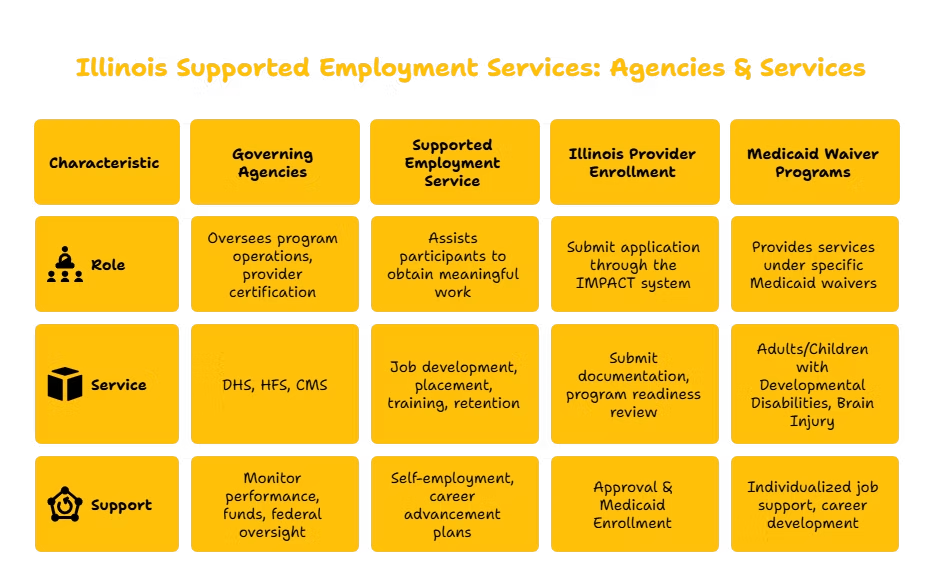
To operate as a provider, an organization must navigate a multi-layered regulatory environment involving the Illinois Department of Human Services (DHS), the Department of Healthcare and Family Services (HFS), and federal oversight by the Centers for Medicare & Medicaid Services (CMS). Successful providers ensure that their service delivery model aligns with the HCBS Settings Rule, person-centered planning, and competitive integrated employment standards.
Who Governs Supported Employment Services in Illinois?
The regulatory framework for these services is distributed across state and federal agencies, each playing a distinct role in program integrity and service delivery. The Illinois Department of Human Services (DHS), through the Division of Rehabilitation Services (DRS) and the Division of Developmental Disabilities (DDD), serves as the primary authority for program operations. These divisions are responsible for provider certification, service authorizations, and the ongoing performance monitoring of employment programs.
The Illinois Department of Healthcare and Family Services (HFS) manages the financial and technical backbone of the program. Specifically, HFS administers Medicaid waiver funding for Supported Employment Services and oversees the complex provider enrollment and billing systems. Furthermore, the Centers for Medicare & Medicaid Services (CMS) provides the overarching federal framework, ensuring that all Medicaid-funded activities adhere to national mandates regarding community integration and participant rights.
What Specific Services Do Approved Providers Deliver?
Approved providers are responsible for delivering a comprehensive suite of services that foster independence and career longevity for participants. The scope of these services is wide-ranging, encompassing every stage of the employment lifecycle, from initial vocational assessment to long-term job retention. These interventions must be explicitly directed by the participant’s Person-Centered Plan (PCP) and Employment Plan, which must contain measurable goals and clearly defined timeframes to reduce reliance on paid supports over time.
- Job development: Assessing individual interests and skills, creating professional resumes, completing job applications, and conducting mock interview preparation.
- Job placement: Matching participants to appropriate, meaningful employment opportunities within the local community.
- On-the-job training and coaching: Providing direct, hands-on support at the worksite to assist participants in learning specific job tasks and adjusting to the nuances of their work environment.
- Job retention services: Offering ongoing support to sustain employment, which includes serving as a bridge for communication between the employee and employer, and facilitating workplace accommodations.
- Self-employment support: Providing technical guidance for individuals interested in launching and managing their own small businesses.
- Career advancement planning: Helping participants explore opportunities for promotions, salary increases, or specialized skills training.
What Are the Prerequisites for Provider Approval?
Establishing an agency as a Medicaid-approved provider requires a systematic approach to business and regulatory compliance. Before a provider can bill for services, they must be legally established and vetted by the state. This begins with registering the business entity with the Illinois Secretary of State and obtaining a Federal Employer Identification Number (EIN) from the IRS, followed by securing a Type 2 National Provider Identifier (NPI).
Once the business is legally recognized, the organization must navigate the Illinois Medicaid Provider Enrollment Portal, known as the IMPACT system. During this process, providers must demonstrate that they possess the necessary infrastructure to support participants. This includes maintaining comprehensive general liability insurance—and vehicle insurance if the agency provides transportation—and drafting robust internal policies that cover participant safety, employment assessment methodology, and documentation standards. Ensuring that all staff meet the mandated background screening and credentialing requirements is a non-negotiable step in achieving provider status.
How Does the Enrollment and Certification Process Work?
The path to becoming a Medicaid-approved provider is structured into sequential stages designed to ensure operational readiness. The process begins with the submission of the Provider Enrollment Application through the IMPACT system, identifying the specific Supported Employment Services the agency intends to provide under the relevant waiver programs. Documentation such as Articles of Incorporation, proof of NPI/EIN, and comprehensive policy manuals must be submitted to substantiate the agency’s capacity.
Following the initial application, DHS conducts a Program Readiness Review. This phase is critical, as state officials evaluate the provider’s employment service models, staff qualifications, health and safety standards, and participant rights protections. They also verify that the agency has a concrete plan for HIPAA-compliant documentation and Medicaid billing. Only upon successful completion of this review and subsequent approval are providers assigned the specific billing codes required for job development, placement, coaching, and retention supports.
What Are the Essential Staffing and Training Requirements?
The quality of Supported Employment Services is directly linked to the competency and training of the staff. A Supported Employment Program Manager is typically required to oversee operations; this role generally calls for a bachelor’s degree in vocational rehabilitation, special education, human services, or a related field, alongside previous experience in disability employment services. Employment Specialists and Job Coaches, who provide direct support, must hold at least a high school diploma or GED and possess documented training in job development strategies and workplace accommodations.
- HCBS Settings Rule compliance: Training on the standards for community-based employment.
- Disability awareness and ADA compliance: Education on the Americans with Disabilities Act and inclusive support techniques.
- Safety and risk mitigation: Protocols for ensuring participant safety in various community-based workplace settings.
- Ethics and confidentiality: Mandatory instruction on abuse prevention, participant rights, and HIPAA-compliant data handling.
- Professional development: Ongoing annual competency evaluations and continuing education in evidence-based employment practices.
Frequently Asked Questions
Which Medicaid waivers currently include Supported Employment Services in Illinois?
These services are available under the Adults with Developmental Disabilities Waiver, the Children and Young Adults with Developmental Disabilities Waiver, and the Persons with Brain Injury (BI) Waiver.
What is the typical timeline for launching a Supported Employment agency?
The timeline typically spans 6 to 9 months, consisting of 1–2 months for business formation, 2–3 months for staff hiring and program development, 60–90 days for IMPACT system enrollment and readiness review, and a final 30–45 days for billing system setup.
What documentation is required to pass the Readiness Review?
Providers must present a detailed Policy & Procedure Manual covering participant intake, assessment, coaching protocols, safety procedures, grievance handling, HIPAA standards, and evidence of staff background checks and training completion.
Key Takeaway
Successful entry into the Illinois Supported Employment market requires meticulous attention to both state regulatory standards and Medicaid billing requirements. By focusing on building a compliant infrastructure—prioritizing staff credentialing, rigorous policy development, and strict adherence to the IMPACT enrollment process—provider agencies can position themselves to deliver high-quality, person-centered employment outcomes for individuals with disabilities.
Last verified: 2024. This information is provided for general guidance and educational purposes only and does not constitute legal or professional advice. Always consult with the Illinois Department of Human Services (DHS) and the Illinois Department of Healthcare and Family Services (HFS) for the most current rules, regulations, and specific provider requirements, as they are subject to change.