SUPPORTED EMPLOYMENT SERVICES PROVIDER IN HAWAII
By Fatumata Kaba · 2025-07-16 · 5 min read
HELPING INDIVIDUALS WITH DISABILITIES ACHIEVE MEANINGFUL, COMPETITIVE EMPLOYMENT IN THEIR COMMUNITIES
Supported Employment Services in Hawaii empower individuals with disabilities to secure and maintain competitive integrated employment, fostering financial independence and community inclusion. These services, authorized through Hawaii’s Medicaid Home and Community-Based Services (HCBS) waiver programs, provide the necessary framework for job discovery, placement, and long-term vocational success.
What Are the Governing Agencies Responsible for Supported Employment in Hawaii?
The administration of Supported Employment Services in Hawaii involves a collaborative structure between state and federal entities. The Hawaii Department of Human Services (DHS) Med-QUEST Division serves as the primary authority for Medicaid provider enrollment, overseeing the financial and administrative aspects of service authorization and reimbursement. This ensures that all providers operate within the fiscal boundaries set by the state’s Medicaid program.
Complementing this, the Hawaii Department of Health (DOH) Developmental Disabilities Division (DDD) manages the clinical and programmatic delivery of HCBS waiver-supported employment for individuals with intellectual and developmental disabilities. Simultaneously, the Centers for Medicare & Medicaid Services (CMS) provides the overarching federal regulatory framework. CMS ensures that all services delivered under Hawaii’s waivers align with national standards for community integration and quality of care.
How Do Providers Deliver Supported Employment Services Effectively?
Supported Employment is designed to be highly individualized, centering on the unique goals outlined in the participant’s Individualized Service Plan (ISP). Providers act as intermediaries between the participant and the regular workforce, ensuring that the necessary supports are in place for the individual to succeed in competitive settings. Services are structured to move the participant from initial interest toward sustainable, long-term employment.
Approved providers are authorized to deliver a comprehensive suite of vocational services including:
- Discovery and career exploration assessments to identify skills and interests.
- Job development, job matching, and placement services within local businesses.
- Job coaching and on-the-job skills training to foster independence.
- Support for learning workplace etiquette and developing self-advocacy skills.
- Job retention strategies, problem-solving, and ongoing follow-up support.
- Self-employment or microenterprise support, where specifically authorized by the waiver.
What Are the Essential Prerequisites for Provider Approval?
Establishing an agency to provide Supported Employment requires strict adherence to both business and clinical prerequisites. Before an entity can begin serving participants, it must achieve formal recognition through the state’s registration and certification processes. This ensures the agency is legally and operationally prepared to handle the complexities of Medicaid reimbursement.
The initial setup phase includes the following critical requirements:
- Registering the business entity with the Hawaii Department of Commerce and Consumer Affairs (DCCA).
- Obtaining a federal Employer Identification Number (EIN) from the IRS.
- Securing an NPI (Type 2) for organizational identification.
- Enrolling as an official Medicaid provider with the Hawaii Med-QUEST Division.
- Completing the DDD Provider Standards Certification specific to employment services.
- Securing robust general liability and professional liability insurance coverage.
- Establishing comprehensive policies regarding vocational assessment, participant rights, and workplace safety.
What Is the Step-by-Step Process for Medicaid Enrollment?
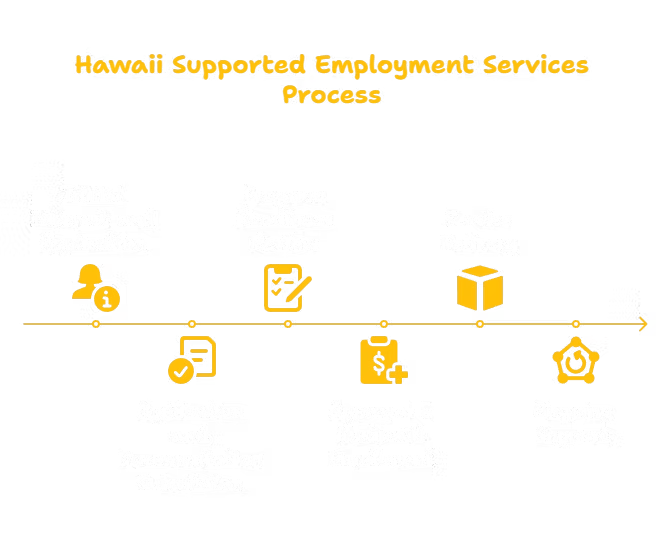
The enrollment journey is a multi-phased endeavor that requires significant attention to detail, specifically regarding documentation and internal program readiness. Initially, the applicant must signal intent by submitting the Provider Enrollment Application to Med-QUEST, clearly identifying Supported Employment as the intended service area. This triggers the formal review process by both DHS and DOH.
Following the initial application, the agency must provide extensive evidence of operational capacity. This includes submitting Articles of Incorporation, proof of valid insurance, and a detailed Policy & Procedure Manual. The state will conduct a program readiness review to assess staffing structures, documentation practices, and the ability to maintain compliance with billing codes. Once approved, the provider must configure their internal systems to align with Medicaid billing stages, such as discovery, intensive job coaching, and extended services.
What Documentation and Staffing Standards Are Required?
A compliant provider agency must maintain a rigorous internal documentation system. This includes maintaining up-to-date staff credentialing records, background screening clearances, and thorough participant vocational profiles. Policies must cover HIPAA confidentiality, grievance procedures, and specific protocols for employment crisis response. Because these services are Medicaid-funded, audit readiness is a continuous operational requirement.
Staffing qualifications ensure that participants receive professional support. While a Supported Employment Program Manager should ideally hold a bachelor’s degree in a relevant field like human services or vocational rehabilitation, Employment Specialists and Job Coaches are generally required to possess a high school diploma or GED, with specialized certifications (such as ACRE) preferred. Regardless of the role, all staff must participate in mandatory training sessions covering person-centered planning, disability awareness, workplace accommodation, and emergency response.
Frequently Asked Questions
What waivers in Hawaii cover Supported Employment?
Currently, the Developmental Disabilities/Intellectual Disabilities (DD/ID) Waiver is the primary program in Hawaii that authorizes Supported Employment Services. This waiver allows for discovery, job development, intensive coaching, and extended retention supports.
How long does the provider enrollment process typically take?
The process is divided into several phases: 1–2 weeks for business formation, 60–90 days for Med-QUEST/DDD application and review, 30–45 days for staff and program development, and 45–60 days for final billing system setup.
What core policies must be included in the Policy & Procedure Manual?
The manual must detail participant intake, vocational profiling, job development and placement procedures, on-site support protocols, HIPAA compliance, grievance handling, staff competency records, and Medicaid billing and audit readiness procedures.
Key Takeaways for Prospective Providers
Launching a Supported Employment agency in Hawaii requires a strategic approach that balances business registration with specialized HCBS compliance. By focusing on the rigorous documentation required by Med-QUEST and DOH, and investing in qualified staff trained in person-centered employment models, providers can successfully build sustainable programs that meet the vital needs of the disability community. Ensuring organizational readiness through established billing, insurance, and policy frameworks is the foundation for long-term participation in Hawaii’s Medicaid waiver system.
Last verified: 2024. Waiver Consulting Group (WCG) provides specialized consultation for disability service organizations navigating state-specific Medicaid HCBS regulations. This information is intended for educational purposes and should not be considered legal or financial advice; providers should verify all requirements directly with Hawaii DHS/Med-QUEST and DOH/DDD.