SUPPORTED EMPLOYMENT SERVICES PROVIDER IN GEORGIA
By Fatumata Kaba · 2025-07-14 · 5 min read
How Can My Organization Become a Supported Employment Services Provider in Georgia?
Becoming a Supported Employment Services provider in Georgia requires a rigorous commitment to helping individuals with disabilities achieve competitive, integrated employment. Authorized under Georgia’s Medicaid Home and Community-Based Services (HCBS) waiver programs and Vocational Rehabilitation (VR) systems, these services prioritize independence and community inclusion for participants in the New Options Waiver (NOW) and Comprehensive Supports Waiver Program (COMP).
To successfully operate, agencies must align their service delivery models with the regulatory frameworks of the Georgia Department of Behavioral Health and Developmental Disabilities (DBHDD) and the Georgia Department of Community Health (DCH). By facilitating vocational assessments, job development, and ongoing on-the-job coaching, providers play a vital role in transforming the lives of individuals with intellectual and developmental disabilities (IDD) across the state.
Which Agencies Govern Georgia Supported Employment Services?
The regulatory landscape for employment services is multifaceted, involving several state and federal entities that ensure quality, safety, and compliance. The Georgia Department of Behavioral Health and Developmental Disabilities (DBHDD) serves as the primary administrative agency for the NOW and COMP waivers, defining the standards for service delivery and provider expectations. Concurrently, the Georgia Department of Community Health (DCH) manages the fiscal and enrollment aspects of the Medicaid program, ensuring that providers are correctly credentialed for reimbursement.
Beyond the state level, the Georgia Vocational Rehabilitation Agency (GVRA) often works in tandem with waiver programs to provide specialized vocational training and placement supports. Finally, the Centers for Medicare & Medicaid Services (CMS) establishes federal guidelines that dictate person-centered planning and community integration requirements, ensuring that all services delivered under Medicaid are designed to uphold the autonomy and rights of every program participant.
- DBHDD: Oversees service authorization and standards for IDD waiver populations.
- DCH: Manages Medicaid enrollment, billing, and provider reimbursement.
- GVRA: Coordinates vocational training, pre-vocational services, and employment placement.
- CMS: Provides federal oversight to ensure compliance with HCBS community integration mandates.
What Are the Core Components of Supported Employment Services?
Supported Employment Services are designed to move beyond traditional training by focusing on the specific career goals and strengths of the individual. Approved providers are responsible for delivering a continuum of care that begins with career exploration and concludes with long-term employment retention. This process is deeply personalized, requiring providers to document every step within the participant's Individualized Service Plan (ISP) or Vocational Profile.
Essential services include active job development, which involves building relationships with local employers, and intensive job coaching to help the individual adapt to their new environment. Furthermore, providers are expected to teach soft skills—such as professional communication, problem-solving, and time management—that are crucial for maintaining long-term job security. When necessary, providers may also offer guidance on self-employment or small business start-ups, provided such support is approved within the participant's waiver authorization.
How Do Providers Navigate the Licensing and Enrollment Process?
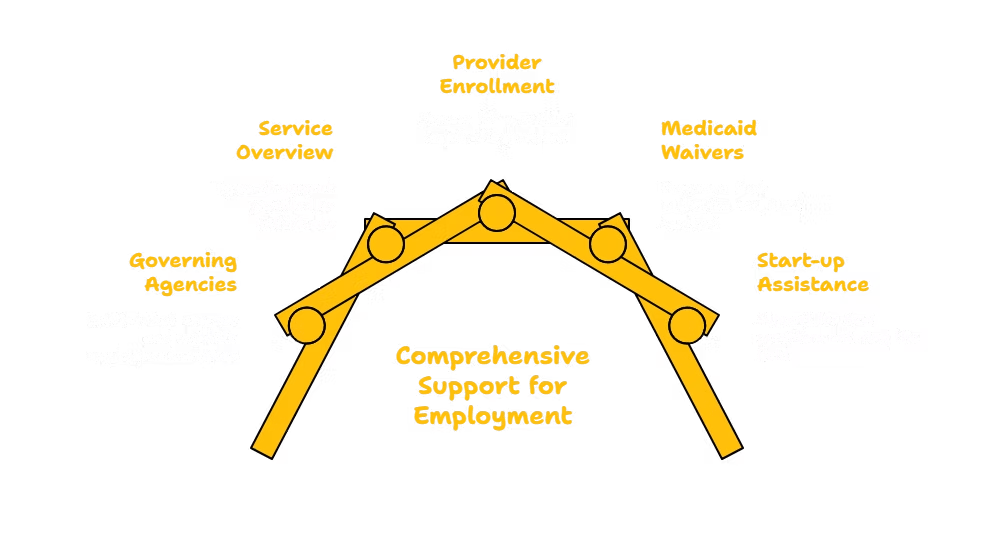
Securing status as an approved provider is a multi-phased project that requires careful attention to administrative detail. Before applying to DBHDD, agencies must first establish a legal foundation by registering with the Georgia Secretary of State, obtaining an Employer Identification Number (EIN) from the IRS, and securing a Type 2 NPI. These documents serve as the foundation for the subsequent Medicaid enrollment process through the Georgia Medicaid Management Information System (GAMMIS).
Once the legal framework is in place, the agency must initiate the DBHDD Provider Enrollment process. This involves submitting a formal Letter of Intent, followed by a comprehensive documentation package that includes organizational charts, staff credentialing files, and a robust policy and procedure manual. Following the documentation review, DBHDD will conduct a program readiness review to assess the agency's systems for billing, quality assurance, and participant safety.
What Are the Staffing and Training Requirements?
The efficacy of Supported Employment Services rests heavily on the qualifications and preparedness of the agency’s staff. At the leadership level, a Supported Employment Services Manager or supervisor is typically required to hold a Bachelor’s degree in a human services field and possess significant experience in vocational settings. This supervisor is responsible for overseeing the quality of services and ensuring that all Employment Specialists are meeting their performance benchmarks.
Direct service staff, or Job Coaches, are the frontline support for program participants. While a High School diploma or GED is the minimum education requirement, it is highly recommended that these professionals complete recognized certifications, such as those offered by the Association of Community Rehabilitation Educators (ACRE). All staff must undergo thorough background screenings and complete comprehensive training in person-centered planning, disability awareness, HIPAA compliance, and workplace safety protocols.
Frequently Asked Questions
What is the typical timeline to launch an agency?
The entire startup process generally spans several months. Business formation and initial setup typically take 1–2 weeks, followed by a 60–90 day window for the DBHDD application and readiness review. Staff hiring and development usually require 30–45 days, and the final steps for Medicaid enrollment and billing system configuration often take 45–60 days.
Are there specific insurance requirements for providers?
Yes, providers must maintain both general liability and professional liability insurance. These policies must be active and verifiable during the DBHDD provider enrollment and credentialing process to demonstrate the agency's capacity to mitigate operational and professional risks.
What documentation is required for initial DBHDD approval?
Applicants must provide proof of business registration, EIN/NPI documentation, and a detailed policy and procedure manual. This manual must cover participant intake, vocational assessment, job development protocols, HIPAA compliance, grievance procedures, and systems for tracking employment outcomes and Medicaid billing.
Key Takeaway
Successfully launching a Supported Employment Services agency in Georgia requires rigorous adherence to DBHDD and DCH guidelines, a commitment to person-centered service delivery, and the development of robust internal systems for billing and staff training. By meticulously managing the enrollment, credentialing, and compliance phases, providers can establish a sustainable operation that effectively empowers individuals with disabilities to secure and maintain competitive, meaningful employment in their communities.
Waiver Consulting Group (WCG) supports employment agencies, community service organizations, and rehabilitation providers in launching Medicaid-compliant Supported Employment Services under Georgia’s HCBS waiver programs. Our scope of work includes business registration, DBHDD provider enrollment, Medicaid billing setup, and the development of comprehensive Policy & Procedure manuals. Last verified on May 22, 2024. This information is for educational purposes only and does not constitute legal or financial advice.