SUPPORTED EMPLOYMENT SERVICES PROVIDER IN DELAWARE
By Fatumata Kaba · 2025-07-07 · 5 min read
Supported Employment Services in Delaware provide the essential framework for individuals with intellectual and developmental disabilities (IDD) to secure and maintain competitive, integrated employment. Authorized under the Delaware Lifespan Waiver and overseen by the Division of Developmental Disabilities Services (DDDS), these services are vital to the state's "Employment First" commitment, ensuring that community-based work is the priority option for all waiver participants.
For entrepreneurs and social service organizations, becoming an approved provider involves navigating a rigorous regulatory landscape. This guide details the administrative, clinical, and operational requirements necessary to launch a compliant agency that successfully facilitates career growth for Delaware’s disability community.
Understanding the Governing Agencies and Regulatory Framework
Operating a supported employment agency in Delaware requires engagement with a multi-tiered regulatory structure. The Division of Developmental Disabilities Services (DDDS) serves as the primary entity overseeing the Lifespan Waiver, ensuring that all service delivery models align with federal Home and Community-Based Services (HCBS) standards. DDDS is responsible for provider accountability and monitoring the employment outcomes of participants enrolled in their programs.
Beyond DDDS, the Division of Medicaid and Medical Assistance (DMMA) is the fiscal authority that funds and reimburses waiver-authorized employment services. Coordination is also often required with the Division of Vocational Rehabilitation (DVR), which frequently manages the initial phase of job placement before a participant transitions to long-term, waiver-funded follow-along supports. Finally, the Centers for Medicare & Medicaid Services (CMS) sets the overarching federal requirements that mandate person-centered planning and full community integration for all HCBS services.
Core Service Components and Delivery Models
Supported Employment Services are designed to be individualized, meeting the specific needs of each participant as outlined in their Individual Service Plan (ISP). Providers act as facilitators between the participant and the local labor market, offering both on-site job coaching and off-site professional development. The goal is to ensure that every participant receives the necessary training to build vocational skills while maintaining their job in an integrated environment.
Approved providers generally deliver a comprehensive suite of services, including:
- Conducting vocational assessments and developing long-term employment goals.
- Managing job development and securing matches with community-based employers.
- Providing interview preparation, application assistance, and job site advocacy.
- Delivering on-the-job coaching and systematic skills training.
- Offering ongoing follow-along support to ensure long-term retention.
- Coordinating travel training or supports to assist with work-related transportation needs.
- Maintaining meticulous documentation of work hours, employment milestones, and employer feedback.
Navigating the Provider Enrollment and Compliance Process
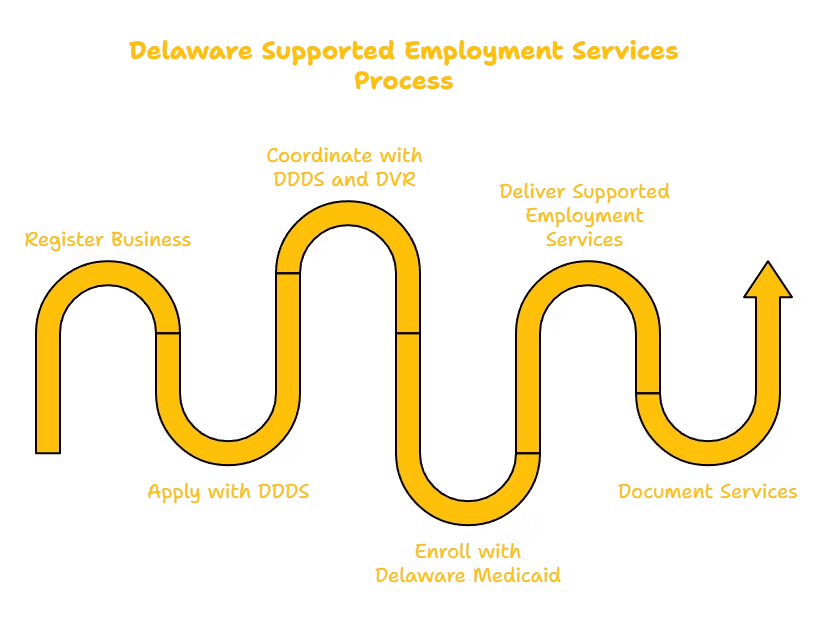
To officially operate as a Supported Employment provider, an organization must complete a multi-step registration process. The administrative journey begins with formal business registration through the Delaware Division of Corporations, followed by securing an Employer Identification Number (EIN) from the IRS and a Type 2 National Provider Identifier (NPI). These foundational credentials are required for any entity engaging in professional billing within the healthcare and human services sector.
Once the business structure is established, the provider must apply specifically through the DDDS Lifespan Waiver enrollment portal. This involves submitting detailed organizational capacity reports, staff training protocols, and service delivery models. If the provider intends to bill Medicaid directly, they must also complete the credentialing process through the Delaware Medicaid (DMAP) system. Throughout this phase, providers should maintain strong communication with DDDS support coordinators to ensure alignment with current referral needs.
Staffing, Training, and Quality Assurance Standards
High-quality employment support is entirely dependent on the competence of the staff. Agencies must employ qualified Job Coaches or Employment Specialists who possess the required education and experience to assist individuals with IDD in real-world workplace settings. These staff members must undergo background checks and maintain up-to-date CPR and First Aid certifications, ensuring they are prepared for the physical and environmental demands of the job site.
Supervisory personnel are equally critical, as they must provide consistent oversight of coaching activities and maintain professional relationships with local employers. All staff members must receive ongoing training in the following areas:
- Employment First principles and strict adherence to HCBS compliance.
- HIPAA-compliant data management and participant confidentiality protocols.
- Safety protocols specifically tailored to community-based job sites.
- Person-centered planning processes and alignment with the participant’s ISP.
- Standardized documentation practices and Medicaid billing requirements.
Documentation and Reporting Requirements
Operational success as a Medicaid-waiver provider is contingent upon strict documentation. Providers are expected to maintain comprehensive policy and procedure manuals that cover everything from vocational intake forms to incident reporting. When auditors or DDDS representatives review your operations, they will look for detailed service logs that clearly track the participant’s progress toward their specific employment goals.
Key records that must be maintained include:
- Articles of Incorporation and proof of business licensure.
- Staff credentialing files and records of completed job coach training.
- Vocational intake assessments and personalized service planning templates.
- Daily or weekly service logs and verifiable progress tracking forms.
- Established job site safety guidelines and incident reporting systems.
- Formal grievance policies and documentation of participant rights.
Frequently Asked Questions
What is the typical timeline to launch an agency?
The timeline varies based on organizational readiness, but generally, business formation takes 1–2 weeks, followed by a 30–60 day window for DDDS waiver enrollment. Hiring and training staff usually requires 2–4 weeks, while employer outreach and service development are considered ongoing processes throughout the life of the organization.
Can a provider receive funding from both DVR and DDDS?
Yes. Often, a participant will start with job placement and initial training funded by the Division of Vocational Rehabilitation (DVR). Once those initial goals are achieved, the funding and support services typically transition to the DDDS Lifespan Waiver for long-term "follow-along" services to ensure job retention.
Are there specific requirements for incident reporting?
Yes. All providers must have an established incident reporting system that documents any safety issues, injuries, or concerns at the job site. This is a critical component of state oversight and is necessary to maintain compliance with both DDDS and Medicaid quality assurance standards.
The launch of a Supported Employment agency requires careful coordination between state regulatory requirements and local business operations. By prioritizing robust staff training, meticulous documentation, and consistent communication with the DDDS and DVR, providers can play a pivotal role in fostering a more inclusive workforce in Delaware. Ensuring that every participant receives person-centered, high-quality job coaching remains the benchmark for success in this sector.
Last verified: 2024. The information provided in this article is for educational purposes and does not constitute legal or financial advice. Readers should consult the official websites of the Delaware Division of Developmental Disabilities Services (DDDS), the Division of Medicaid and Medical Assistance (DMMA), and the Division of Vocational Rehabilitation (DVR) for the most current regulatory requirements and enrollment guidelines.