SUPPORTED EMPLOYMENT SERVICES PROVIDER IN ALASKA
By Fatumata Kaba · 2025-07-03 · 5 min read
HELPING INDIVIDUALS WITH DISABILITIES ACHIEVE COMPETITIVE, INTEGRATED EMPLOYMENT THROUGH PERSON-CENTERED SUPPORTS
Supported Employment Services in Alaska provide essential pathways for individuals with intellectual and developmental disabilities (IDD) and other qualifying conditions to secure and maintain meaningful, competitive work within their communities. By operating under Alaska’s Home and Community-Based Services (HCBS) Medicaid Waiver programs, these services prioritize individual choice, vocational growth, and full workforce integration.
What Is the Role of Regulatory Agencies in Alaska Supported Employment?
The successful operation of a Supported Employment program in Alaska requires strict adherence to oversight from both state and federal authorities. The Alaska Department of Health’s Division of Senior and Disabilities Services (SDS) serves as the primary regulatory body responsible for approving providers, monitoring service delivery, and ensuring that all programs remain in full compliance with Employment First principles and HCBS standards. SDS also plays a critical role in verifying that the services provided effectively reduce reliance on segregated work environments.
At the administrative level, Alaska Medicaid manages the complexities of provider enrollment and the reimbursement structure for employment-related services. Concurrently, the federal Centers for Medicare & Medicaid Services (CMS) provides the overarching regulatory framework, ensuring that Alaska’s Medicaid waiver programs align with national mandates for community integration. Providers must remain constantly aware of the expectations set by these agencies to maintain their eligibility for program funding and service authorization.
How Do Providers Deliver Individualized Supported Employment Services?
Supported Employment Services are defined by their person-centered nature, meaning every intervention must be aligned with the individual’s specific career goals, strengths, and personal preferences. Rather than a one-size-fits-all model, providers must craft individualized plans that help participants navigate the transition from initial vocational interest to long-term job retention.
Approved providers generally deliver a comprehensive suite of supports, which may include the following:
- Job exploration and formal vocational assessments to identify career pathways.
- Resume development, interview coaching, and soft-skills training.
- Proactive employer outreach and customized job development.
- On-the-job training and persistent job coaching to ensure workplace success.
- Follow-along supports for long-term job retention and career advancement.
- Coordination of transportation and the identification of necessary workplace accommodations.
- Benefits counseling in collaboration with certified work incentive specialists to ensure employment does not negatively impact other essential supports.
What Are the Prerequisites for Provider Approval in Alaska?
Before initiating the SDS enrollment process, a prospective provider must establish a solid business foundation that meets Alaska’s state-level requirements. This begins with registering the business entity through the Alaska Division of Corporations, Business and Professional Licensing. Once the entity is legally formed, the provider must secure a federal Employer Identification Number (EIN) and a Type 2 National Provider Identifier (NPI) specifically for organizational billing purposes.
Beyond basic business registration, providers must demonstrate operational readiness. This involves maintaining a physical or administrative office within the state of Alaska and ensuring that all staff are sufficiently trained in person-centered planning and supported employment best practices. A critical component of this phase is establishing internal systems for clinical documentation, secure employer communication, and performance tracking. Furthermore, providers must secure the appropriate general liability and professional insurance coverage to mitigate operational risks and fulfill contract requirements.
How Does the SDS Provider Enrollment Process Work?
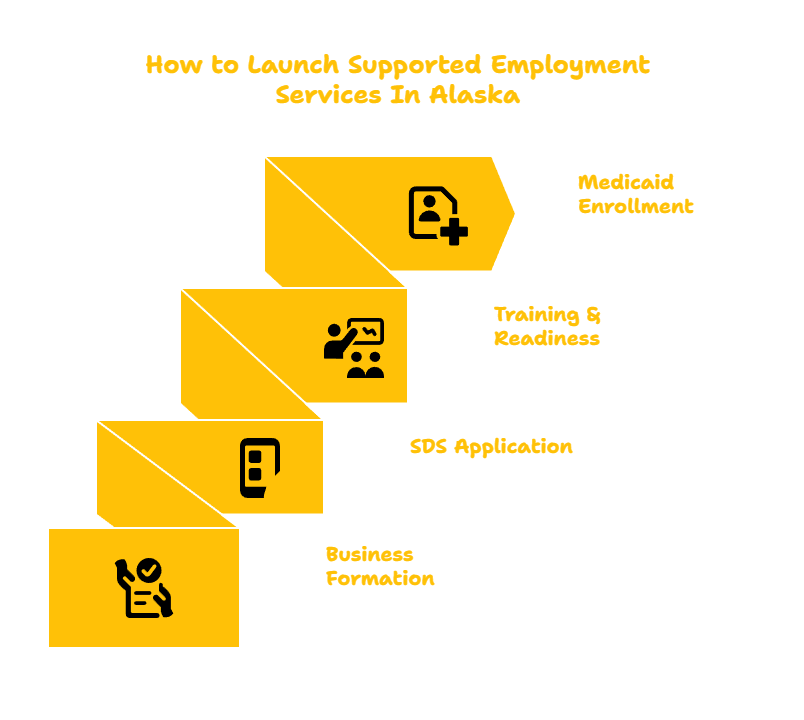
The transition from a business concept to an approved Medicaid provider follows a structured, multi-phase application process managed by SDS. The journey begins by requesting the Supported Employment Services Provider Application Packet from SDS and attending the recommended orientation sessions to understand the specific nuances of employment service delivery in Alaska.
The application requires extensive documentation, including a detailed service delivery plan that outlines the methodologies for job development, coaching, and long-term retention. Applicants must also submit templates for vocational assessments and progress tracking to demonstrate their ability to provide high-quality, measurable support. Once submitted, SDS conducts a readiness review. This review evaluates the provider's staff credentials, background check protocols, and their demonstrated ability to collaborate with external entities like vocational rehabilitation (VR) agencies. Upon final SDS approval, the provider must complete the Medicaid enrollment process through the Alaska MMIS (Conduent) to activate billing codes and establish a formal agreement for reimbursement.
What Are the Essential Staffing and Training Standards?
The quality of a supported employment program is largely dependent on the competency of its staff. The Employment Services Coordinator or Program Supervisor is expected to have documented experience in vocational rehabilitation or workforce development. Meanwhile, Job Coaches and Employment Specialists are required to possess at least a high school diploma or GED, with a bachelor’s degree often preferred to ensure high-quality service delivery. All staff must undergo thorough background checks prior to working with participants.
All personnel are mandated to complete specific training modules to ensure they can deliver services in line with state expectations. Required areas of focus include:
- SDS-specific orientation and supported employment best practices.
- Detailed training on person-centered planning and documentation compliance.
- Workplace accommodation strategies and employer engagement techniques.
- Annual education regarding ethics, patient confidentiality, and the complexities of Medicaid billing compliance.
Frequently Asked Questions
Which Medicaid Waivers cover Supported Employment in Alaska?
Supported Employment Services are authorized under the Individuals with Intellectual and Developmental Disabilities (IDD) Waiver, the Adults with Physical and Developmental Disabilities (APDD) Waiver, and, for transition-aged youth where appropriate, the Children with Complex Medical Conditions (CCMC) Waiver.
What is the typical timeline to launch a provider agency?
The process is multi-phased and generally requires 6 to 9 months. Business formation and staffing take 1–2 weeks, the SDS application and document review process typically lasts 60–90 days, program readiness training requires 30–45 days, and final Medicaid enrollment and MMIS setup can take another 45–60 days.
What should be included in the Policy & Procedure Manual?
The manual must detail intake and person-centered planning protocols, workflows for job development and placement, guidelines for employer communication, incident response procedures, participant rights, and comprehensive staff training and monitoring systems.
Key Takeaway: Establishing a Supported Employment agency in Alaska is a rigorous, highly regulated process that demands strict adherence to SDS and Medicaid standards. Success depends on the provider’s ability to combine professional business infrastructure with a deeply personalized approach to vocational support, ensuring that every participant receives high-quality, integrated employment services.
Last verified: September 2023. Disclaimer: This document is for informational purposes only and does not constitute legal or professional advice. Always verify current requirements directly with the Alaska Department of Health and the Centers for Medicare & Medicaid Services (CMS) before beginning the provider enrollment process.