SUPPORT BROKER SERVICES PROVIDER IN MISSOURI
By Fatumata Kaba · 2025-08-07 · 5 min read
Support Broker Services in Missouri are specialized professional supports designed to empower individuals with disabilities and their families to navigate the complexities of self-directed Home and Community-Based Services (HCBS) waivers. By acting as a guide, resource coordinator, and advocate, a Support Broker helps participants develop person-centered plans, manage individualized budgets, and ensure that their care aligns with their unique needs and long-term goals.
For entrepreneurs and organizations looking to enter this vital healthcare sector, understanding the regulatory landscape and operational requirements is the first step toward building a compliant and effective service agency. This article provides a comprehensive overview of the administrative, clinical, and logistical requirements for establishing and operating a Support Brokerage in the state of Missouri.
Understanding the Governing Framework and Agency Oversight
The Missouri HCBS landscape is built upon a multi-layered regulatory structure that ensures the safety, rights, and autonomy of waiver participants. Organizations offering Support Broker services must operate within the guidelines set forth by state and federal authorities to maintain active provider status and eligibility for Medicaid reimbursement.
The Missouri Department of Health and Senior Services (DHSS) serves as the primary entity for administering the various HCBS waiver programs that utilize support brokerage. Concurrently, the Missouri Department of Social Services (DSS) manages the critical components of Medicaid provider enrollment and the authorization of services. Finally, the Centers for Medicare & Medicaid Services (CMS) provides federal oversight, ensuring that Missouri’s waiver programs remain in compliance with national standards for person-centered care and fiscal responsibility.
- Missouri Department of Health and Senior Services (DHSS): Responsible for the administration of Medicaid and HCBS waiver programs, including the design and oversight of support broker service standards.
- Missouri Department of Social Services (DSS): Oversees the technical aspects of Medicaid provider enrollment, claims processing, and the formal authorization of service delivery.
- Centers for Medicare & Medicaid Services (CMS): Provides federal oversight to ensure state programs adhere to federal waiver requirements and quality assurance benchmarks.
Core Functions and Scope of Support Broker Services
Support Brokerage is fundamentally about facilitating choice and control. Unlike traditional agency-managed care, self-directed programs allow participants to direct their own services, and the Support Broker acts as the primary facilitator in this process. Their role is to provide the participant with the necessary tools and information to manage their own staff, budget, and service goals effectively.
The scope of services is highly customized to the Individual Service Plan (ISP) or Person-Centered Plan (PCP). Beyond simple coordination, the broker must assist the participant in developing robust self-directed care plans that reflect their personal preferences. This involves ongoing monitoring of service utilization, advocacy for the participant's rights, and regular adjustments to the plan as the individual's needs evolve or life circumstances change.
Establishing Your Agency: Licensing and Enrollment Prerequisites
To operate as a formal provider of Support Broker Services, an agency must undergo a structured business formation and enrollment process. This begins with standard business registration through the Missouri Secretary of State, followed by obtaining a federal Employer Identification Number (EIN) and a Type 2 National Provider Identifier (NPI) for organizational billing.
Once the legal entity is formed, the agency must initiate the Medicaid provider enrollment process with the Missouri Department of Social Services. This process confirms that the agency meets the state’s rigorous standards for service delivery. Compliance is not a one-time event; providers must maintain current liability insurance, ensure all staff meet qualification standards, and possess valid certification where specifically required by the relevant waiver program.
The Medicaid Provider Enrollment Roadmap
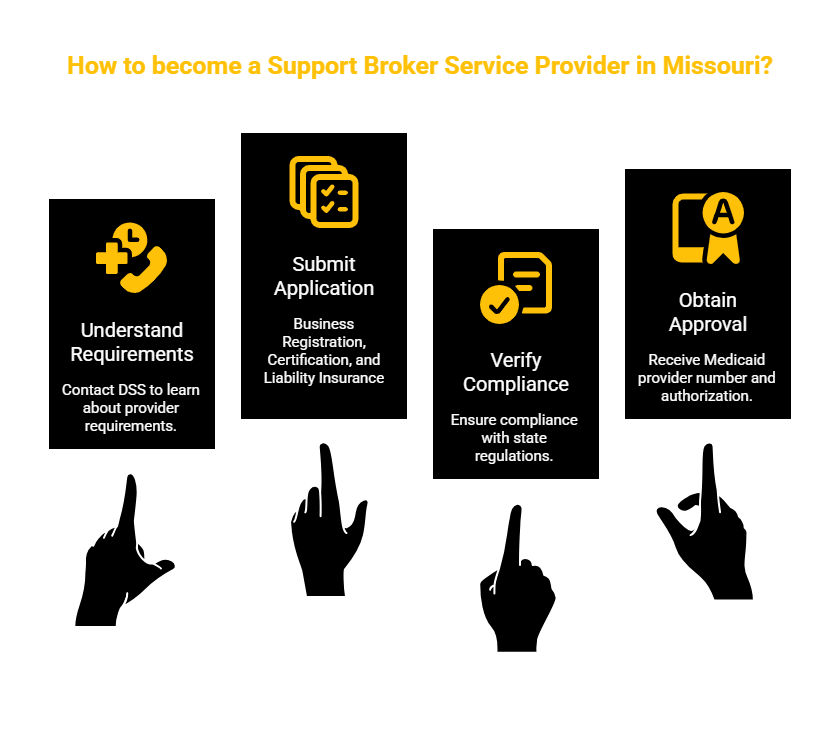
The path to becoming an approved provider requires meticulous attention to administrative detail and adherence to the state’s specified timeline. The process typically begins with a pre-application contact with the Department of Social Services to verify the current specific requirements for Support Broker providers. This preliminary engagement prevents unnecessary delays and ensures that the applicant understands the scope of services they are authorized to deliver.
Following the initial contact, the agency must submit a comprehensive application package. This includes business registration documents, evidence of professional liability insurance, staff credentials, and detailed descriptions of the proposed services. Upon successful verification of these documents and compliance with state requirements, the agency will receive a formal Medicaid provider number, officially authorizing them to begin billing for services rendered under eligible waivers.
Staffing, Training, and Documentation Requirements
The quality of a Support Brokerage depends heavily on the caliber of its staff. The Support Broker Program Manager typically oversees all operational compliance and case management activities, requiring significant experience in disability services or self-directed care. The Support Broker Specialists, who work directly with participants, must meet baseline requirements, including a high school diploma, background checks, and clearance for tuberculosis (TB) testing.
Comprehensive training is mandatory to ensure all staff operate within the principles of person-centered planning. This includes formal instruction on budget management, financial accountability, and the protection of client rights. Furthermore, robust documentation practices—including maintaining detailed records of client interactions, service utilization, and adjustments to care plans—are essential for maintaining compliance during state audits.
Frequently Asked Questions
What types of Missouri HCBS waivers include support broker services?
Support broker services are generally accessible through the Aged and Disabled Waiver (ADW), the Independent Living Waiver, and the Medically Fragile Adult Waiver, depending on the specific needs of the participant and their enrollment in self-directed program models.
What is the typical timeline to launch a new provider agency?
The timeline varies by agency readiness, but the total process generally ranges from 4 to 6 months. This includes 1–2 weeks for business formation, 60–90 days for Medicaid provider enrollment, 30–45 days for staffing, and 2–4 weeks for initial client onboarding.
What documentation is essential for a Medicaid audit?
Providers must maintain organized records including Articles of Incorporation, NPI confirmation, current liability insurance, and a comprehensive policy and procedure manual. This manual must detail client intake protocols, budget management, staff training logs, and evidence of ongoing service monitoring.
Key Takeaways for Prospective Providers
Entering the Missouri Support Brokerage market requires a commitment to both administrative excellence and a person-centered care philosophy. By aligning your business formation with the regulatory requirements of the DHSS and DSS, maintaining rigorous training and documentation standards, and focusing on the specific needs of individuals in self-directed waiver programs, you can establish a sustainable and impactful organization. Success in this field relies on understanding the nuances of the Medicaid system and ensuring that every staff interaction reinforces the autonomy and quality of life of the individuals you serve.
Last verified: May 2024. This information is for educational purposes only and does not constitute legal or professional advice. Always verify current state regulations and policy updates directly with the Missouri Department of Health and Senior Services and the Missouri Department of Social Services before making business decisions.