Starting Non-Medical Home Care in Idaho: What to Set Up First
By Fatumata Kaba · 2026-07-07 · 5 min read
Launching a non-medical home care agency in Idaho is a strategic opportunity for providers, as the state does not mandate a specific license for non-medical personal care services. However, success requires navigating a clear path between regulatory compliance, business entity formation, and the specific requirements for Medicaid reimbursement eligibility.
To begin, entrepreneurs must distinguish between "non-medical" companionship and "skilled" healthcare, formalize their business structure, and establish a robust administrative foundation. This guide outlines the essential steps to prepare your Idaho home care agency for operational readiness and long-term sustainability within the home and community-based services (HCBS) landscape.
Distinguishing Non-Medical vs. Skilled Home Care Services
The first critical decision for any Idaho home care founder is defining the scope of service. In Idaho, non-medical personal care includes assistance with activities of daily living (ADLs), instrumental activities of daily living (IADLs), companionship, and basic homemaking tasks. Because these tasks do not involve clinical intervention, they do not require a state-issued license. This lowers the barrier to entry, allowing agencies to focus on operational efficiency and client recruitment immediately upon formation.
Conversely, if your business model includes "skilled" services—such as nursing, physical therapy, occupational therapy, or speech therapy—the regulatory burden changes significantly. These activities fall under the purview of the Idaho Department of Health and Welfare, which requires agencies to obtain a Home Health Agency license. Operating without this license while performing skilled tasks is a violation of state law. Defining your scope early prevents future regulatory friction.
Establishing Your Legal and Administrative Foundation
Before you can begin operations or accept your first client, you must formalize your business entity with the Idaho Secretary of State. This process involves filing the necessary formation documents, choosing a business structure, and obtaining an Employer Identification Number (EIN) from the IRS. A legally registered entity is the prerequisite for all subsequent steps, including insurance procurement and Medicaid provider enrollment.
Beyond the legal entity, you must develop a comprehensive policy and procedure manual. Even without a non-medical license, you must be able to demonstrate to payers—and eventually, to state surveyors—that your agency maintains high standards of care, background check compliance for employees, and clear documentation practices. Being prepared for documentation audits from day one is the hallmark of a professional, sustainable agency.
Managing Liability and Risk Mitigation
While Idaho does not license non-medical agencies, it does not absolve providers of the professional and legal risks inherent in healthcare services. Carrying professional and general liability insurance is an essential requirement for any agency providing care in a private home setting. These policies protect the agency, its staff, and the clients from unexpected accidents, property damage, or claims of negligence.
Risk management goes beyond insurance policies. It involves implementing rigorous onboarding protocols, such as:
- Performing comprehensive criminal background checks on all caregivers.
- Establishing clear job descriptions and supervisory roles for staff.
- Maintaining secure, HIPAA-compliant storage for client records and personal health information.
- Ensuring that all staff members are properly trained on emergency protocols, even for non-medical tasks.
Navigating Medicaid Personal Care Services Enrollment
Many home care agencies in Idaho look to Medicaid Personal Care Services (PCS) as a primary revenue stream. It is important to understand that enrolling as a Medicaid provider is a distinct, separate process from forming your business. The Bureau of Long Term Care oversees these programs, and you must satisfy specific state requirements to become a qualified, billable provider within the Idaho Medicaid network.
The enrollment process typically requires verifying that your staff meet training or certification requirements mandated for Medicaid-funded personal care assistants. Because the Bureau of Long Term Care sets specific standards for the quality and reporting of these services, you should consult the current provider manual and state guidelines early in your setup process. Proper enrollment allows you to bill Medicaid directly for approved services provided to eligible participants under the state’s HCBS waivers.
Operationalizing Your Billing and Documentation Systems
Administrative readiness is just as important as clinical or care-based readiness. To bill for services successfully, your agency must implement an electronic visit verification (EVV) system if required, alongside a robust billing platform. This ensures that the hours recorded by caregivers in the field correspond precisely to the billing claims submitted to the Idaho Medicaid program.
Documentation is the evidence of your services. In the event of a state audit or a claim review, your agency must produce documentation that clearly validates the services provided, the time spent on those tasks, and the specific client needs met during those hours. Without accurate, timely documentation, agencies risk claim denials and recoupments, which can threaten the financial health of the business.
Frequently Asked Questions
Does Idaho require a license for companion care?
No, Idaho does not require a specific state license for non-medical personal care, companionship, or homemaking services. However, you must still legally register your business, maintain proper insurance, and adhere to state employment laws.
When is a Home Health Agency license required?
A Home Health Agency license from the Idaho Department of Health and Welfare is required if you intend to offer skilled services such as nursing, physical therapy, occupational therapy, or speech therapy. If you only provide non-medical, daily-living assistance, this license is not required.
Is Medicaid enrollment automatic once I register my business?
No, enrolling with the Idaho Medicaid program is a separate administrative process managed by the Bureau of Long Term Care. You must meet specific provider qualifications, training standards, and documentation requirements to be eligible to bill for services under Idaho Medicaid programs.
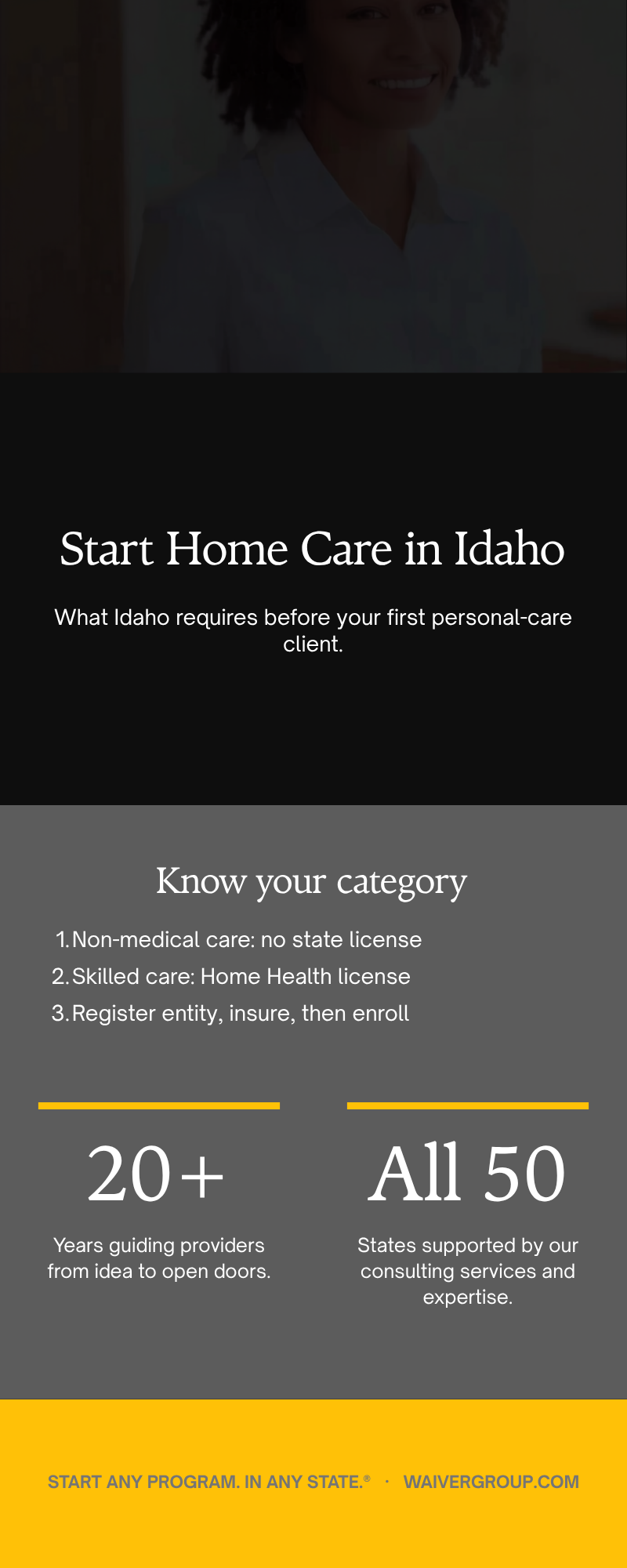
Key takeaway: Non-medical care needs no Idaho license, skilled care needs a Home Health license, and you still register your entity, insure, and enroll to bill Medicaid. Start Any Program. In Any State.® Ready to launch home care in Idaho? Book a video consultation at waivergroup.com/videoappointment, call 302.888.9172, or email [email protected].
Last verified: 05/22/2024. This content is for informational purposes only and does not constitute legal or professional advice. Requirements for Medicaid and state-regulated healthcare programs are subject to change. Always consult with state agencies or professional legal counsel before making business decisions. Waiver Consulting Group assumes no liability for the accuracy or completeness of this information.