Starting an NEMT Company in Massachusetts: How the Broker System Works
By Fatumata Kaba · 2026-07-08 · 5 min read
Starting a non-emergency medical transportation (NEMT) company in Massachusetts requires navigating a structured, broker-managed system overseen by the Human Service Transportation (HST) Office. Success in this market depends on understanding the regional brokerage model, maintaining rigorous compliance standards, and establishing formal contractual relationships with the transit authorities that coordinate care-related travel for MassHealth members.
How Does the Broker-Managed NEMT System Function in Massachusetts?
In Massachusetts, the delivery of NEMT services is not handled through a direct, open-market relationship between individual transportation providers and the MassHealth program. Instead, the Commonwealth utilizes a regional broker model to manage the logistics of member transportation. This system is centralized under the Human Service Transportation (HST) Office, which sits within the Executive Office of Health and Human Services.
The HST Office mandates that all NEMT trips be coordinated through designated regional transit authority brokers. These entities act as the primary gatekeepers for trip assignments. A transportation provider cannot simply solicit rides directly from medical facilities or MassHealth members; they must instead interface with the specific broker assigned to the geographic territory where they intend to operate. These brokers, such as MART or GATRA, handle trip scheduling, eligibility verification, and payment processing, ensuring that services remain consistent and compliant with state requirements.
Geographic Considerations and Choosing Your Service Area
Before launching your company, you must determine your operational footprint. Because Massachusetts utilizes regional brokers, your business model will be heavily influenced by the specific rules and capacity needs of the broker operating in your intended city or county. Researching which broker manages your target area is a foundational step in your business plan.
Some brokers may have a surplus of providers in certain zones while maintaining an urgent need for more capacity in others. Aligning your service area with these needs can expedite the onboarding process. New operators often find it most effective to focus on a single service region initially, mastering the protocols of that specific broker before attempting to expand into jurisdictions governed by other transit authorities.
Ensuring Regulatory Compliance Before Contracting
The barrier to entry for NEMT providers in Massachusetts is high, largely due to the focus on member safety and service reliability. Before a broker will even consider a contract, your business must demonstrate that it meets strict operational standards. This phase involves significant administrative preparation and investment in infrastructure.
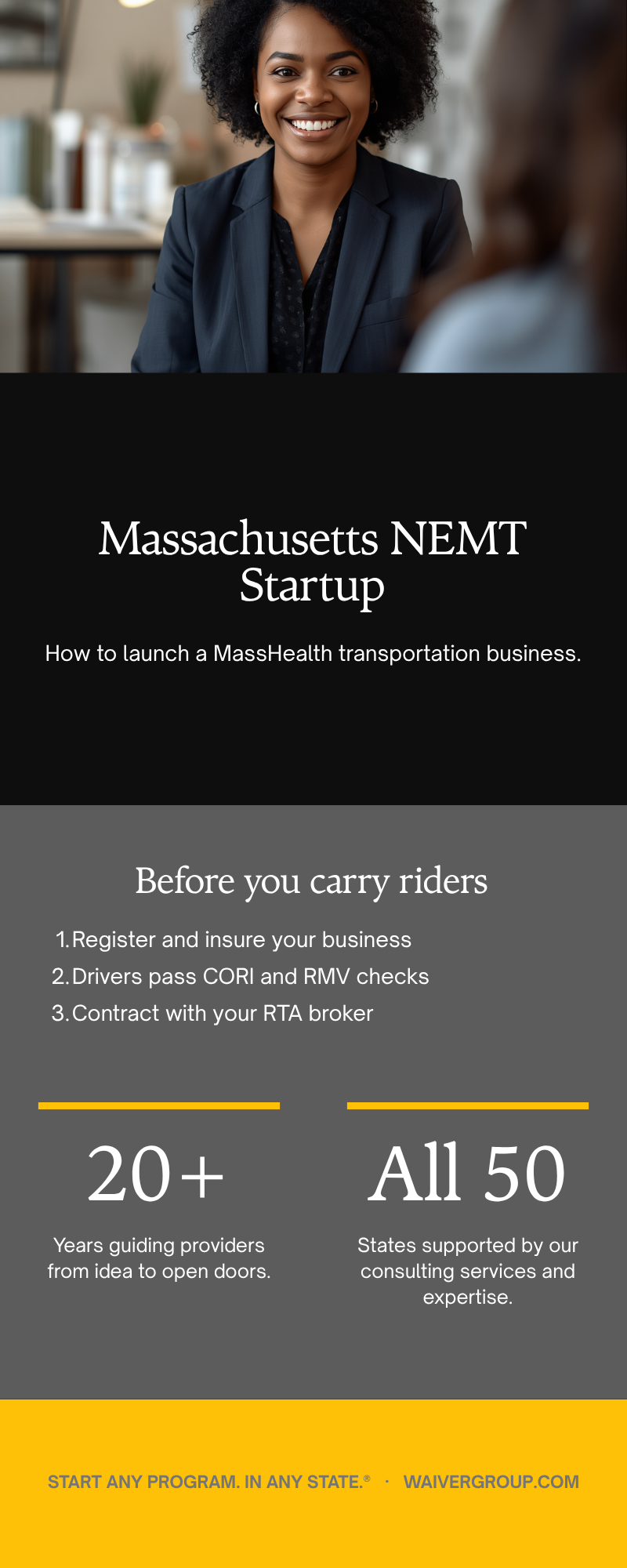
Compliance begins with the legal and financial foundation of the company. You must register your business entity with the Commonwealth and maintain active, professional-grade commercial auto and general liability insurance. Because these vehicles serve vulnerable populations, insurance requirements are generally more stringent than those for standard taxi or ride-share operations.
- Register your business with the Secretary of the Commonwealth.
- Obtain adequate commercial auto and general liability insurance policies.
- Establish a formal office or dispatch center capable of communicating with brokers.
- Implement a vehicle maintenance program to ensure all units pass mandatory inspections.
The Role of Vehicle and Driver Qualifications
Vehicle standards and driver vetting processes are the most critical components of your regulatory compliance profile. The HST Office and regional brokers demand that both your fleet and your personnel meet specific safety benchmarks that are reviewed on a recurring basis. Neglecting these standards can lead to immediate contract termination.
Drivers must pass thorough criminal history and record reviews. This includes completing Criminal Offender Record Information (CORI) background checks and Registry of Motor Vehicles (RMV) record reviews. These checks are not a one-time onboarding requirement; they must be repeated on an annual basis to ensure ongoing eligibility. Similarly, your fleet is subject to strict performance standards, requiring at least annual vehicle inspections to confirm that all safety equipment, accessibility features, and communication tools are fully operational.
Securing Your First Contract with a Regional Broker
Once your business is fully compliant—meaning your insurance is bound, your vehicles are inspected, and your drivers have cleared their background checks—you are ready to approach the regional broker. The contracting process involves demonstrating that your agency is "broker-ready" and can fulfill trip requests in accordance with the service level agreements established by the HST Office.
Depending on the specific population you intend to serve and your chosen enrollment path, you may also be required to enroll directly as a provider with MassHealth. This dual-track process ensures that you are both a contracted transportation vendor for the broker and a recognized entity within the state's medical reimbursement system. Many successful operators begin with a small fleet, scaling their operations only after they have successfully navigated the billing and dispatch protocols of their primary broker.
Frequently Asked Questions
Do I need to contract with MassHealth directly or just the broker?
While the regional brokers manage the actual trip scheduling and logistics, depending on the population served and your specific enrollment pathway, you may also be required to enroll as a provider directly with MassHealth to facilitate proper reimbursement and program participation.
How often must my drivers undergo background checks?
Under the requirements set by the HST Office, drivers must clear CORI criminal background checks and RMV record reviews. These specific safety checks must be repeated on an annual basis for every driver employed by your company.
Can I operate in multiple regions within Massachusetts?
Yes, you can operate across different broker service areas. However, keep in mind that each regional transit authority broker may have specific operational procedures and documentation requirements. It is generally advised to ensure total compliance in your primary region before expanding to additional broker jurisdictions.
Key Takeaway
Starting an NEMT company in Massachusetts requires a disciplined approach: register and insure your business, ensure all vehicles pass required inspections, and maintain rigorous, ongoing compliance for your drivers through yearly CORI and RMV checks. Once these foundational requirements are met, you must engage with the regional transit authority broker serving your target area to finalize contracts and begin receiving trip assignments.
Last verified: 2024. The information provided in this article is for educational purposes only and does not constitute legal or professional advice. Requirements for MassHealth and HST Office compliance may change; always refer to the official Massachusetts Human Service Transportation Office guidelines for the most current regulations and program updates.