Starting a Medicaid NEMT Business? Plan for These Three Pillars First
By Fatumata Kaba · 2026-06-26 · 5 min read
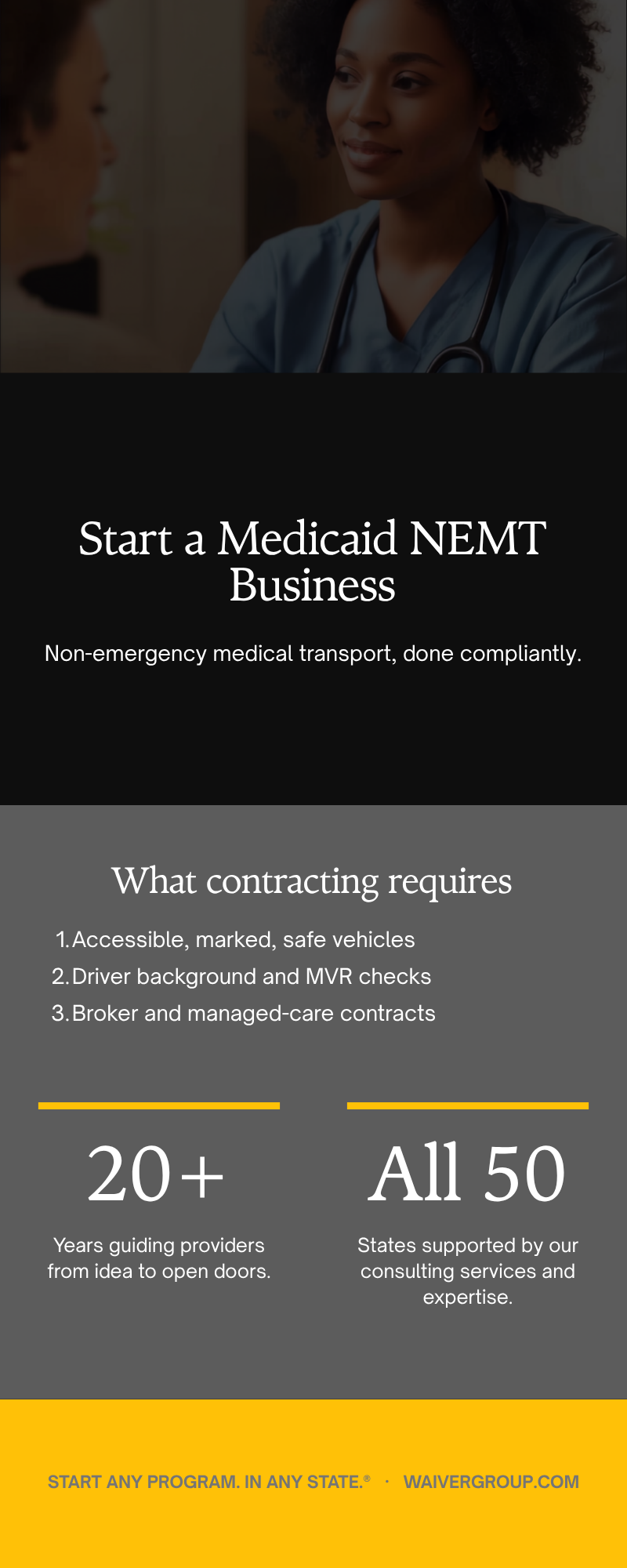
Starting a non-emergency medical transportation (NEMT) business requires navigating a complex landscape of state-specific healthcare regulations, safety mandates, and logistical requirements. Success in this sector hinges on establishing a foundation built upon three essential pillars: fully compliant vehicles, rigorously vetted drivers, and strategic partnerships with managed care organizations and brokers.
Why the Medicaid NEMT sector requires a structured approach
The demand for reliable NEMT services is driven by the growing need for Medicaid beneficiaries to access essential care, ranging from dialysis and physical therapy to routine checkups. Unlike standard taxi or rideshare operations, Medicaid NEMT is a healthcare-adjacent service subject to federal and state oversight. Providers must demonstrate that they operate with the same level of care and regulatory adherence expected of clinical providers.
Entering the market without a comprehensive operational strategy often leads to failed credentialing or retroactive audits. By prioritizing compliance in vehicle maintenance, driver certification, and contract management, new agency founders can establish a reputation for reliability, which is the most critical asset for securing long-term contracts with state-funded programs and private brokerage entities.
Pillar 1: Establishing and maintaining compliant vehicles
Vehicle compliance is the first point of inspection for any state agency or managed care organization (MCO). Regulators demand that vehicles used for Medicaid transport meet specific accessibility and safety standards, which often exceed those required for a standard commercial driver’s license or personal insurance policy. Compliance begins with the selection of the correct vehicle type, such as wheelchair-accessible vans equipped with industry-standard lifts or ramps, and extends to mandatory safety equipment.
Maintaining compliance is an ongoing task rather than a one-time setup. Agencies must implement a rigorous documentation system that tracks every vehicle. This includes keeping up-to-date insurance certificates, proof of comprehensive commercial auto coverage, and detailed inspection logs that verify the functionality of lifts, restraints, and emergency medical equipment. Establishing these protocols early ensures that the business is prepared for the inevitable audits conducted by oversight bodies.
- Maintain a centralized digital fleet maintenance log to track oil changes, tire safety, and brake inspections.
- Install required safety features including fire extinguishers, first-aid kits, and securement systems that meet ADA accessibility standards.
- Ensure all vehicles display required signage and possess valid state-issued transportation permits.
Pillar 2: Vetting and qualifying professional drivers
The human element of an NEMT business is the most significant area of liability and regulatory focus. Because drivers interact directly with vulnerable populations—including the elderly, individuals with disabilities, and those with chronic health conditions—states and brokers enforce strict background requirements. A driver’s record is a reflection of the agency’s commitment to patient safety and service quality.
Beyond the standard motor vehicle record (MVR) pull and federal/state background checks, agencies must ensure their staff possesses specific credentials. These usually include current CPR and first-aid certification, as well as specialized passenger assistance training. This training ensures that drivers know how to safely assist individuals with mobility aids and how to handle potential medical emergencies during transport. Relying on untrained or improperly vetted personnel is the fastest way to lose a contract and damage professional standing with state programs.
Pillar 3: Navigating broker and managed-care contracts
In the vast majority of jurisdictions, Medicaid NEMT is managed through a tiered system. Instead of contracting directly with the state’s Medicaid office, providers typically contract with transportation brokers or MCOs. These entities are responsible for coordinating trips, verifying eligibility, and processing reimbursements. Treat each broker and MCO as a distinct client with its own unique set of requirements and credentialing portals.
Securing these contracts requires a meticulous approach to the credentialing process. Each entity will demand proof of insurance, detailed driver files, and verified vehicle safety reports before they will grant an agency active status. Because requirements vary significantly from one broker to another, providers must establish a standardized internal system for organizing and submitting these documents. Failure to follow the specific instructions of a broker’s credentialing portal can result in long delays or a total rejection of the application.
Streamlining operations for long-term viability
Once the three pillars of vehicles, drivers, and contracts are firmly established, the focus must shift to operational efficiency and consistency. Scaling an NEMT business requires the use of dispatch software that can communicate effectively with broker portals to minimize trip cancellations and maximize on-time performance. Providers that can prove consistent, reliable, and compliant service often find themselves prioritized by brokers during high-demand periods.
Founders should treat compliance reporting as a daily operational task rather than an annual project. By maintaining clean, up-to-date files on every driver and vehicle, an agency is always audit-ready. This approach not only prevents regulatory fines but also provides the professional transparency necessary to scale across new territories or secure high-volume contracts with regional managed care plans.
Frequently asked questions
What specific certifications do my drivers need to start working?
Most state programs and brokers require drivers to hold current, valid CPR and first-aid certifications from recognized providers. Additionally, drivers must complete specific passenger assistance training (PAT) which covers the safe handling of wheelchairs, walkers, and other mobility equipment, as well as sensitivity training for interacting with vulnerable patient populations.
Do I need to sign contracts with the state or with brokers?
In most instances, you will contract with third-party transportation brokers or individual managed care organizations (MCOs) that have been delegated the authority to manage the Medicaid transportation benefit for the state. While you must adhere to state laws, your active operational contract and reimbursement payments are typically handled through these brokers.
What is the most common reason for a failed credentialing application?
The most common cause for delay or rejection during the credentialing process is incomplete documentation. Brokers have stringent requirements regarding insurance limits, background check timelines, and vehicle inspection reports. If a single document is expired, missing, or does not meet the specific state-mandated format, the entire credentialing file is often paused until the discrepancy is resolved.
Key takeaway: A Medicaid NEMT business stands on three pillars — compliant vehicles, qualified drivers, and broker and managed-care contracts. Build all three in from the start.
Start Any Program. In Any State.®
Ready to talk it through? 20+ years clearing the path in all 50 states — we've done this before, and we'll do it for you. Book a video consultation at waivergroup.com/videoappointment, call 302.888.9172, or email [email protected].
Last verified: October 2023. Disclaimer: This information is for educational purposes only and does not constitute legal or professional advice. Always consult with state-specific Medicaid manuals and legal counsel regarding your unique business requirements and local statutes.