SPECIALIZED THERAPIES SERVICES PROVIDER IN SOUTH CAROLINA
By Fatumata Kaba · 2025-10-13 · 6 min read
Delivering customized therapeutic interventions—including physical, occupational, and speech-language therapies—is essential for promoting function, communication, and quality of life for South Carolina Medicaid beneficiaries across the lifespan. Specialized therapy providers in South Carolina must navigate a complex regulatory landscape overseen by the South Carolina Department of Health and Human Services (SCDHHS), the Department of Health and Environmental Control (DHEC), and the Department of Disabilities and Special Needs (DDSN) to ensure compliant service delivery under Medicaid State Plan benefits and Home and Community-Based Services (HCBS) Waiver programs.
What is the Regulatory Landscape for South Carolina Specialized Therapies?
The provision of specialized therapies is governed by both state and federal oversight, requiring providers to maintain rigorous compliance with administrative and clinical standards. The South Carolina Department of Health and Human Services (SCDHHS) serves as the primary entity managing Medicaid reimbursement and service authorizations, ensuring that all clinical activities align with approved waiver and state plan definitions. Providers must adhere to federal guidelines established by the Centers for Medicare & Medicaid Services (CMS), which dictate the scope and necessity of reimbursable services.
In addition to financial oversight, operational safety is maintained by the South Carolina Department of Health and Environmental Control (DHEC), which regulates licensed therapy practices and facility licensure for outpatient settings. Furthermore, for services provided under the ID/RD, HASCI, and CS Waivers, the South Carolina Department of Disabilities and Special Needs (DDSN) provides additional program oversight. Navigating these agencies requires a structured approach to credentialing, facility management, and ongoing regulatory reporting.
How Do Specialized Therapies Improve Participant Outcomes?
Specialized therapies are designed to help individuals achieve developmental milestones, improve communication, strengthen motor skills, and increase independence in daily living activities. By providing skilled interventions, providers help bridge the gap between an individual’s current functional status and their long-term health objectives. These services are vital for those with physical disabilities, developmental delays, traumatic injuries, or chronic conditions.
- Physical Therapy (PT): Focused on strengthening, mobility training, gait support, and balance work.
- Occupational Therapy (OT): Centered on fine motor skills, activities of daily living (ADL) retraining, sensory integration, and adaptive strategies.
- Speech-Language Pathology (SLP): Includes speech production, language comprehension, feeding and swallowing interventions, and augmentative and alternative communication (AAC) device use.
- Clinical Support: Functional evaluations to determine goals, 1:1 direct interventions, treatment plan development, and rigorous progress monitoring.
Effective documentation is the backbone of service delivery. Providers are responsible for maintaining detailed session notes, tracking outcome data, and ensuring that treatment plans are continuously updated to reflect the evolving needs of the participant. This documentation is essential for fulfilling Medicaid billing requirements and demonstrating medical necessity during audits.
What Are the Prerequisites for Provider Enrollment?
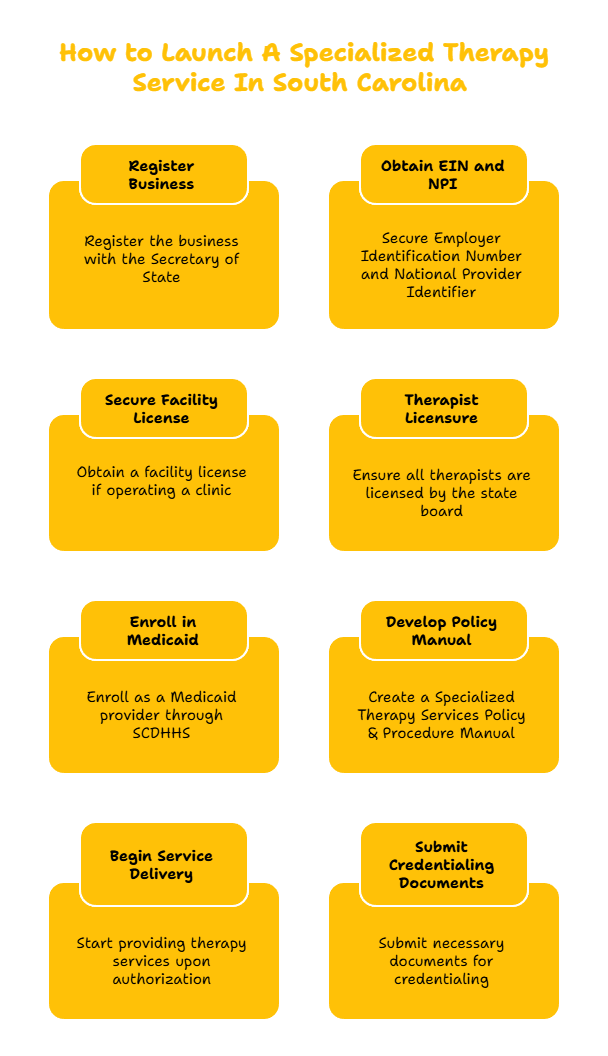
Launching a specialized therapy practice in South Carolina requires a systematic approach to business formation and clinical credentialing. Founders must first register their business with the South Carolina Secretary of State and secure an EIN and a Type 2 NPI. Once the business entity is established, all professional staff must ensure their individual licenses are active and in good standing with the appropriate South Carolina state boards for their specific discipline.
For those establishing a brick-and-mortar clinic, a DHEC facility license is mandatory. Following the acquisition of these core requirements, the entity must enroll as a Medicaid provider through the SCDHHS Provider Enrollment Portal. The development of a robust Specialized Therapy Services Policy & Procedure Manual—covering treatment models, HIPAA compliance, and internal billing standards—is a critical step to demonstrate operational readiness during the enrollment and credentialing phase.
What Does the Provider Enrollment Process Involve?
The enrollment process is a sequential workflow designed to confirm that the provider meets state and federal criteria for participation. Initially, founders must secure necessary liability insurance and finalize all business registrations. Once administrative foundations are set, the focus shifts to the therapist-level credentialing phase, where licensure and background checks are verified for every practitioner.
The final phase involves formal submission through the SCDHHS Provider Enrollment Portal. Applicants must select each therapy discipline (PT, OT, or SLP) they intend to provide. This submission must be accompanied by comprehensive credentialing documents, institutional policies, and samples of treatment plans that reflect the provider's adherence to clinical best practices. Service delivery can only commence once the provider receives official authorization and individual participant plans of care are finalized by case managers or physicians.
What Are the Staffing and Training Requirements?
Maintaining a qualified workforce is a non-negotiable component of Medicaid compliance. All therapists must hold an active South Carolina license and be properly credentialed in the Medicaid system. When utilizing therapy assistants (PTA, COTA, or SLPA), providers must ensure these individuals work under the direct supervision of a fully licensed therapist, as defined by state board regulations and Medicaid guidelines.
- Clinical Supervisor/Program Director: Responsible for overall documentation, quality assurance, and compliance oversight.
- Training Mandates: All staff must complete training in HIPAA/confidentiality, abuse prevention, incident reporting, emergency safety procedures, and accurate Medicaid billing standards.
- Continuing Education: Therapists must maintain their professional status through mandatory continuing education as required by their respective state boards.
Which Medicaid Programs Support Specialized Therapies?
Access to specialized therapy is facilitated through various Medicaid pathways, each designed to meet specific population needs. The ID/RD Waiver provides critical support for individuals with intellectual and developmental disabilities, while the HASCI Waiver addresses the specialized needs of those recovering from head or spinal cord injuries. The Community Supports (CS) Waiver serves individuals who require non-residential habilitative therapies to maintain their placement in the community.
Beyond the waiver programs, services are available through the Medicaid State Plan, which allows for therapy based on physician referral. Pediatric populations are often served through the Katie Beckett/TEFRA program for children with complex medical needs, or via EPSDT (Early and Periodic Screening, Diagnosis, and Treatment), which ensures comprehensive access to therapeutic services for Medicaid-eligible children under the age of 21.
Frequently Asked Questions
What is the typical timeline for launching a therapy agency in South Carolina?
The process generally spans several months. Business formation and policy development typically take 1–2 months, followed by 2–3 months for therapist credentialing and Medicaid enrollment. Facility setup, if required, and staff orientation add another 30–60 days before the provider is ready to begin service delivery.
Is a physical location required to provide specialized therapy services?
Not necessarily. While some providers operate brick-and-mortar clinics requiring DHEC licensure, many therapeutic services are delivered in-home or in community settings. The decision depends on the specific service model and the needs of the populations served.
What documentation is essential for maintaining compliance?
Providers must maintain organized records, including current therapist licenses, Medicaid approval letters, liability insurance certificates, and an updated Policy & Procedure Manual. Clinical documentation must include consistent progress notes, treatment plans with measurable goals, incident reports, and evidence of regular quality assurance peer reviews.
Key Takeaway
Success as a Specialized Therapies provider in South Carolina hinges on the ability to integrate clinical expertise with rigorous administrative compliance. By focusing on timely credentialing, maintaining active licensure, and strictly adhering to the documentation standards set forth by SCDHHS and the various waiver programs, agencies can build sustainable, high-quality programs that meaningfully improve outcomes for participants across the state.
Last verified: 2024. The information provided is for educational purposes only and does not constitute legal or financial advice. We are not responsible for any changes in agency regulations or state laws. Please contact the appropriate governing bodies to confirm current program requirements.