SPECIALIZED THERAPIES SERVICES PROVIDER IN GEORGIA
By Fatumata Kaba · 2025-07-14 · 5 min read
Specialized Therapies in Georgia represent a critical component of the state’s Home and Community-Based Services (HCBS) waiver system, offering essential support for individuals with developmental disabilities or chronic health conditions. By providing targeted interventions—such as speech, occupational, physical, and behavioral therapies—these providers play a pivotal role in enhancing a participant's functional independence, mobility, and communication capabilities within their own communities.
For healthcare entrepreneurs and therapy clinic administrators, entering the Georgia Medicaid provider space requires a comprehensive understanding of regulatory frameworks, clinical documentation standards, and the specific authorization processes managed by state departments. This guide outlines the essential steps for establishing a Specialized Therapies service provider agency, ensuring alignment with both Georgia Department of Community Health (DCH) and Department of Behavioral Health and Developmental Disabilities (DBHDD) requirements.
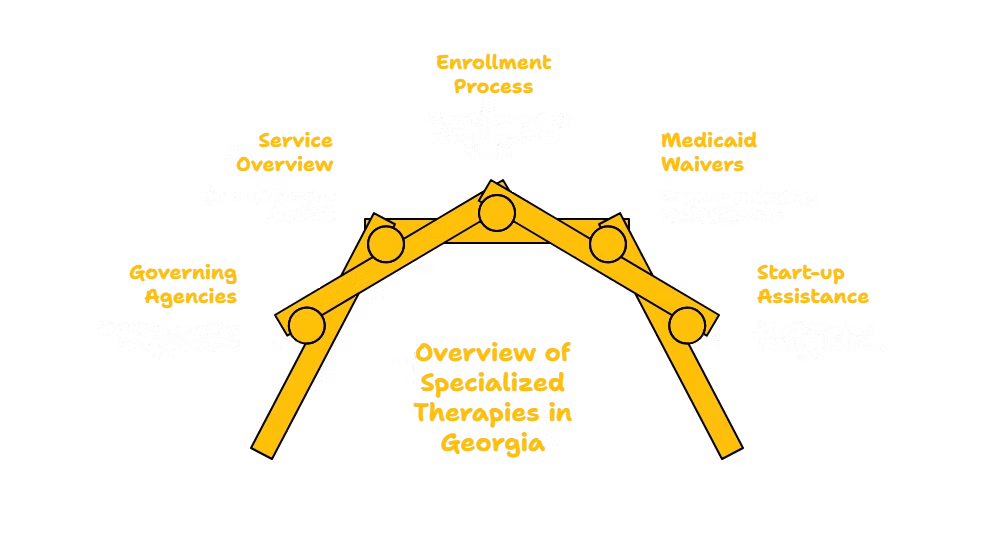
How Do Governing Agencies Regulate Specialized Therapies?
The delivery of Specialized Therapies in Georgia is governed by a multi-tiered regulatory structure designed to ensure the quality of care and the responsible use of public funds. The Georgia Department of Community Health (DCH) serves as the single state agency responsible for Medicaid enrollment, service authorization, and final reimbursement, ensuring that all claims align with federal Medicaid standards.
Parallel to DCH, the Georgia Department of Behavioral Health and Developmental Disabilities (DBHDD) holds administrative authority over the waiver-based therapy services provided to individuals with developmental disabilities. Meanwhile, the Centers for Medicare & Medicaid Services (CMS) maintains overarching federal oversight to ensure that state-run HCBS programs remain in compliance with federal guidelines for quality, safety, and equitable access to therapeutic supports.
What Services Fall Under the Specialized Therapies Scope?
Specialized Therapies are defined as targeted, clinical interventions aimed at improving functional outcomes and promoting greater independence for participants enrolled in waiver programs. Each service must be explicitly authorized within the participant’s Individual Service Plan (ISP) to ensure that the treatment remains focused on specific goals related to the individual’s daily functioning and community integration.
Providers authorized through the Medicaid waiver program may deliver a variety of discipline-specific interventions, provided they adhere to professional scope-of-practice standards. Common services include:
- Speech-Language Therapy: Focused on communication skills and swallowing function.
- Occupational Therapy: Addressing fine motor skills, sensory integration, and activities of daily living.
- Physical Therapy: Targeting gross motor skills, balance, strength, and mobility training.
- Behavioral Therapy: Utilizing non-ABA models to promote emotional regulation and social skills.
- Alternative Therapies: Including Music Therapy and Art Therapy, where authorized by the specific waiver.
- Specialized Feeding Therapy: Tailored for individuals experiencing complex eating or swallowing difficulties.
What Are the Prerequisites for Licensure and Provider Enrollment?
Establishing a compliant therapy agency requires navigating a rigorous set of administrative and clinical prerequisites. Before an agency can begin billing for services, it must establish a formal legal entity, register with the Georgia Secretary of State, and secure a federal Employer Identification Number (EIN). Additionally, the agency must obtain a Type 2 National Provider Identifier (NPI), which is essential for institutional billing under the Medicaid system.
Clinical integrity is maintained through strict licensing requirements. Every therapist providing services must hold an active, unrestricted license issued by the relevant Georgia professional board (e.g., the Georgia Board of Physical Therapy or the Georgia Board of Speech-Language Pathology and Audiology). Furthermore, the agency must maintain robust professional and general liability insurance and have documented internal policies addressing service delivery, participant safety, clinical documentation, and HIPAA-compliant data management.
How Does the DBHDD and DCH Provider Enrollment Process Function?
The path to becoming an approved provider involves a systematic progression from initial intent to formal program readiness. Initially, an agency must submit a Letter of Intent to DBHDD expressing its commitment to delivering Specialized Therapy Services. This is followed by a thorough pre-qualification phase, during which the agency must verify its business registration, professional insurance coverage, and staff licensure.
Once documentation is submitted—including proof of NPI, therapist credentials, and detailed service delivery models—the agency undergoes a Program Readiness Review. DBHDD inspectors examine the provider’s clinical infrastructure, including their therapy planning systems, participant rights protection protocols, and documentation practices. Upon receiving DBHDD approval, the provider proceeds to the final stage: completing the Medicaid enrollment through the Georgia Medicaid Management Information System (GAMMIS) to finalize billing code configurations.
What Documentation Is Required for Ongoing Compliance?
Maintaining long-term compliance with state and federal regulations depends on the agency's ability to produce consistent, accurate documentation. Providers are expected to maintain an up-to-date Policy & Procedure Manual that covers every aspect of agency operations, from the initial intake and evaluation of a participant to the ongoing management of progress notes and treatment plan updates.
- Legal/Administrative: Articles of Incorporation, proof of EIN/NPI, and current business licenses.
- Clinical/Credentialing: Active license verification for all staff, background screening clearance, and proof of professional liability insurance.
- Operations: Standardized therapy assessment templates, treatment plan formats, progress reporting systems, and audit-ready service delivery logs.
- Safety and Privacy: Documented HIPAA confidentiality procedures, participant grievance protocols, and emergency preparedness/incident response plans.
Frequently Asked Questions
Which Medicaid waivers currently authorize Specialized Therapy Services in Georgia?
Specialized Therapies are primarily authorized under the Comprehensive Supports Waiver Program (COMP) and the New Options Waiver Program (NOW). Additionally, the Independent Care Waiver Program (ICWP) may cover these services in specific instances where clinical necessity for therapy is demonstrated.
What are the core requirements for a Clinical Supervisor in a therapy agency?
A Clinical Supervisor must hold an active, valid Georgia professional license in their respective therapy discipline (PT, OT, or SLP). They should possess documented supervisory experience, meet all state background screening requirements, and be capable of managing clinical documentation and quality assurance programs.
What is the typical timeline for an agency to launch and receive approval?
The total timeline varies, but generally, business formation takes 1–2 weeks, followed by a 60–90 day window for the DBHDD application and readiness review. Staff hiring and systems setup typically require 30–45 days, and the final Medicaid enrollment through GAMMIS requires an additional 45–60 days for completion.
Key Takeaway
Launching a Specialized Therapies agency in Georgia is a sophisticated process that requires deep integration with the state’s healthcare infrastructure. By prioritizing rigorous documentation, maintaining strict compliance with DBHDD standards, and ensuring all clinical staff remain fully licensed and trained, agencies can provide essential, high-quality support to participants within the COMP, NOW, and ICWP waiver programs, ultimately facilitating better health and independence for those they serve.
Last verified: 05/22/2024. This information is provided for educational purposes and does not constitute legal or professional advice. Always verify current state and federal regulations directly with the Georgia Department of Community Health (DCH), the Department of Behavioral Health and Developmental Disabilities (DBHDD), and the Centers for Medicare & Medicaid Services (CMS) before making business decisions.