SPECIALIZED THERAPIES SERVICES PROVIDER IN FLORIDA
By Fatumata Kaba · 2025-07-11 · 5 min read
Specialized Therapies Services in Florida represent a critical component of the continuum of care for individuals with developmental disabilities, providing essential occupational, physical, and speech-language supports. By operating as an approved Medicaid and iBudget Waiver provider, clinical practices can deliver targeted interventions that improve functional outcomes, communication abilities, and overall quality of life for Medicaid recipients in home and community-based settings.
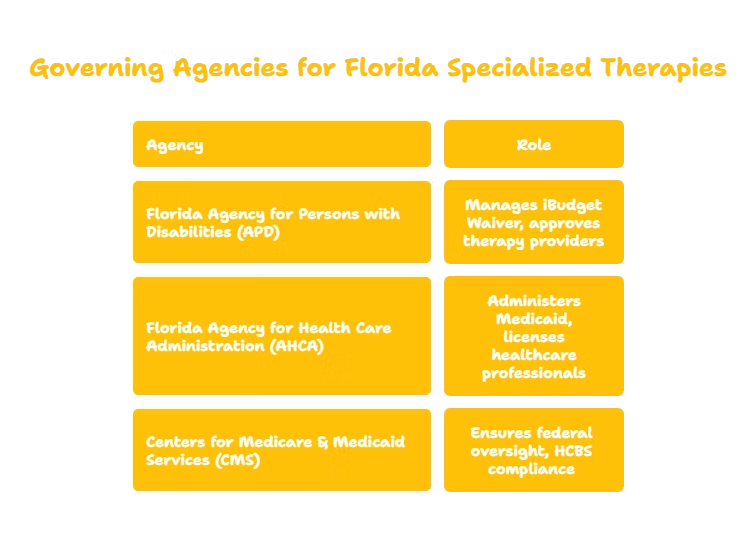
The provision of these services is strictly governed by a regulatory framework involving the Agency for Persons with Disabilities (APD), the Agency for Health Care Administration (AHCA), and federal oversight through the Centers for Medicare & Medicaid Services (CMS). This guide outlines the operational, clinical, and administrative requirements necessary to launch and maintain a compliant specialized therapy practice within the Florida Medicaid ecosystem.
Navigating the Regulatory Landscape for Specialized Therapies
The regulatory structure for specialized therapies in Florida is bifurcated between clinical oversight and programmatic management. The Agency for Health Care Administration (AHCA) is primarily responsible for the administration of the Florida Medicaid program and the licensure of the individual healthcare professionals who deliver these services. Compliance with AHCA standards ensures that practitioners meet state-mandated qualifications, maintain valid licensure, and adhere to established billing practices.
Complementing this, the Agency for Persons with Disabilities (APD) oversees the iBudget Waiver, which is the primary funding mechanism for specialized therapies tailored to individuals with developmental disabilities. While AHCA focuses on the provider's professional credentials, the APD ensures that services are person-centered, aligned with an individual's Support Plan, and consistent with the specific requirements of the Home and Community-Based Services (HCBS) program. Providers must maintain dual alignment with these agencies to remain eligible for reimbursement.
Defining the Scope of Specialized Therapy Services
Specialized therapies encompass a range of clinically necessary interventions prescribed by a physician to address developmental, physical, and communication-related challenges. These services are not merely maintenance; they are designed to be restorative or compensatory in nature, aimed at enhancing the recipient’s independence. Providers are expected to deliver these services in settings that maximize the recipient's comfort and clinical progress, including the participant's home, local clinics, or community environments.
Approved providers are responsible for a comprehensive service delivery model that includes:
- Occupational Therapy (OT): Focused on developing daily living skills, enhancing motor planning, and implementing sensory integration strategies.
- Physical Therapy (PT): Aimed at improving strength, range of motion, balance, and overall mobility.
- Speech-Language Pathology (SLP): Specialized support for communication skills, articulation, swallowing therapy, and the use of Augmentative and Alternative Communication (AAC) devices.
- Clinical Administration: Conducting thorough assessments, developing individualized treatment plans, monitoring progress through consistent data collection, and providing essential caregiver training to support the continuity of care.
Establishing Your Business for Medicaid and APD Enrollment
Before initiating the enrollment process, a provider must establish a formal business entity and secure the necessary federal and state identifiers. The foundational steps involve registering the business with the Florida Division of Corporations (Sunbiz) and obtaining a federal Employer Identification Number (EIN). Furthermore, the agency must secure a Type 2 National Provider Identifier (NPI), which is essential for billing under a group or practice entity.
Once the corporate structure is in place, the provider must prioritize professional and liability coverage. Implementing a HIPAA-compliant documentation system is not optional; it is a regulatory requirement to protect participant privacy while ensuring that clinical records, billing documentation, and incident reports are stored and transmitted securely. A well-organized administrative backbone is critical for audit preparedness and maintaining good standing with state agencies.
Executing the Provider Enrollment Process
The provider enrollment process is a sequential journey that requires meticulous attention to detail. It begins with enrollment in the Florida Medicaid program as a provider of PT, OT, and/or SLP. This process typically involves verifying the active professional licenses of all therapists who will provide services under the agency’s banner. Following Medicaid enrollment, the agency must apply for APD-approved status specifically for the "Specialized Therapies" service category under the iBudget Waiver.
During the application phase, providers will be required to submit a comprehensive documentation package. This package serves as proof of operational readiness and usually includes:
- Proof of business registration and tax identification.
- NPI confirmation and active Florida professional licenses for all clinical staff.
- Detailed policy and procedure manuals covering intake, treatment planning, HIPAA, and incident reporting.
- Sample documentation templates and evidence of professional liability insurance.
Managing Staffing and Clinical Compliance
The quality of specialized therapy services is inextricably linked to the qualifications and training of the staff. All therapists—whether PTs, OTs, or SLPs—must hold an active Florida license in their respective discipline. Furthermore, all personnel must undergo a mandatory AHCA Level 2 background screening. These screens are a non-negotiable prerequisite for ensuring the safety and well-being of the vulnerable populations served by the iBudget Waiver.
Beyond initial hiring, agencies are responsible for ongoing staff training and development. This includes, at a minimum, training in Medicaid documentation and billing standards, HIPAA compliance, abuse prevention, and emergency/infection control protocols. If the agency employs therapy aides, they must be supervised at all times by a licensed clinician, and their documentation must be meticulously reviewed to ensure compliance with Medicaid standards.
Frequently Asked Questions
How long does the overall process to become an approved provider take?
The timeline varies based on the completeness of your application, but generally, business formation takes 1–2 weeks, Medicaid enrollment lasts 30–60 days, and APD iBudget Waiver enrollment requires an additional 30–90 days. Ongoing coordination with local APD regions is necessary for final referral activation.
What are the core components of a successful clinical policy manual?
An effective manual must include specific templates for intake and assessment, standardized treatment planning, clear HIPAA and confidentiality protocols, incident reporting and emergency procedures, staff training logs, and formalized participant rights and grievance policies.
Can therapy be provided in settings other than a medical clinic?
Yes, specialized therapies under the iBudget Waiver are intended to be flexible. Services are frequently provided in the participant's home or community settings to ensure that therapeutic goals are relevant to the individual’s daily life and natural environment, as determined by their Support Plan.
Key Takeaway
Launching a Specialized Therapies practice in Florida requires a dual focus on rigorous clinical compliance and disciplined administrative management. By adhering to the standards set forth by AHCA and the APD, providers can successfully deliver high-quality, person-centered care that meets the complex needs of Medicaid recipients while ensuring long-term operational sustainability.
Last verified: 2024-05-22. This article is for informational purposes only and does not constitute legal or professional advice. Always consult directly with the Florida Agency for Persons with Disabilities (APD) and the Agency for Health Care Administration (AHCA) to obtain the most current regulatory requirements and guidance for your specific practice.