SPECIALIZED THERAPIES PROVIDER IN DELAWARE
By Fatumata Kaba · 2025-07-07 · 6 min read
Becoming a Specialized Therapies provider in Delaware requires a strategic approach to aligning clinical practice with the state’s complex Medicaid and waiver infrastructure. Providers of physical therapy (PT), occupational therapy (OT), speech-language pathology (SLP), and other habilitative supports play a vital role in the Lifespan Waiver program, ensuring that individuals with developmental disabilities receive the necessary clinical interventions to maintain health and independence in their chosen communities.
This guide serves as an authoritative framework for clinical practice owners and administrators looking to navigate the Delaware Division of Medicaid & Medical Assistance (DMMA) and the Division of Developmental Disabilities Services (DDDS) landscape. By adhering to rigorous state and federal standards, new providers can successfully bridge the gap between medical necessity and person-centered home and community-based services (HCBS).
Navigating the Governance of Delaware’s Therapeutic Ecosystem
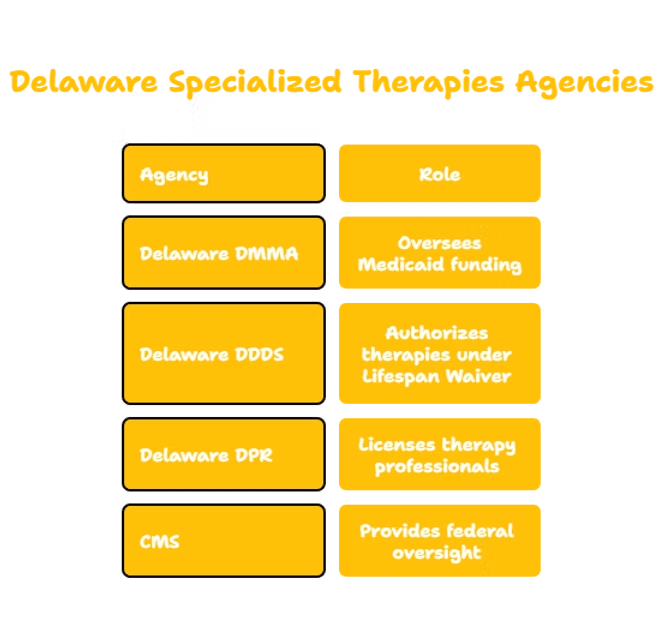
The regulatory structure for specialized therapies in Delaware is multi-layered, requiring coordination between state agencies and federal oversight. The Division of Medicaid & Medical Assistance (DMMA) serves as the primary authority for Medicaid funding and provider reimbursement, while the Division of Developmental Disabilities Services (DDDS) manages the authorization of these services through person-centered planning within the Lifespan Waiver. Understanding the intersection of these agencies is the first step toward operational compliance.
Furthermore, the Delaware Division of Professional Regulation (DPR) maintains the standards for individual clinician licensure, which is a prerequisite for any therapy business. Federal oversight via the Centers for Medicare & Medicaid Services (CMS) ensures that all delivered services meet national HCBS and medical necessity standards. Compliance with these governing bodies is not merely an administrative requirement; it is the foundation of quality care and financial sustainability for the provider agency.
Defining the Scope of Specialized Therapy Services
Specialized Therapies are designed to improve or maintain physical, communicative, or daily living skills essential for functioning in a home or community setting. For a service to be reimbursable under the Lifespan Waiver, it must be explicitly included in the participant’s Individual Service Plan (ISP) and supported by medical necessity. Providers are expected to move beyond standard clinical models to incorporate person-centered strategies that align with the participant’s unique functional goals.
Approved providers generally offer a range of essential habilitative and restorative services. These include:
- Physical therapy: Mobility training, strength-building, and fall prevention strategies.
- Occupational therapy: Daily living skill development, sensory integration, and adaptive strategy implementation.
- Speech-language pathology: Communication skills enhancement, swallowing evaluations, and Augmentative and Alternative Communication (AAC) device support.
- Specialized interventions: Behavioral feeding therapies, sensory-motor integration, and other clinician-directed habilitative supports.
- Clinical oversight: Ongoing evaluation, progress monitoring, and rigorous documentation for every authorized service encounter.
Mastering the Provider Enrollment and Credentialing Pathway
The enrollment process is a sequential journey that transforms a business entity into a state-sanctioned provider. Founders must first establish a formal business structure, registering with the Delaware Division of Corporations and obtaining a federal Employer Identification Number (EIN). Simultaneously, the business must secure a Type 2 National Provider Identifier (NPI) to function as an organizational billing entity within the Medicaid framework.
Once the business is legally established, the focus shifts to professional credentialing and program-specific enrollment. This involves:
- Licensure: Ensuring every clinician holds an active Delaware professional license through the DPR.
- Medicaid Enrollment: Completing the provider application through the Delaware Medical Assistance Portal (DMAP).
- Waiver Approval: Applying with DDDS to become an authorized provider under the Lifespan Waiver.
- Insurance Requirements: Securing and maintaining necessary malpractice and general liability insurance.
Establishing Essential Documentation and Compliance Infrastructure
The integrity of a provider agency is measured by its documentation and compliance systems. A robust policy and procedure manual must be the first document finalized, covering everything from intake and assessment procedures to strict HIPAA-compliant protocols. Because Specialized Therapies are subject to state audits, maintaining accurate records of frequency, duration, and clinical goals is non-negotiable.
Every therapy session must be supported by documentation that clearly maps the service back to the participant’s ISP. Key documentation categories that must be maintained include:
- Administrative: Articles of Incorporation, IRS EIN letter, and NPI confirmation.
- Clinical: Current therapist licenses, treatment plan templates, and detailed progress notes.
- Regulatory: DDDS provider agreements, signed consent forms, and proof of HIPAA-compliant data handling.
- Safety & Risk: Emergency response protocols, incident reporting systems, and therapist supervision/CEU tracking logs.
Managing Staffing and Training Requirements
Providing high-quality clinical support requires a commitment to ongoing staff development and adherence to state-mandated qualifications. Whether hiring licensed therapists or therapy assistants, the agency must verify all credentials against the Delaware DPR database before the staff member begins client contact. Background checks and valid CPR certification are universal requirements for all field-based staff.
Beyond technical competency, all staff must be trained on the nuances of the HCBS model. This includes:
- Person-centered planning: Understanding the ISP and how to integrate therapeutic goals into the participant’s daily life.
- Documentation standards: Ensuring that notes accurately reflect the medically necessary components of the visit.
- Protective protocols: Comprehensive training on abuse prevention, mandated reporting, and emergency incident procedures.
- Regulatory maintenance: Annual tracking of Continuing Education Units (CEUs) to ensure professional licensure remains in good standing.
Frequently Asked Questions
What is the typical timeline for launching a Specialized Therapies practice in Delaware?
The timeline varies based on administrative efficiency, but generally, business formation takes 1–2 weeks, followed by a 30–60 day window for state licensure and credentialing. Medicaid and waiver enrollment processes also typically span 30–60 days, while referral networking is an ongoing, long-term phase of development.
Are Specialized Therapies limited to the Lifespan Waiver?
While the Lifespan Waiver is a primary vehicle for these services under DDDS, specialized therapies may also be reimbursed through the Delaware Medicaid State Plan, as well as Early Intervention and specific school-based Medicaid programs, depending on the age and eligibility status of the participant.
How does a provider receive referrals for DDDS participants?
Once a provider is fully enrolled and approved by DDDS, they should proactively connect with local case managers and DDDS service coordinators. These professionals serve as the primary link between the service needs identified in an individual’s ISP and the network of authorized, community-based therapy providers.
Key Takeaway
Launching a Specialized Therapies practice in Delaware requires a disciplined adherence to the standards set forth by DMMA and DDDS. Success is achieved by prioritizing rigorous HIPAA-compliant documentation, maintaining active state licensure, and fostering a strong referral network within the DDDS system. By focusing on person-centered outcomes and technical compliance, providers can effectively contribute to the health and independence of the individuals they serve.
WAIVER CONSULTING GROUP'S START-UP ASSISTANCE SERVICE — DELAWARE SPECIALIZED THERAPIES PROVIDER: We help therapy practices and clinicians establish fully credentialed Medicaid and waiver-compliant services throughout Delaware. Scope of Work: Business registration (LLC, EIN, NPI); Therapist licensing and Medicaid enrollment support; DDDS waiver provider application guidance; Policy & procedure manual for evaluations, therapy delivery, and documentation; Templates for treatment plans, progress notes, and session tracking; Website, domain, and email setup; Staff credentialing trackers and license monitoring tools; Client intake packet, consent forms, and HIPAA documentation; Incident reporting systems and audit readiness support; Referral networking with DDDS, schools, clinics, and care teams. Last verified: October 2023. Disclaimer: This information is for educational purposes only and does not constitute legal or financial advice. Always consult with the Delaware Division of Medicaid & Medical Assistance (DMMA) or the Division of Developmental Disabilities Services (DDDS) for the most current regulatory updates.