SPECIALIZED MEDICAL EQUIPMENT SERVICES PROVIDER IN TENNESSEE
By Fatumata Kaba · 2025-10-22 · 5 min read
Understanding the Role of Specialized Medical Equipment Providers in Tennessee
Specialized Medical Equipment (SME) services in Tennessee represent a vital infrastructure for individuals with disabilities, providing the essential devices and assistive technologies required to enhance mobility, daily functioning, and safety. By bridging the gap between standard Durable Medical Equipment (DME) and the highly personalized needs of waiver participants, SME providers facilitate greater independence for members within the TennCare, ECF CHOICES, and 1915(c) waiver programs.
For healthcare entrepreneurs and administrative leaders, establishing an SME agency requires navigating a complex regulatory landscape overseen by TennCare and the Tennessee Department of Intellectual and Developmental Disabilities (DIDD). Success in this sector relies on maintaining strict adherence to federal and state standards for medical necessity, procurement, and participant training, ensuring that every delivered device directly improves the quality of life for the individual served.
How Do Governing Agencies Regulate SME Services?
The provision of Specialized Medical Equipment in Tennessee is governed by a multi-layered regulatory framework. TennCare serves as the primary authority, overseeing the intersection of State Plan DME and the specialized requirements inherent in waiver-based services. Because these devices often fall outside the scope of standard medical coverage, they require precise navigation of TennCare’s policy manuals to ensure compliance with federal and state reimbursement rules.
The Tennessee Department of Intellectual and Developmental Disabilities (DIDD) acts as the secondary, yet equally critical, regulatory body for waiver programs. DIDD is responsible for monitoring and certifying providers to ensure they have the operational capacity to manage the unique needs of the I/DD population. Furthermore, all providers must adhere to rules established by the Centers for Medicare & Medicaid Services (CMS), which mandate strict medical necessity criteria to qualify for Medicaid funding.
- TennCare: Primary administrator for Medicaid and waiver oversight.
- DIDD: Certifying agency for 1915(c) and ECF CHOICES waiver delivery.
- CMS: Federal authority establishing the baseline for medical necessity and clinical requirements.
What Defines Specialized Medical Equipment and Its Scope?
Specialized Medical Equipment refers to a specific category of devices that extend beyond traditional DME. While standard DME is often limited to items used for basic mobility or fundamental health needs, SME includes highly customized solutions tailored to the participant's specific functional goals, such as environmental controls, complex adaptive seating, or advanced communication devices (AAC). These items are intended to support the individual in their home or community setting.
To qualify as an SME service, the equipment must be clearly linked to a participant's Individual Support Plan (ISP) and be supported by physician documentation. The service model goes beyond the mere sale of a device; it encompasses the full lifecycle of the equipment, including professional assessment, specialized delivery, precise installation, and comprehensive training for the participant and their caregivers to ensure the equipment is used safely and effectively.
What Are the Essential Steps for Provider Enrollment?
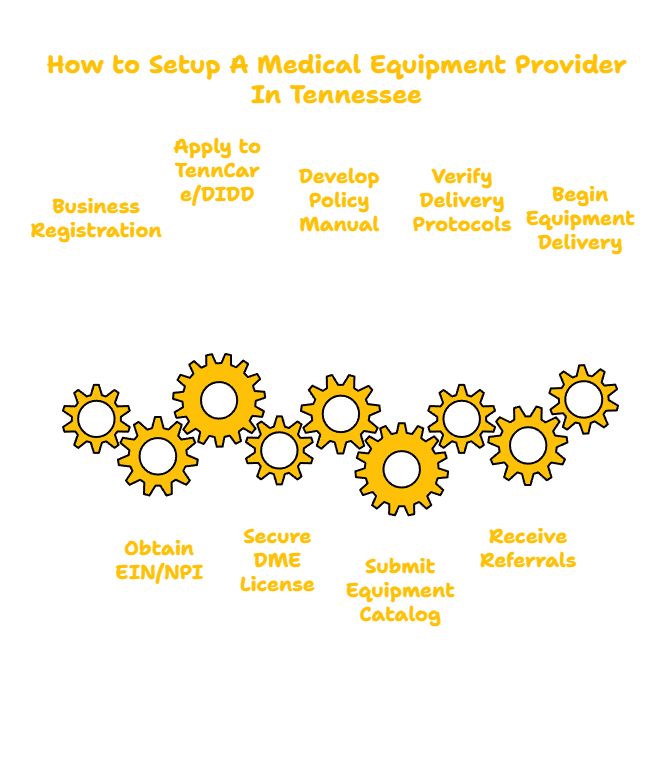
The enrollment process is a structured sequence that begins with the formal establishment of a business entity. Prospective providers must register with the Tennessee Secretary of State and obtain the necessary federal identifiers, including an Employer Identification Number (EIN) and a Type 2 National Provider Identifier (NPI). This foundational step ensures that the business is recognized as a legal entity capable of entering into state contracts.
Following registration, the agency must apply for status as a TennCare DME/SME provider or seek certification via the DIDD waiver enrollment process. This phase requires the submission of a comprehensive catalog of equipment, detailed medical necessity criteria, and formal procedures for managing orders. Providers must also document their delivery and return policies, which are evaluated by the state to ensure that participants receive timely and reliable service.
How Should Providers Manage Staffing and Documentation?
Operational success requires a robust staffing strategy that aligns technical expertise with regulatory compliance. Key roles include the SME Delivery Technician, who handles the physical transport and initial setup of equipment, and the Equipment Specialist or Assistive Technology Professional (ATP), who is vital for configuring complex, high-acuity devices. All personnel must undergo rigorous background checks and receive specific training regarding HIPAA compliance, infection control, and safe operation protocols.
Documentation is the backbone of audit readiness. Agencies must develop and maintain a comprehensive Policy & Procedure Manual that addresses every aspect of service delivery, from the initial review of medical necessity to the long-term maintenance of the equipment. This manual must be updated regularly to reflect changes in TennCare or DIDD policies and must include clear templates for billing, incident reporting, and participant training verification.
Frequently Asked Questions
What is the difference between standard DME and Specialized Medical Equipment?
Standard DME typically refers to basic medical supplies and equipment covered under the standard State Plan. Specialized Medical Equipment (SME) consists of devices that exceed standard coverage limitations, offering customized solutions for complex disabilities that are documented as medically necessary within an individual’s ISP or physician’s order.
Do I need an Assistive Technology Professional (ATP) on staff?
While not explicitly required for every type of equipment, employing an ATP or a professional with a relevant clinical background (such as an OT or PT) is highly recommended. For complex devices, this level of expertise is often necessary to ensure the equipment is correctly fitted and configured to meet the specific health outcomes of the waiver participant.
How long does the provider enrollment process usually take?
The timeline varies based on the completeness of your documentation and state processing times. Generally, business registration and licensing take 1–2 months, followed by 2–3 months for TennCare/DIDD enrollment and product verification. Total preparation to begin receiving referrals and delivering equipment typically spans a 4–7 month window.
Key Takeaway
Developing a successful SME provider agency in Tennessee requires a deliberate, methodical approach to business architecture, clinical compliance, and state-specific enrollment. By prioritizing high-quality documentation, professional staff training, and deep familiarity with the TennCare/DIDD regulatory environment, providers can ensure the delivery of high-impact assistive technologies that foster independence for Tennessee’s most vulnerable populations.
Last verified: May 2024. This information is intended for educational purposes only and does not constitute legal or professional consulting advice. Rules and regulations regarding Medicaid waivers are subject to change by state and federal authorities. Always consult the official TennCare or DIDD provider manuals for current requirements.