SPECIALIZED MEDICAL EQUIPMENT SERVICES PROVIDER IN PENNSYLVANIA
By Fatumata Kaba · 2025-10-08 · 6 min read
Specialized Medical Equipment (SME) services in Pennsylvania represent a critical component of the state’s Home and Community-Based Services (HCBS) framework, providing essential devices that enable individuals with disabilities to maintain independence and safety. By delivering tailored assistive technology and durable medical equipment, providers bridge the gap between clinical necessity and daily functionality for participants in various Medicaid waiver programs managed by the Office of Developmental Programs (ODP) and the Office of Long-Term Living (OLTL).
For entrepreneurs and healthcare administrators, establishing an SME provider agency requires navigating a complex regulatory landscape involving federal compliance, state-specific Medicaid enrollment, and rigorous documentation standards. This guide outlines the operational requirements, enrollment pathways, and clinical considerations necessary to launch and maintain a compliant, high-quality SME service provider agency in Pennsylvania.
How Do Regulatory Agencies Govern SME Services in Pennsylvania?
The provision of Specialized Medical Equipment is governed by a multi-tiered regulatory structure designed to ensure participant safety and financial accountability. At the federal level, the Centers for Medicare & Medicaid Services (CMS) establishes the overarching framework for 1915(c) HCBS waivers, ensuring that states maintain compliance with federal mandates regarding service delivery and quality assurance. These guidelines dictate that all equipment must be medically necessary and directly related to the participant's specific functional goals as outlined in their Individual Support Plan (ISP).
In Pennsylvania, the Department of Human Services (DHS) serves as the primary oversight entity. The Office of Developmental Programs (ODP) manages services for individuals with intellectual disabilities, while the Office of Long-Term Living (OLTL) administers programs for older adults and individuals with physical disabilities. Providers must also interact with the Pennsylvania Medical Assistance Program via the PROMISe™ portal, which serves as the centralized system for provider enrollment, credentialing, and claims processing. Simultaneously, the Pennsylvania Department of State oversees the legal business formation and registration requirements necessary to operate as a legitimate corporate entity within the Commonwealth.
What Are the Core Categories of SME Services?
SME services are distinct from standard medical supplies in that they are often customized to meet the unique environmental or physiological needs of the participant. These services encompass a broad range of supports that extend beyond simple retail transactions to include professional installation, training, and ongoing technical support. Providers must demonstrate the capacity to manage the entire lifecycle of the equipment, from initial assessment to potential repair or modification.
- Mobility Equipment: Provision and customization of manual or powered wheelchairs, walkers, gait trainers, and patient transfer lifts.
- Environmental Adaptations: Installation of specialized controls for home infrastructure, including automated lighting, door openers, climate control systems, and emergency safety alarms.
- Communication Aids: Sourcing and configuration of Augmentative and Alternative Communication (AAC) devices to support independent interaction.
- Daily Living Supports: Provision of specialized bathing chairs, adaptive toileting systems, and feeding equipment designed for ergonomic independence.
- Maintenance and Technical Support: Routine servicing, troubleshooting, and complex configuration to ensure ongoing safety and equipment functionality.
What Are the Prerequisites for Provider Enrollment and Accreditation?
Entering the Pennsylvania Medicaid market requires a disciplined approach to organizational readiness. Before initiating the formal enrollment process, a provider must establish a robust business foundation that meets both state and federal standards. This begins with obtaining a valid Employer Identification Number (EIN) and a Type 2 National Provider Identifier (NPI), which are required for all billing and identification activities within the Medicaid system. Furthermore, providers must secure comprehensive insurance coverage, including general liability and workers’ compensation, to mitigate operational risks.
For agencies dealing with durable medical equipment, obtaining accreditation is often a mandatory prerequisite for successful enrollment. Standards from recognized bodies such as the Community Health Accreditation Partner (CHAP), the Accreditation Commission for Health Care (ACHC), or The Compliance Team serve as evidence of operational quality. Additionally, providers must author a comprehensive Policy & Procedure Manual that codifies every aspect of the service delivery model, from client intake and assessment to privacy safeguards and HIPAA compliance protocols.
How Is the Enrollment Process Structured?
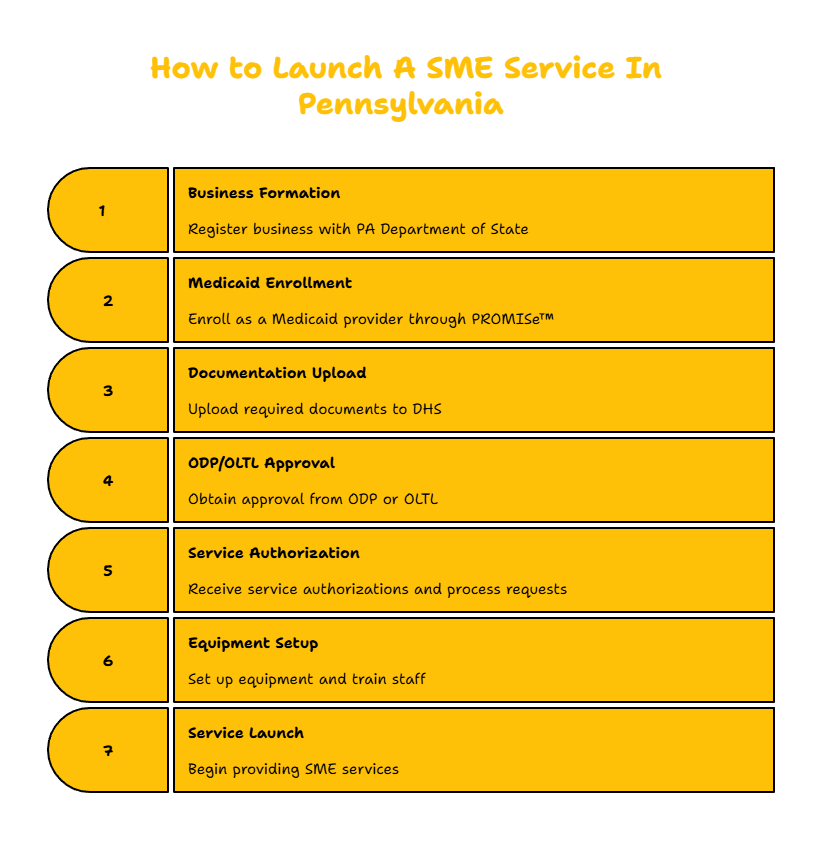
The path to becoming an approved SME vendor involves a sequenced progression through state-managed portals. The process begins with the formation of a legal entity and the acquisition of the necessary documentation, including Articles of Incorporation and insurance certificates. Once these are secured, the provider must navigate the PROMISe™ portal to register as a DME or SME provider. This stage is critical, as it establishes the agency’s credentials for receiving reimbursement for services rendered to Medicaid beneficiaries.
Following the initial registration, providers must submit detailed documentation for review by ODP or OLTL. This includes the aforementioned Policy & Procedure Manual, proof of accreditation, and staff credentials. Successful approval culminates in the agency receiving official vendor status, allowing them to accept service authorizations. Once fully enrolled, the agency enters the operational phase, where it coordinates with Support Coordinators to fulfill equipment requests, conduct onsite setups, and submit claims for authorized services.
Which Staffing and Training Standards Must Be Met?
Staffing for an SME agency requires a blend of technical expertise and a commitment to participant-centered care. The Equipment Technician or Delivery Specialist is the frontline representative who ensures that devices are correctly installed, adjusted for the participant’s safety, and that the individual or their caregiver is fully trained on the equipment’s operation. These roles require extensive background checks and ongoing training in equipment safety and mobility protocols.
The administrative side of the agency is equally vital, requiring a Program Coordinator to manage the complex flow of orders, service authorizations, and meticulous Medicaid documentation. If the agency offers complex or customized equipment, the involvement of licensed clinicians—such as Occupational Therapists (OT), Physical Therapists (PT), or Speech-Language Pathologists (SLP)—may be required to ensure clinical appropriateness. All personnel, regardless of their role, must participate in rigorous annual training programs covering HIPAA compliance, infection control, and current Medicaid documentation standards.
Frequently Asked Questions
What waivers currently cover SME services in Pennsylvania?
SME services are reimbursed through several key programs, including the ODP-managed Consolidated Waiver, Community Living Waiver, and Person/Family Directed Support (P/FDS) Waiver. Additionally, the OLTL oversees SME services for older adults and individuals with physical disabilities under various Aging and Independence Waivers, with further coverage options available through the standard State Plan DME Benefit via PROMISe™.
How long does the launch process typically take?
The timeline to launch is variable based on the agency’s preparedness. Business formation and manual creation generally require 1–2 months. Medicaid enrollment and obtaining necessary accreditations typically add 2–4 months to the timeline. Following this, vendor setup and staff training can take an additional 30–60 days, with actual service delivery commencing once contracts are finalized and referrals begin to flow from Support Coordinators.
What must be included in the Policy & Procedure Manual?
The manual must comprehensively detail the agency’s internal controls. This includes intake and assessment procedures, processes for sourcing and tracking equipment, clear instructions for client and caregiver training, protocols for maintenance and repairs, incident tracking and reporting, HIPAA compliance policies, and specific procedures for Medicaid billing, authorization management, and medical documentation.
Key Takeaway
Launching a Specialized Medical Equipment provider agency in Pennsylvania requires a meticulous focus on regulatory compliance, administrative precision, and operational transparency. By aligning business practices with the requirements of the ODP, OLTL, and PROMISe™ systems, providers can ensure their services effectively enhance the safety and independence of the individuals they support, ultimately building a sustainable and impactful organization within the Medicaid HCBS framework.
Last verified: May 2024. This information is provided for educational purposes and does not constitute legal or financial advice. Readers are encouraged to consult with the Pennsylvania Department of Human Services and official program manuals for the most current regulatory requirements and enrollment guidance.