SPECIALIZED MEDICAL EQUIPMENT SERVICES PROVIDER IN OKLAHOMA
By Fatumata Kaba · 2025-09-08 · 5 min read
SUPPORTING SAFETY, FUNCTIONALITY, AND INDEPENDENCE THROUGH CUSTOMIZED MEDICAL DEVICES
Specialized Medical Equipment (SME) services in Oklahoma provide individuals with disabilities and chronic health needs access to custom devices that promote independence and improve health outcomes within home and community-based settings. These services are authorized under Oklahoma Medicaid’s Home and Community-Based Services (HCBS) waivers, including the ADvantage Waiver, and are essential for supporting members who require adaptive technology that extends beyond standard durable medical equipment (DME) coverage.
What Are the Governing Agencies for SME Services in Oklahoma?
The delivery of Specialized Medical Equipment is governed by a tripartite structure of federal and state oversight. Understanding these roles is critical for any provider seeking to maintain compliance and ensure seamless reimbursement cycles through the SoonerCare program.
- Oklahoma Health Care Authority (OHCA): As the state Medicaid agency, OHCA oversees SoonerCare enrollment, establishes billing protocols, and sets the specific coverage criteria for SME providers.
- Oklahoma Department of Human Services (OKDHS): This agency manages participant eligibility and the coordination of services under specific waiver programs, including ADvantage, Medically Fragile, and Developmental Disabilities Services (DDS).
- Centers for Medicare & Medicaid Services (CMS): CMS provides the necessary federal oversight, ensuring that all Medicaid-funded SME services align with federal medical necessity requirements and established HCBS quality standards.
What Defines Specialized Medical Equipment Services?
Unlike standard medical equipment, SME services involve a comprehensive cycle of clinical assessment, procurement, custom configuration, and participant instruction. Providers must view their role as an extension of the therapeutic team rather than a simple retail supplier.
Approved providers are responsible for a full continuum of care, starting with a needs assessment conducted in collaboration with therapists or case managers. Once the necessity is established, the provider handles equipment procurement, source tracking, and the physical installation or configuration of devices in the participant's home environment.
Beyond the hardware, providers must deliver thorough participant training to ensure that the individual and their caregivers understand how to operate and maintain the device safely. Furthermore, the provider remains responsible for troubleshooting, repairs, and the detailed documentation required for SoonerCare audit compliance.
How Do You Achieve Licensure and Provider Approval?
Becoming an approved SME provider in Oklahoma requires a methodical approach to business infrastructure. Before approaching the OHCA for enrollment, an agency must demonstrate that it is a fully functioning legal entity with the administrative capacity to manage sensitive health information and complex billing requirements.
Key prerequisites include registering the business with the Oklahoma Secretary of State, securing an EIN from the IRS, and obtaining a Type 2 National Provider Identifier (NPI). Providers must also maintain appropriate liability and product insurance policies to mitigate risks associated with equipment use.
- Develop a comprehensive Specialized Medical Equipment Policy & Procedure Manual.
- Ensure all staff members are properly trained in device safety and documentation standards.
- Partner with licensed Occupational Therapists (OT), Physical Therapists (PT), or Speech-Language Pathologists (SLP) for clinical justifications when necessary.
- Establish internal systems for tracking equipment maintenance and repair history.
What Is the Required Enrollment Sequence in Oklahoma?
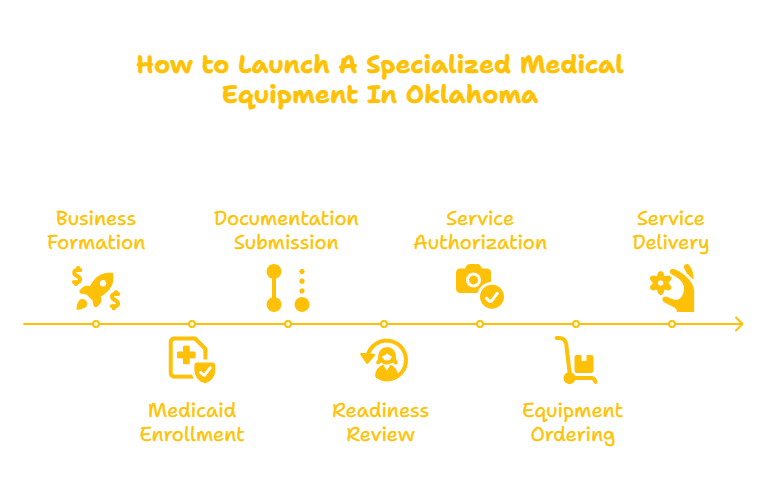
The enrollment process is a multi-phased journey designed to ensure that the provider is operationally ready before delivering services. The initial phase focuses on business formation and the creation of internal policy frameworks that satisfy OHCA requirements.
Following business setup, the provider must register via the SoonerCare Provider Portal, specifically selecting "Specialized Medical Equipment" as the service category. This submission triggers a review process where the OHCA will evaluate business licenses, insurance certificates, staff credentials, and the quality of the policy manual. In some instances, the OHCA may conduct a formal Readiness Review to examine the provider's billing capabilities and equipment tracking systems before granting final activation. Once approval is granted, the provider may begin accepting referrals and submitting claims for authorized items.
What Are the Essential Staffing and Training Mandates?
Success in this field relies on a team that balances technical expertise with administrative discipline. The Equipment Services Coordinator plays a pivotal role in logistics and vendor management, ensuring that orders are fulfilled according to strict waiver specifications.
Certified technicians or installers must be prepared to perform on-site setups with professional care. These staff members require training in device sanitation, basic repairs, and emergency procedures. Because the provider acts as a liaison for clinical needs, access to licensed therapists is also necessary to provide the clinical justification that often serves as the cornerstone of a Medicaid reimbursement request.
- All staff must undergo mandatory HIPAA and participant rights training.
- Documentation training is required to ensure that service logs meet state audit standards.
- Staff must be updated regularly on product recall procedures and manufacturer safety alerts.
Frequently Asked Questions
Which Medicaid waiver programs allow for SME reimbursement?
Specialized Medical Equipment is reimbursable under several programs, including the ADvantage Waiver for aging adults, the Medically Fragile Waiver, and various DDS waivers such as the IHSW and Community Waiver. Additionally, the Living Choice Program and the State Plan EPSDT for children under 21 also support these services when criteria are met.
How long should a new provider expect the launch process to take?
The timeline typically spans several months. Business formation and policy development generally require 1–2 months, followed by 2–3 months for staff hiring and enrollment. The final Readiness Review and approval phase takes roughly 60–90 days, leading to a total development cycle of approximately 6–9 months before full service delivery.
What must be included in the Specialized Medical Equipment Policy & Procedure Manual?
The manual must cover equipment sourcing, participant assessment documentation, staff training protocols, and maintenance tracking. It must also include templates for delivery and installation, HIPAA and grievance procedures, and specific tools for Medicaid billing compliance and quality assurance monitoring.
Key Takeaway
Establishing an SME provider agency in Oklahoma is a high-impact endeavor that requires rigorous adherence to OHCA and OKDHS standards. By focusing on compliant documentation, robust staff training, and the clinical integration of therapeutic equipment, providers can ensure long-term stability and success within the SoonerCare and HCBS waiver frameworks.
Last verified: October 2023. Disclaimer: This article is for informational purposes only and does not constitute legal or professional Medicaid consulting advice. Regulations governing Oklahoma Medicaid and HCBS waiver programs are subject to change. Always consult the Oklahoma Health Care Authority (OHCA) and current state policy manuals for the most accurate and up-to-date requirements.