SPECIALIZED MEDICAL EQUIPMENT SERVICES PROVIDER IN MICHIGAN
By Fatumata Kaba · 2025-07-27 · 5 min read
Specialized Medical Equipment services in Michigan provide essential devices that enable individuals with disabilities to maintain health, safety, and independence within their homes and communities. These services are authorized under Michigan’s Home and Community-Based Services (HCBS) Medicaid Waivers, requiring providers to adhere to rigorous standards set by the Michigan Department of Health and Human Services (MDHHS) to ensure compliance and quality of care.
What Are Specialized Medical Equipment Services Under Michigan HCBS Waivers?
Specialized Medical Equipment Services represent a critical component of the HCBS ecosystem, designed to bridge the gap between clinical necessity and personal autonomy. These services go beyond basic medical supply provision; they encompass a person-centered approach where equipment is selected, installed, and maintained based specifically on the needs identified in an individual’s person-centered service plan. By providing mobility aids, oxygen delivery systems, and other necessary assistive technology, providers play a vital role in preventing institutionalization.
The scope of these services is comprehensive, involving more than just the delivery of hardware. Approved providers are responsible for assessing the client's home environment, consulting with the care team, performing professional installations, and providing hands-on training to both the individual and their primary caregivers. This holistic approach ensures that the medical equipment is not only appropriate for the user's condition but is also used safely and effectively over the long term.
Who Governs and Authorizes These Services?
Navigating the regulatory landscape of Michigan’s waiver programs requires an understanding of the hierarchy of oversight. At the state level, the Michigan Department of Health and Human Services (MDHHS) serves as the primary authority. MDHHS is responsible for managing provider enrollment, establishing service authorization protocols, and ensuring that all participating entities maintain strict compliance with Medicaid regulations. The Michigan Medicaid Agency works in tandem to handle the logistical aspects of provider enrollment and the reimbursement process for approved services.
Federal oversight is provided by the Centers for Medicare & Medicaid Services (CMS). CMS ensures that Michigan’s HCBS waivers operate within federal guidelines, focusing on health and safety standards for waiver participants. Providers must be prepared to satisfy the requirements of all three layers of governance, as failure to comply with either state or federal mandates can result in the loss of provider status or denial of reimbursement claims.
How Do Providers Meet Licensing and Operational Requirements?
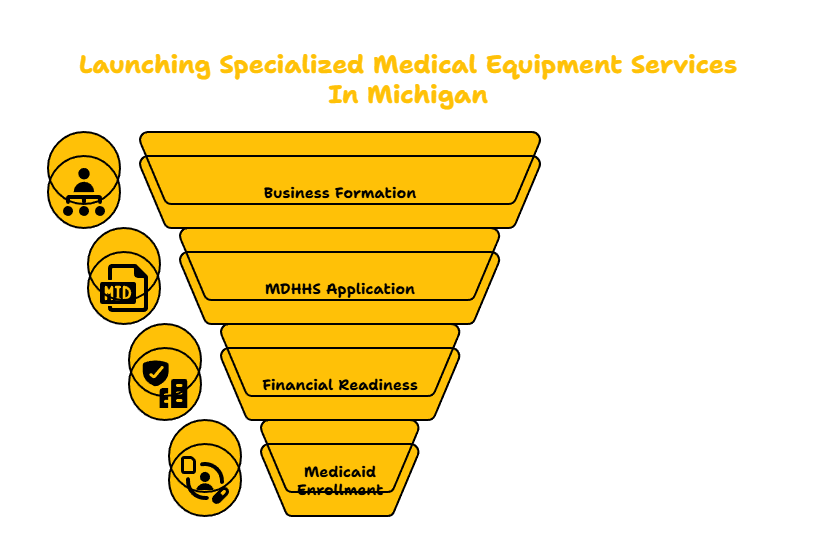
Establishing a provider agency in Michigan is a structured process that begins with formal business registration through the Michigan Department of Licensing and Regulatory Affairs (LARA). Before a business can be considered for a waiver contract, it must be legally established and possess a Type 2 NPI and an EIN from the IRS. A physical office location within the state of Michigan is mandatory to ensure that the agency is accessible and capable of responding to local client needs promptly.
Operational readiness is demonstrated through the creation of a robust Policy and Procedure Manual. This document must explicitly detail how the agency manages equipment procurement, inventory tracking, and safety protocols. Prospective providers must also show that they possess the technical expertise required to manage durable medical equipment, ensuring that all staff are not only trained in basic equipment usage but are also qualified to perform routine maintenance, calibration, and emergency troubleshooting for the specific devices they provide.
What Does the Provider Enrollment and Compliance Process Entail?
The enrollment process begins by requesting the Specialized Medical Equipment Provider Application Packet from the MDHHS. Applicants must submit a comprehensive service plan that clearly articulates the provider’s operational framework. This plan is subjected to a Program Readiness Review, where officials evaluate the applicant’s ability to manage medical devices effectively and maintain compliance with established safety regulations. The burden of proof lies with the provider to demonstrate that their internal systems for monitoring and documentation are sufficient to meet the high standards of the Medicaid program.
Credentialing is a mandatory step that involves rigorous background checks for any staff member who will have contact with clients or handle medical equipment in a client's home. Documentation requirements are extensive and include proof of business existence, such as Articles of Incorporation, and evidence of a compliant physical location. Providers must maintain meticulous records, including equipment maintenance logs, training records for caregivers, and financial tracking systems that align with the stringent auditing requirements of the Michigan Medicaid program.
What Are the Staffing and Training Expectations?
Effective service delivery relies on having a qualified team, specifically an Equipment Coordinator and certified Medical Equipment Technicians. The Equipment Coordinator serves as the administrative lead, ensuring that equipment orders are accurate and that safety protocols are strictly followed. Technicians, on the other hand, must hold certifications in medical device installation and maintenance to ensure that all equipment is assembled and calibrated to manufacturer and state specifications.
Ongoing staff training is a cornerstone of compliance. Beyond initial onboarding, all employees must undergo annual training covering safety, maintenance updates, and regulatory changes. Furthermore, the agency must provide mandatory training in confidentiality, professional ethics, and the protection of client rights. This ensures that the provider agency operates not just as a hardware supplier, but as a healthcare entity that respects the dignity and privacy of every waiver participant.
Frequently Asked Questions
Which Michigan Medicaid waivers allow for Specialized Medical Equipment services?
Specialized Medical Equipment services are authorized under the MI Choice Waiver, the Habilitation Supports Waiver, and the Children’s Waiver Program.
How long does the provider enrollment process typically take?
The timeline includes approximately 60–90 days for MDHHS application review, 30–60 days for financial and program readiness review, and 60–90 days for final Medicaid enrollment.
What documentation is critical for the initial provider application?
Essential documentation includes the Articles of Incorporation, IRS EIN letter, NPI confirmation, proof of a physical Michigan office location, and a comprehensive Policy & Procedure Manual covering procurement, maintenance, and safety standards.
Key Takeaway
Launching a Specialized Medical Equipment service provider in Michigan is a multi-phased endeavor that requires meticulous attention to MDHHS regulations, staffing qualifications, and operational compliance. By establishing a robust internal framework for equipment maintenance and client support, providers can successfully integrate into the Michigan HCBS waiver system and deliver vital services that empower individuals with disabilities.
Last verified: 2024. The information provided in this article is for educational purposes only and does not constitute legal or professional advice. Requirements for Medicaid provider enrollment in Michigan are subject to change; always refer to the official Michigan Department of Health and Human Services (MDHHS) publications and policy manuals for the most current regulations.