SKILLED NURSING SERVICES PROVIDER IN WYOMING
By Fatumata Kaba · 2026-04-14 · 5 min read
Providing Expert Skilled Nursing Care in Wyoming’s Home and Community-Based Settings
Skilled nursing services in Wyoming represent a vital bridge between acute clinical care and independent home living for individuals with complex medical needs. By delivering professional nursing intervention directly to the patient's residence, provider agencies play a critical role in preventing unnecessary hospitalizations and delaying institutional placement for residents with chronic health conditions, disabilities, or post-acute recovery requirements.
These services are governed by strict state and federal mandates, requiring providers to operate under the oversight of the Wyoming Department of Health while adhering to the clinical standards established by the Wyoming Board of Nursing. Whether serving adults through the Community Choices Waiver or supporting children with developmental disabilities, successful providers must balance rigorous documentation requirements with high-quality, compassionate clinical delivery.
Understanding the Governing Agency Landscape
The regulatory framework for skilled nursing in Wyoming is multi-faceted, requiring providers to navigate distinct responsibilities between state departments and licensing boards. At the core is the Wyoming Department of Health’s Division of Healthcare Financing, which sets the foundational policies for Medicaid State Plan and Home and Community-Based Services (HCBS) waiver coverage, including the specific reimbursement methodologies that sustain provider operations.
Complementing this administrative structure are the Public Health Nursing (PHN) and various case management agencies. These entities serve as the primary coordinators, responsible for assessing a patient's nursing needs, developing comprehensive care plans, and securing authorization for nursing hours. Additionally, the Wyoming Board of Nursing serves as the sole licensing authority for all RNs, LPNs, and APRNs, ensuring that the staff delivering care meet the necessary educational and clinical competency standards to practice within the state.
- Department of Healthcare Financing: Governs Medicaid reimbursement and program eligibility.
- PHN/Case Management: Manages individualized care plans and service authorization.
- Wyoming Board of Nursing (BON): Maintains licensure standards and professional practice regulations.
- Medicaid Provider Services: Oversees the enrollment process, provider credentialing, and billing workflows.
Clinical Scope and Service Delivery Requirements
Skilled nursing services are defined by the requirement for clinical expertise that cannot be safely performed by unlicensed caregivers. Under a physician-ordered Plan of Care (POC), licensed nurses perform interventions ranging from routine vital sign monitoring to intensive technical support. Each service must be clearly justified by the medical necessity of the patient’s condition and documented with precise accuracy to remain compliant with Medicaid audit standards.
Commonly covered clinical interventions include the administration of oral, intramuscular, intravenous, or subcutaneous medications and comprehensive wound management. For patients with high-acuity needs, services often encompass tracheostomy care, ventilator support, tube feeding, and complex catheter management. Nurses are also responsible for documenting clinical progress, facilitating physician coordination, and providing essential education to patients and their primary caregivers.
- Continuous or intermittent medication administration and safety monitoring.
- Complex wound care, including advanced dressing changes.
- Respiratory maintenance, including ventilator and tracheostomy care.
- Diabetes management, including insulin titration and monitoring.
- Task delegation to unlicensed staff, strictly overseen by a Registered Nurse.
Licensing, Credentialing, and Provider Enrollment
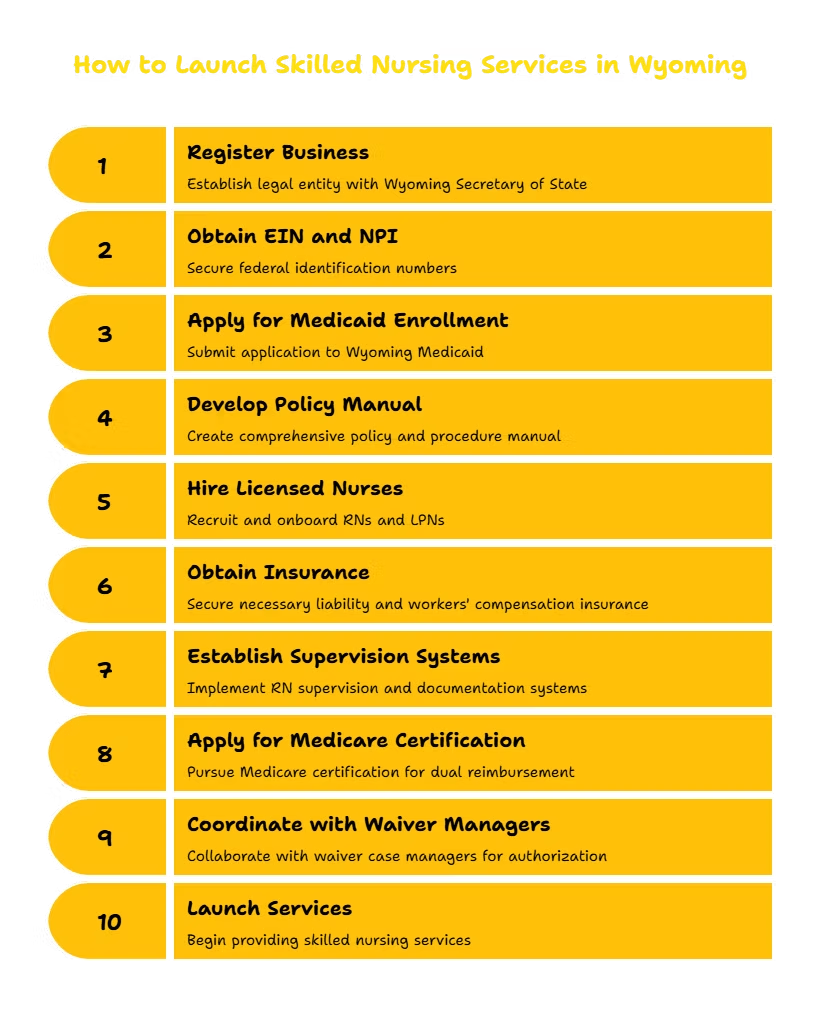
Launching a skilled nursing provider agency in Wyoming requires a disciplined approach to business formation and Medicaid enrollment. Initially, an entity must register with the Wyoming Secretary of State, obtain a Federal Employer Identification Number (EIN), and secure a Type 2 National Provider Identifier (NPI). These foundational steps allow the business to interact with federal and state healthcare systems legally.
Following initial business registration, the agency must apply for Medicaid enrollment as a designated skilled nursing or home health provider. This stage is exhaustive and requires the submission of a comprehensive policy and procedure manual, proof of professional liability and workers' compensation insurance, and verified staff credentials. While Medicare certification is not strictly required for all Medicaid-only providers, many organizations choose to pursue it to allow for dual reimbursement models for qualified patients.
Establishing Documentation and Staffing Protocols
Documentation is the primary defense against audit findings and is the cornerstone of clinical accountability. Agencies must implement a robust policy and procedure manual that covers everything from initial patient assessment and POC development to incident reporting and infection control. Each clinical interaction must be recorded using templates that capture the nurse’s assessment, the specific interventions performed, and the patient’s response, ensuring a clear audit trail for every billable hour.
Staffing requirements are equally stringent. The Registered Nurse acts as the clinical leader, responsible for assessing needs, drafting care plans, and supervising any delegated tasks performed by Licensed Practical Nurses. Every member of the nursing staff must maintain an active Wyoming license, remain current on CPR and first aid certifications, and complete mandatory training regarding abuse and neglect prevention. Regular charting audits and skill validations are required to maintain compliance with both the Board of Nursing and Medicaid regulations.
Medicaid Programs and Waiver Integration
Wyoming’s Medicaid system utilizes several funding streams to support skilled nursing, depending on the patient's age and specific disability profile. The Medicaid State Plan provides the primary vehicle for physician-ordered services for eligible participants. Beyond this, HCBS waivers offer more specialized pathways, such as the Community Choices Waiver (CCW) for aging adults or individuals with physical disabilities, and the Comprehensive/Supports Waivers tailored for individuals with Intellectual and Developmental Disabilities (I/DD).
For pediatric populations, the Early and Periodic Screening, Diagnosis and Treatment (EPSDT) benefit may cover necessary skilled nursing, while the Katie Beckett Program provides an essential safety net for children with complex medical conditions who might not otherwise meet standard Medicaid income eligibility criteria. Each program has unique authorization requirements, and agencies must verify which waiver or plan the client is enrolled in before initiating service delivery.
Frequently Asked Questions
What is the role of an RN in a skilled nursing agency?
The Registered Nurse is responsible for clinical governance. They must conduct initial and ongoing patient assessments, develop the individualized Plan of Care, supervise LPNs, and manage the delegation of clinical tasks. They act as the primary liaison between the provider agency, the physician, and the Medicaid case manager.
Is Medicare certification required for all providers?
No, Medicare certification is optional. However, it is a recommended step for agencies that wish to serve dual-eligible patients, as it allows for broader reimbursement options and demonstrates a higher standard of clinical certification.
How long does the provider enrollment process typically take?
The timeline varies based on the agency's readiness. Business registration and policy development usually take 2–3 weeks, followed by 30–60 days for staffing. The Medicaid enrollment and waiver registration process often spans 2–4 months, meaning agencies should plan for a total lead time of approximately 4–6 months before delivering services.
Key Takeaway
Success as a skilled nursing provider in Wyoming depends on strict adherence to physician-ordered care plans, meticulous documentation of clinical interventions, and proactive management of state-level credentialing requirements. By aligning internal operations with the standards set by the Wyoming Department of Health and the Board of Nursing, agencies can build sustainable, compliant businesses that provide essential support for Wyoming’s most vulnerable populations.
Last verified: October 2023. Disclaimer: This article is for informational purposes only and does not constitute legal or professional regulatory advice. All providers must refer to official Wyoming Medicaid manuals and the Wyoming Board of Nursing statutes for the most current rules and requirements.