SKILLED NURSING SERVICES PROVIDER IN WISCONSIN
By Fatumata Kaba · 2026-04-14 · 6 min read
Skilled Nursing Services in Wisconsin provide essential, medically necessary care for individuals with chronic health conditions, disabilities, or post-acute recovery needs through the expertise of Registered Nurses (RNs) and Licensed Practical Nurses (LPNs). These professionals deliver intermittent or continuous clinical support—including medication administration, wound care, and health monitoring—directly within the participant's home or community setting to foster independence and long-term stability. By operating under physician-ordered Plans of Care (POC), these services bridge the gap between acute clinical intervention and sustainable community living for Medicaid and waiver program participants.
Navigating the Regulatory Framework and Oversight Agencies
The delivery of skilled nursing in Wisconsin is governed by a multi-layered regulatory environment designed to ensure high standards of patient safety and clinical excellence. The Wisconsin Department of Health Services (DHS) serves as the primary authority, setting the overarching policies for Medicaid and Home and Community-Based Services (HCBS) waiver programs. Providers must align their operational standards with DHS guidelines to maintain eligibility for reimbursement and participation in state-funded programs.
Operational oversight extends to several key entities that manage the day-to-day functionality of the nursing ecosystem. ForwardHealth acts as the central hub for Medicaid provider enrollment, the administration of prior authorization (PA) requests, and the processing of financial claims. Simultaneously, for waiver-specific services, IRIS Consultant Agencies and Managed Care Organizations (MCOs) are responsible for the authorization of nursing hours, ensuring that care delivery remains congruent with the participant’s individualized needs and budget.
- Wisconsin Department of Health Services (DHS): Oversees Medicaid and waiver nursing policy, licensing, and service standards.
- ForwardHealth: Manages Medicaid provider enrollment, prior authorization (PA), and reimbursement.
- IRIS Consultant Agencies / Managed Care Organizations (MCOs): Authorize nursing hours based on participant needs and care plans.
- Wisconsin Department of Safety and Professional Services (DSPS): Licenses RNs and LPNs practicing in the state.
Understanding the Scope of Skilled Nursing Services
Skilled Nursing Services are strictly defined by their medical necessity and must be performed under the supervision of a licensed nurse, usually within the individual’s residence or an approved community setting. These services are not custodial in nature; they require the clinical judgment of a licensed professional to manage complex health tasks that could otherwise lead to institutionalization if left unaddressed. Every service provided must be documented in a formal Plan of Care, which serves as the blueprint for all clinical interventions.
The range of services provided by an agency is diverse, tailored to the specific needs of the patient population served. Common clinical interventions include medication administration through various delivery methods, such as oral, intramuscular (IM), or intravenous (IV) routes. Furthermore, skilled nursing encompasses complex maintenance tasks such as tracheostomy care, ventilator support, tube feedings, and catheter management. Beyond physical interventions, nurses play a critical role in chronic disease oversight, patient education, and training family caregivers to manage complex health requirements safely at home.
- Medication administration (oral, IM, IV)
- Wound care and dressing changes
- Tube feedings and catheter management
- Tracheostomy care and ventilator support
- Vital signs and health monitoring
- Diabetes management and insulin injections
- Chronic disease oversight and patient teaching
- Care coordination with physicians and therapists
- Training for caregivers on complex care tasks
Prerequisites for Establishing a Skilled Nursing Agency
Launching a skilled nursing provider agency in Wisconsin requires a systematic approach to business registration and clinical compliance. Providers must first ensure their business entity is legally recognized by the Wisconsin Department of Financial Institutions (DFI). Once the business is established, the provider must obtain a Federal Employer Identification Number (EIN) and a Type 2 National Provider Identifier (NPI), which are essential for navigating the ForwardHealth enrollment portal and identifying the agency as a corporate entity for billing purposes.
The operational foundation of the agency rests upon the development of a comprehensive Skilled Nursing Services Policy & Procedure (P&P) Manual. This document is not merely a requirement; it is a vital tool that demonstrates to DHS and CMS auditors that the agency has robust safety, clinical, and administrative protocols in place. Following the development of these internal guidelines, the agency must secure appropriate insurance, including liability, malpractice, and workers’ compensation coverage, to protect both the staff and the individuals receiving care.
The Provider Enrollment and Launch Roadmap
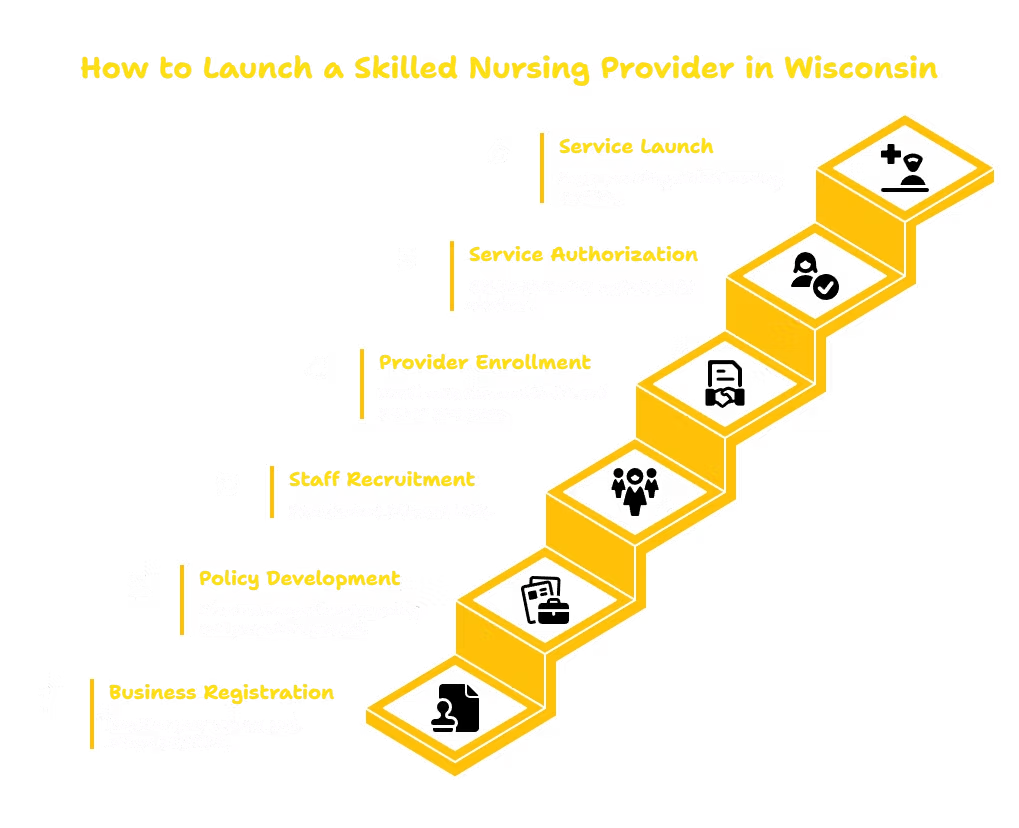
The journey from startup to service delivery involves several sequential phases. The process begins with securing business credentials, followed by applying for enrollment through the ForwardHealth portal specifically as a Skilled Nursing or Home Health provider. During this phase, the agency must submit all requested documentation, including valid nursing licenses for staff, the finalized P&P Manual, and proof of administrative readiness. Providing accurate, complete documentation during the initial application is the most effective way to prevent delays.
Once the agency is recognized by ForwardHealth, the next step involves active outreach to the network of IRIS Fiscal Employer Agents (FEAs) and MCOs. This is crucial for agencies aiming to serve participants in waiver programs. The launch timeline generally spans several months, reflecting the rigorous nature of state and managed care vetting. Agencies should prepare for a 2–4 week period for business setup, 30–60 days for staffing and compliance, and 2–3 months for the completion of network enrollments before formal service initiation.
Maintaining Compliance through Clinical Documentation
Compliance is the backbone of a successful nursing agency. Because these services are funded by Medicaid and waiver programs, the integrity of the clinical record is subject to frequent audits. Agencies are responsible for maintaining detailed records that confirm that every service billed corresponds directly to a physician’s order and the established Plan of Care. This documentation must clearly reflect the progress of the patient and the necessity of the skilled interventions performed.
Essential components of the agency’s documentation system include rigorous shift notes, RN supervision logs for LPNs, and clear medication administration records. The P&P Manual must explicitly outline the protocols for HIPAA compliance, infection control, and emergency response. Furthermore, maintaining a current record of staff credentials and proof of ongoing continuing education is a strict requirement. Any breach in documentation standards can jeopardize provider status and lead to recoupments or termination from the Medicaid network.
Frequently Asked Questions
What is the difference between an RN and an LPN in this context?
An RN is responsible for the overall assessment, the creation and oversight of the Plan of Care, and the supervision of other clinical staff. An LPN functions under the supervision of the RN and is qualified to perform delegated skilled tasks such as injections, wound care, and routine monitoring.
How are nursing services authorized under the IRIS program?
Under the IRIS self-direction waiver, participants work with their IRIS Consultant to identify their clinical needs. Once identified, the participant or their representative arranges for services, and the cost is authorized through the Fiscal Employer Agent (FEA) based on the individual’s budget and care plan.
Are there ongoing training requirements for nursing staff?
Yes, all clinical staff must complete regular training in universal precautions and infection control, emergency procedures, and medication safety. Agencies are also required to conduct annual skills validations and regular charting audits to ensure that staff practice remains aligned with the agency's P&P Manual and state regulations.
Key Takeaway: Developing a successful Skilled Nursing agency in Wisconsin requires a disciplined integration of clinical expertise with strict adherence to Medicaid and waiver-specific administrative protocols. By focusing on comprehensive documentation, professional staff credentialing, and systematic alignment with DHS and ForwardHealth requirements, providers can deliver sustainable, high-quality care that supports the health and stability of the individuals they serve.
Last verified: 2024. The information provided is for educational purposes only and does not constitute legal or professional advice. Requirements for Medicaid and waiver programs may change; always consult the Wisconsin Department of Health Services and ForwardHealth directly for the most current policy and regulatory guidance.