SKILLED NURSING SERVICES PROVIDER IN WASHINGTON
By Fatumata Kaba · 2026-04-06 · 6 min read
Skilled Nursing Services in Washington offer essential clinical care for individuals requiring ongoing medical monitoring, rehabilitation, or complex health management within their own homes. By providing these services under the umbrella of Apple Health (Washington Medicaid) and Home and Community-Based Services (HCBS) waivers, providers enable vulnerable populations to maintain medical stability and independence while avoiding unnecessary institutionalization.
For healthcare entrepreneurs and agency administrators, entering the Washington skilled nursing market requires a robust understanding of state regulations, clinical documentation standards, and the nuances of the Medicaid reimbursement system. This guide outlines the operational framework, regulatory requirements, and strategic steps necessary to establish a compliant and effective skilled nursing provider agency in Washington State.
How Are Skilled Nursing Services Regulated in Washington?
The provision of skilled nursing in Washington is governed by a multi-agency framework designed to ensure patient safety and clinical excellence. Oversight is primarily divided between the Washington State Department of Health (DOH), the Health Care Authority (HCA), the Developmental Disabilities Administration (DDA), and the Department of Social and Health Services (DSHS). Navigating this landscape requires careful adherence to the specific mandates of each agency.
The Department of Health (DOH) is the primary regulatory body for licensing. Whether operating as an independent home health agency or managing individual nurse practice, providers must adhere to rigorous clinical practice standards. Simultaneously, the HCA manages the financial backbone of these services through Apple Health, while the DDA and DSHS play critical roles in authorizing care based on individual medical necessity and coordinating waiver-specific supports.
- Department of Health (DOH): Licenses home health agencies and monitors individual nursing practice standards.
- Health Care Authority (HCA): Oversees the billing, reimbursement, and administration of Apple Health Medicaid programs.
- Developmental Disabilities Administration (DDA): Authorizes specific nursing services for participants enrolled in DDA waivers.
- Department of Social and Health Services (DSHS): Manages the credentialing of caregivers and sets the standards for in-home service support.
What Clinical Services Qualify for Medicaid Reimbursement?
Medicaid covers skilled nursing when services are deemed medically necessary and delivered by a licensed Registered Nurse (RN) or Licensed Practical Nurse (LPN). These services must always be provided under a valid physician’s order and documented within a formal Plan of Care (POC). The scope of work is focused on interventions that require professional clinical judgment rather than basic custodial care.
Providers must maintain meticulous clinical documentation to justify the need for these services. Common billable interventions include complex medication administration, such as IV therapy or specialized injections, and chronic disease management. Furthermore, patients with significant respiratory needs, such as those requiring ventilator support or tracheostomy care, are frequently authorized for long-term skilled nursing support to ensure their health remains stable at home.
- Medication administration, including IVs and complex injections.
- Advanced wound care and pressure ulcer management.
- Catheter, ostomy, and tube-feeding care.
- Respiratory therapy, including ventilator or tracheostomy maintenance.
- Pre- and post-operative monitoring and clinical education for families.
What Are the Prerequisites for Agency Enrollment?
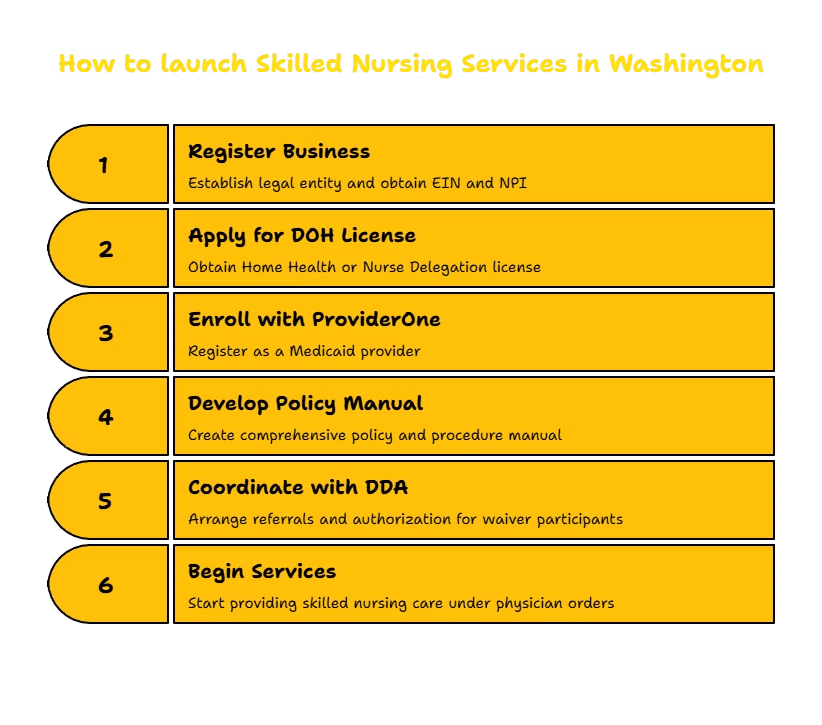
Launching a skilled nursing provider agency in Washington is a multi-phased process that begins with formal business registration and concludes with Medicaid enrollment. Before any patient can be served, the business entity must be recognized by the state and possess the necessary operational documentation, including a comprehensive Policy & Procedure Manual that reflects both state and federal (CMS) requirements.
Agencies must secure appropriate insurance, including malpractice, general liability, and workers’ compensation coverage. Additionally, individual nurses performing the work must hold active Washington state licenses and clear comprehensive background checks. The process of enrolling as a Medicaid provider through the ProviderOne portal is the final gateway to billing, requiring all professional credentials to be current and verified by the relevant state boards.
- Register the business with the Washington Secretary of State and obtain an EIN and Type 2 NPI.
- Secure a Home Health Agency license through the DOH if operating under the agency model.
- Develop a comprehensive Policy & Procedure Manual covering scope of practice, infection control, and emergency response.
- Enroll in the ProviderOne portal to obtain an official Medicaid provider number.
- Establish clinical workflows for physician order processing and POC development.
How Do Agencies Manage Staffing and Compliance?
Quality assurance and clinical oversight are the cornerstones of a successful skilled nursing operation. Registered Nurses (RNs) are responsible for performing initial assessments and developing the Plan of Care. They must also provide ongoing supervision for Licensed Practical Nurses (LPNs) and any home health aides, ensuring that the care delivered consistently aligns with the physician’s orders and the patient’s evolving medical needs.
Beyond clinical skills, all staff members must undergo rigorous mandatory training. This includes HIPAA compliance, abuse prevention protocols, documentation accuracy, and infection control standards. Regular skills competency checks are not only a best practice but a regulatory requirement to maintain the agency’s licensure. Administrators must maintain clear, accessible logs of these certifications to ensure they are prepared for state audits at any time.
Frequently Asked Questions
What is the difference between Apple Health State Plan and HCBS Waivers?
Apple Health State Plan covers short-term, acute nursing needs typically ordered following a hospitalization. In contrast, HCBS waivers, such as the Core, Basic Plus, and Community First Choice (CFC) programs, provide ongoing, long-term support for individuals with disabilities or chronic conditions who require skilled intervention to live safely in the community.
Is a Home Health Agency license always required?
If you are operating as a professional agency that employs nurses to provide home health services, a DOH Home Health license is a prerequisite. Individual practitioners may have different paths, but for those scaling a business model, the agency license is the primary requirement to operate within the Washington regulatory environment.
What happens if a patient’s medical needs change?
When a patient’s condition changes, the Plan of Care must be updated immediately to reflect new medical necessities. This requires coordination with the patient’s physician to obtain updated orders, which must then be approved by the authorizing entity, such as the DDA or a case manager, before the provider can bill for new or modified services.
Strategic Roadmap for Launching Services
The timeline for launching a skilled nursing agency typically spans several months, requiring dedicated attention to administrative and clinical details. Business setup and licensing generally consume the first 1-2 months, followed by the rigorous DOH application and ProviderOne enrollment phase, which can take an additional 2-3 months. Following these steps, the development of internal policies and staff credentialing takes approximately 2-4 weeks.
Once the infrastructure is in place, service delivery begins upon the receipt of authorized physician orders and a confirmed POC. Providers who prioritize building relationships with case managers and DDA representatives often find a smoother referral process once they have proven their administrative and clinical readiness. Success in this sector depends on the consistent, accurate execution of care plans and strict adherence to the standards set by Washington state regulatory bodies.
Key Takeaway: Successful operation as a Washington skilled nursing provider requires a dual focus on rigorous administrative compliance and high-quality clinical documentation. By maintaining strict adherence to DOH and HCA guidelines and ensuring all staff hold current credentials, agencies can provide vital, reimbursed care that allows medically fragile individuals to thrive in community-based settings.
Last verified: 2024. Waiver Consulting Group provides this information for educational purposes only and does not constitute legal or professional advice. Always consult with the Washington State Department of Health (DOH), the Health Care Authority (HCA), and the Department of Social and Health Services (DSHS) for the most current regulations and licensing requirements specific to your unique business structure.