SKILLED NURSING SERVICES PROVIDER IN VIRGINIA
By Fatumata Kaba · 2026-04-08 · 5 min read
Delivering Clinical Care at Home to Support Medical Stability, Independence, and Quality of Life
Skilled Nursing Services in Virginia encompass medically necessary clinical care provided to individuals with chronic conditions, disabilities, or post-acute needs within the comfort of their own homes or community settings. By providing essential, hands-on professional care, these services play a critical role in preventing unnecessary hospitalizations and ensuring that individuals with complex medical profiles can maintain their independence and quality of life while receiving high-level clinical oversight.
For healthcare providers, offering these services requires navigating a rigorous regulatory landscape governed by the Virginia Department of Medical Assistance Services (DMAS) and the Virginia Department of Health (VDH). Whether operating under the CCC Plus Waiver, the Community Living (CL) Waiver, the Family and Individual Supports (FIS) Waiver, or the Early and Periodic Screening, Diagnostic, and Treatment (EPSDT) program for children, providers must adhere to strict state standards to ensure clinical safety, regulatory compliance, and successful reimbursement.
What Are the Roles of Governing Agencies and MCOs in Virginia?
The provision of Skilled Nursing in Virginia is a highly regulated effort that necessitates coordination between several key agencies. The Virginia Department of Medical Assistance Services (DMAS) serves as the primary authority, administering Medicaid coverage and overseeing the provider enrollment process. Concurrently, the Virginia Department of Health (VDH) holds the responsibility for licensing Home Care Organizations (HCOs), ensuring that every agency meets the health and safety standards required to provide care in a home-based environment.
In addition to state agencies, providers must engage with Managed Care Organizations (MCOs) and Community Services Boards (CSBs). Under the CCC Plus program, MCOs are responsible for managing authorization and facilitating reimbursement for skilled nursing services. For those operating under the CL and FIS Waivers, coordination typically shifts to local CSBs. Understanding the unique reporting and authorization requirements of each entity is a fundamental prerequisite for any agency administrator aiming to maintain a compliant and sustainable practice.
What Scope of Clinical Care Is Included in Skilled Nursing?
Skilled Nursing is defined by the delivery of complex, hands-on clinical care that requires the expertise of a licensed nurse under the supervision of a physician. Services are not custodial in nature; rather, they are targeted interventions designed to manage significant health conditions. Every service provided must be documented as medically necessary and must align strictly with a physician-ordered Plan of Care.
Common covered services for skilled nursing providers include:
- Medication administration, including oral, intramuscular, and intravenous delivery.
- Advanced wound care, dressing changes, and pressure ulcer management.
- Respiratory support, including tracheostomy care and ventilator management.
- Maintenance of medical devices such as catheters and ostomy equipment.
- Enteral nutrition, tube feedings, and clinical suctioning.
- Ongoing monitoring of chronic diseases such as epilepsy or diabetes.
- Caregiver education, patient health documentation, and comprehensive RN assessments.
How Do Providers Navigate Licensing and Enrollment Requirements?
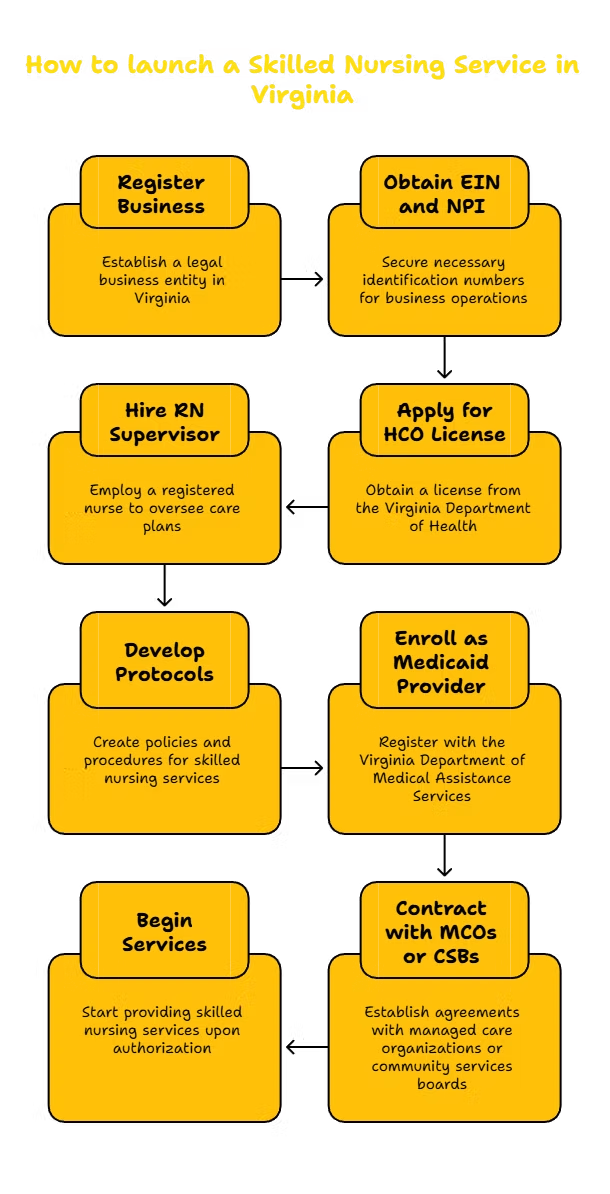
Becoming an approved Skilled Nursing provider in Virginia is a multi-step process that demands careful attention to detail. Agencies must first establish a formal business entity, register with the Virginia State Corporation Commission (SCC), and secure a federal Employer Identification Number (EIN) and a Type 2 National Provider Identifier (NPI). This foundational step allows the business to legally enter into contracts and engage with regulatory bodies.
Once the business entity is established, the agency must apply for a Home Care Organization (HCO) license from the VDH. This process involves a formal inspection to ensure the organization is prepared to provide safe, professional care. Following licensure, the agency must enroll as a Medicaid provider through the Medicaid Enterprise System (MES) portal. Throughout this phase, it is vital to maintain appropriate general liability, workers’ compensation, and clinical malpractice insurance to protect the business and its staff.
What Are the Essential Staffing and Policy Documentation Standards?
Operational success depends heavily on the quality of the clinical team and the depth of the agency's policy manual. The agency must employ a Director of Nursing (RN) who is responsible for overseeing the development of individualized Plans of Care, conducting initial and periodic assessments, and providing direct supervision to Licensed Practical Nurses (LPNs). Both RNs and LPNs must hold active, unencumbered Virginia licenses and undergo regular competency testing.
In addition to staff qualifications, an agency must maintain a comprehensive Policy & Procedure Manual. This document must explicitly cover clinical protocols, medication administration, infection control, wound care standards, and emergency response procedures. Furthermore, providers must maintain rigorous documentation templates—such as shift notes and Medication Administration Records (MARs)—that meet both HIPAA and Medicaid standards to ensure the agency remains "audit-ready" at all times.
What Is the Typical Timeline for Launching a Skilled Nursing Program?
The timeline to launch is influenced by the length of the VDH licensing inspection process and the speed of state-level enrollment through the MES portal. Generally, agencies should anticipate a phased timeline of several months to achieve full operational status.
- Business Formation & HCO Licensing: 2–3 months, including the VDH inspection process.
- Medicaid Enrollment & MCO/CSB Contracting: 1–2 months, contingent on portal processing times and contract negotiations.
- Staff Hiring, Credentialing & Policy Development: 4–6 weeks, focusing on verifying licensure, conducting background checks, and ensuring staff training.
- Launch of Services: Commences only after the official Plan of Care is approved and the service authorization is received from the payer.
Frequently Asked Questions
Does Medicaid cover Skilled Nursing for pediatric patients in Virginia?
Yes, children under the age of 21 who are eligible for Medicaid may receive pediatric nursing services through the EPSDT program, provided the care is deemed medically necessary and follows an approved physician’s Plan of Care.
What is the difference between an MCO and a CSB in this context?
MCOs manage authorization and reimbursement for individuals enrolled in the CCC Plus waiver program. In contrast, Community Services Boards (CSBs) coordinate services and authorizations for individuals participating in the Community Living (CL) and Family and Individual Supports (FIS) waivers.
What qualifications must a nursing supervisor hold?
A Director of Nursing must be a Registered Nurse (RN) with an active Virginia license. They are responsible for the clinical integrity of the agency, including the development of Plans of Care, staff supervision, and ensuring that all care provided aligns with state regulations.
Key Takeaway
Operating a Skilled Nursing agency in Virginia requires a dual focus on rigorous clinical compliance and disciplined administrative management. By adhering to the licensing requirements of the VDH and the provider enrollment standards of the DMAS, and by maintaining a robust policy framework that supports both RN and LPN staff, agencies can successfully deliver essential, life-sustaining services within the Commonwealth’s Medicaid waiver landscape.
Last verified: August 2024. This content is for informational purposes only and does not constitute legal or medical advice. Providers are responsible for consulting current Virginia Department of Medical Assistance Services (DMAS) and Virginia Department of Health (VDH) regulations for the most up-to-date program requirements.