SKILLED NURSING SERVICES PROVIDER IN VERMONT
By Fatumata Kaba · 2026-04-09 · 5 min read
Delivering Medically Necessary Skilled Nursing Services in Vermont
Skilled Nursing Services in Vermont provide essential clinical support to individuals with chronic health conditions, disabilities, or post-acute recovery needs within their home or community setting. By bridging the gap between institutional care and independent living, these services ensure that participants receive professional medical oversight, medication management, and complex clinical intervention while remaining in their preferred environment.
This service model is strictly regulated under Vermont Medicaid’s State Plan and various Home and Community-Based Services (HCBS) Waivers. To operate as a provider, organizations must maintain rigorous adherence to clinical protocols authorized through an Individual Support Plan (ISP) or a physician-ordered Plan of Care, all while maintaining active compliance with the Department of Vermont Health Access (DVHA) and the Department of Disabilities, Aging and Independent Living (DAIL).
Navigating the Regulatory Landscape and Oversight Agencies
Understanding the interplay between state agencies is the foundation of a successful skilled nursing program. In Vermont, the Department of Vermont Health Access (DVHA) serves as the primary entity for Medicaid billing, managing prior authorizations, and establishing reimbursement standards. Compliance with DVHA protocols is mandatory for any agency seeking to bill for professional nursing time.
Simultaneously, the Department of Disabilities, Aging and Independent Living (DAIL) oversees waiver-based services, ensuring that the clinical support provided aligns with the participant's ISP goals. Providers must also coordinate with the Vermont Secretary of State’s Office of Professional Regulation (OPR) to ensure that all Registered Nurses (RNs) and Licensed Practical Nurses (LPNs) possess current, active, and unencumbered licenses. Furthermore, Designated Agencies (DAs) or Specialized Services Agencies (SSAs) often act as intermediaries, coordinating service delivery and granting necessary authorizations for ISP-based nursing supports.
Clinical Scope and Service Delivery Requirements
Skilled Nursing Services are characterized by the delivery of high-level medical care that requires the expertise of a licensed clinician. These services are intended to stabilize chronic conditions, prevent hospitalizations, and facilitate the safe administration of complex treatments in a non-clinical setting. The breadth of services is wide, yet every action must be directly linked to a physician’s order or an established Plan of Care.
Covered services include, but are not limited to, the following interventions:
- Medication administration, injections, and complex pharmaceutical management.
- Advanced wound care, dressing changes, and pressure ulcer management.
- Life-sustaining support, including ventilator or tracheostomy care.
- Specialized clinical tasks such as catheter and ostomy maintenance.
- Monitoring of chronic conditions like diabetes, epilepsy, and seizure disorders.
- Symptom management, including pain relief and respiratory therapy.
- Clinical training for family members and informal caregivers.
- Establishing emergency response readiness for high-risk, medically fragile individuals.
Establishing and Enrolling as a Medicaid Provider
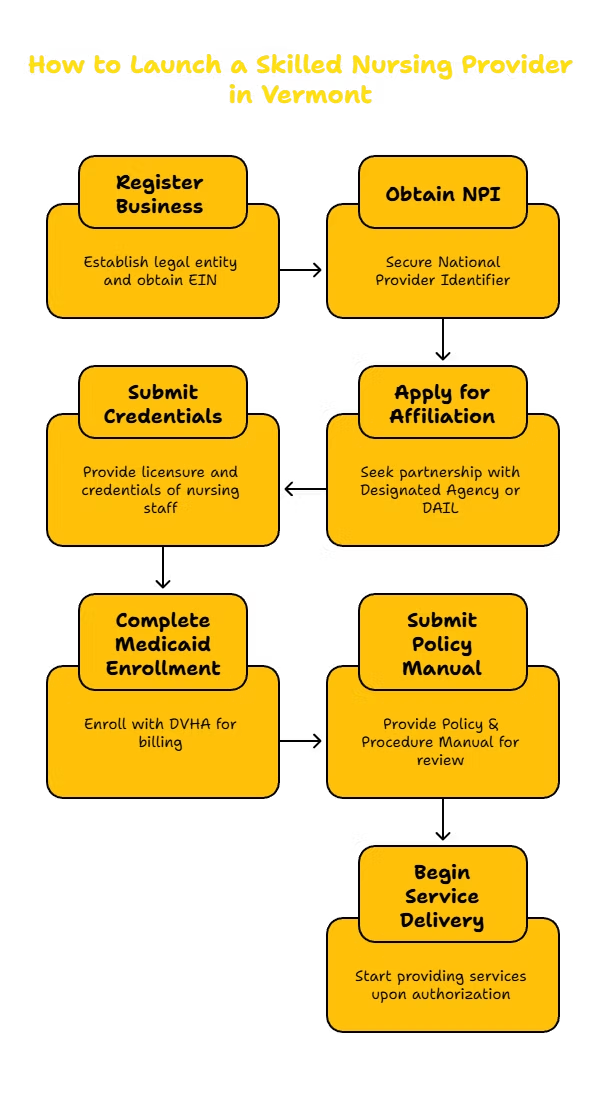
Launching a Skilled Nursing agency in Vermont is a sequential process that demands significant attention to administrative detail. The foundation of the operation requires formal business registration with the Secretary of State, followed by the acquisition of an Employer Identification Number (EIN) and a Type 2 National Provider Identifier (NPI). These initial steps are the prerequisites for all subsequent interactions with the state’s fiscal agent.
Once the legal entity is formed, the provider must obtain affiliation through a Designated Agency or apply for independent approval through DVHA. This phase includes the critical development of a comprehensive Skilled Nursing Policy & Procedure Manual. This document acts as the organization’s blueprint for compliance, outlining internal controls for clinical care, emergency response, and HIPAA adherence. After completing these internal preparations, the provider must finalize the Medicaid enrollment process through DVHA to receive billing privileges and begin service delivery.
Staffing, Supervision, and Clinical Competency
The quality of skilled nursing care relies on a workforce that is both highly skilled and continuously monitored. Registered Nurses (RNs) are expected to lead the clinical program, perform complex assessments, design care plans, and provide direct supervision to Licensed Practical Nurses (LPNs). Every staff member, regardless of their role, must hold a valid Vermont license issued by the OPR and maintain current CPR certification.
To ensure patient safety, agencies must implement a robust internal training and auditing system. All staff are required to complete mandatory training regarding HIPAA regulations, infection control, universal precautions, and emergency intervention. Additionally, administrators must maintain a system for tracking Continuing Education Units (CEUs) and performing annual clinical competency reviews, ensuring that all personnel remain qualified to execute the specific medical interventions outlined in individual Plans of Care.
Integration with Vermont Medicaid Waiver Programs
Skilled Nursing is a vital component of several HCBS waiver programs designed to support independence. Providers must be familiar with the specific requirements of each program, as the scope of service may vary based on the participant's needs and program constraints. Services are typically authorized through the following channels:
- Choices for Care (CFC) Waiver: Supports adults with physical disabilities or age-related care requirements.
- Developmental Disabilities Services Waiver (DDSW): Provides care for individuals with intellectual or developmental disabilities who have concurrent medical needs.
- Brain Injury Program: Facilitates specialized, high-intensity care for participants recovering from or living with traumatic brain injuries.
- Children with High-Tech Needs: Focuses on pediatric populations requiring advanced support such as tracheostomy or ventilator care.
- Children’s Personal Care Services (CPCS): Covers skilled nursing interventions for children requiring specialized home-based support.
Frequently Asked Questions
What is the difference between an RN and an LPN in a home care setting?
Registered Nurses (RNs) typically perform comprehensive clinical assessments and develop the overarching care plan. Licensed Practical Nurses (LPNs) provide direct, hands-on clinical care and medication administration under the guidance and supervision of the RN, following the directives established in the participant's Plan of Care.
Are independent providers allowed to bill Medicaid directly?
While independent entities can enroll as Medicaid providers with DVHA, many skilled nursing services are administered through Designated Agencies (DAs) or Specialized Services Agencies (SSAs). It is essential to verify current affiliation requirements with the Department of Disabilities, Aging and Independent Living (DAIL) to determine if your agency requires a specific contract to bill for waiver services.
What documentation is required for a compliance audit?
Providers should maintain detailed records including, but not limited to, active nursing licenses, current physician orders, signed Plans of Care, daily shift notes, medication administration records, and proof of ongoing staff competency training. These documents must be readily accessible for review by DVHA or DAIL to verify service necessity and quality.
Key Takeaway
Operating a Skilled Nursing agency in Vermont requires a strategic approach that balances clinical excellence with strict adherence to Medicaid billing and administrative regulations. Success depends on maintaining robust documentation, ensuring continuous staff competency, and fostering strong collaborative relationships with state agencies like DVHA and DAIL to ensure that medically complex participants receive the care they need to live independently.
Last verified: October 2023. Disclaimer: This article is for informational purposes only and does not constitute legal or professional advice. Requirements for Medicaid providers in Vermont are subject to change; always verify current regulations through official state portals and contact the Department of Vermont Health Access or the Department of Disabilities, Aging and Independent Living directly for the most current guidance on licensure and enrollment.