SKILLED NURSING SERVICES PROVIDER IN TEXAS
By Fatumata Kaba · 2026-03-30 · 5 min read
DELIVERING CLINICALLY SUPERVISED CARE IN HOME AND COMMUNITY SETTINGS TO PROMOTE HEALTH, SAFETY, AND STABILITY FOR MEDICAID WAIVER PARTICIPANTS
Skilled Nursing Services in Texas are defined as medically necessary, clinically supervised interventions provided by licensed nursing professionals to individuals enrolled in Medicaid programs. These services are authorized under the Texas Medicaid State Plan and 1915(c) Home and Community-Based Services (HCBS) Waiver programs, ensuring participants receive essential clinical care within their home or community environment under the regulatory oversight of the Texas Health and Human Services Commission (HHSC).
Understanding the Regulatory Landscape for Texas Skilled Nursing
Operating a Skilled Nursing agency in Texas requires navigating a multi-layered regulatory environment. Providers must maintain alignment with both state-specific mandates and federal guidelines set by the Centers for Medicare & Medicaid Services (CMS). At the state level, the Texas Health and Human Services Commission (HHSC) serves as the primary authority, overseeing service authorizations, provider enrollment, and reimbursement protocols for all waiver and state plan programs.
In addition to HHSC, agencies must adhere to the clinical practice standards established by the Texas Board of Nursing (BON). The BON regulates licensure, scope of practice, and professional conduct for all nursing staff. Furthermore, the Texas Department of State Health Services (DSHS) is responsible for the licensure of Home and Community Support Services Agencies (HCSSAs), which is the foundational legal status required to deliver professional nursing services in a home-based setting.
Core Scope and Examples of Skilled Nursing Interventions
Skilled Nursing Services are characterized by goal-driven, medically necessary care performed by a Registered Nurse (RN) or a Licensed Vocational Nurse (LVN/LPN). These services must be delivered pursuant to a valid physician’s order or an established plan of care. The primary objective of these interventions is to treat, manage, or monitor complex health conditions, thereby preventing medical complications and supporting the participant’s ability to remain in a community-based setting.
Common clinical interventions managed by skilled nursing providers include:
- Medication administration, including complex injections and intravenous (IV) therapy.
- Wound care, dressing changes, and pressure ulcer management.
- Respiratory support, including tracheostomy and ventilator care.
- Management of specialized equipment, such as catheters and ostomies.
- Enteral nutrition, specifically G-tube feeding and monitoring.
- Regular clinical assessments, vital signs monitoring, and health status tracking.
- Comprehensive health education and training for primary caregivers.
- Coordination of care between primary care physicians and medical specialists.
The Roadmap to Provider Enrollment and Licensure
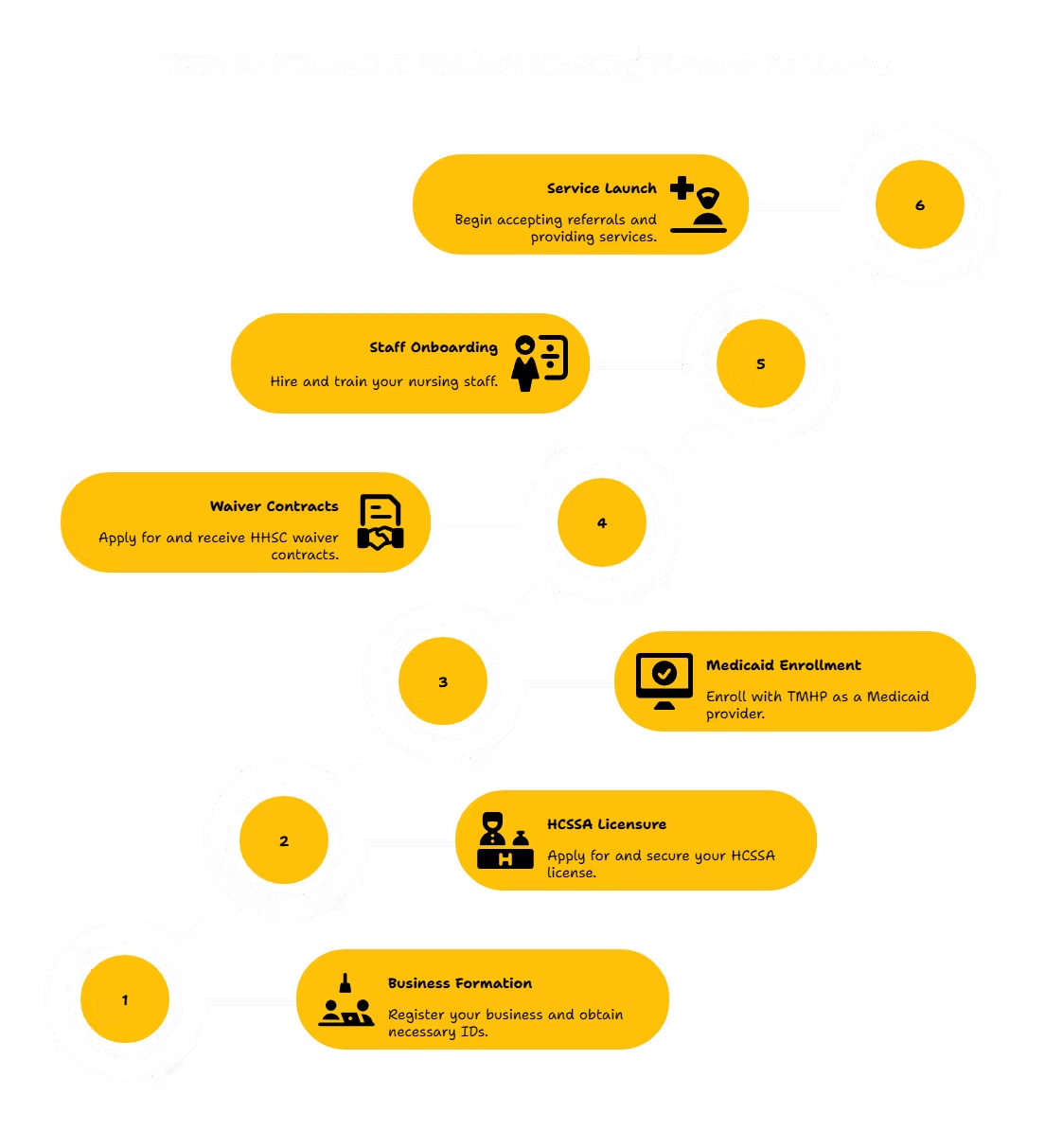
Becoming an approved provider is a multi-step process that requires formal business registration, state licensure, and Medicaid enrollment. Initially, providers must register their business entity with the Texas Secretary of State and obtain a federal Employer Identification Number (EIN) and a Type 2 National Provider Identifier (NPI). These foundational steps are mandatory before pursuing clinical licensure.
The progression of the enrollment process generally follows this sequence:
- HCSSA Licensure: Apply for a Home and Community Support Services Agency license through the Texas DSHS, specifically designating "Licensed and Certified Home Health Services."
- TMHP Enrollment: Enroll as a Medicaid provider through the Texas Medicaid & Healthcare Partnership (TMHP) portal to establish billing capabilities.
- HHSC Contracting: Once licensed and enrolled, submit applications for specific HHSC waiver contracts such as HCS, CLASS, DBMD, or MDCP.
- Readiness Review: Prepare for administrative and clinical audits to verify that the agency is ready to accept physician referrals and service authorizations.
Establishing Essential Clinical Documentation and Policies
A compliant skilled nursing provider must maintain a comprehensive Policy & Procedure Manual. This document serves as the regulatory backbone of the agency, detailing how the provider ensures patient safety and adheres to state standards. Documentation must be robust, reflecting clinical accuracy and adherence to the physician’s orders for every visit or intervention performed.
Key components of an agency's documentation and policy infrastructure include:
- Clinical protocols for specialized procedures, including G-tube management and wound care.
- Formal nurse delegation procedures and RN supervisory standards.
- Templates for care planning, service documentation, and physician order forms.
- Standardized incident reporting mechanisms and protocols for protecting client rights.
- Infection control and emergency preparedness policies specific to home settings.
- Accurate billing logs that correlate directly with verified clinical service delivery.
Staffing, Supervision, and Professional Compliance
Staffing mandates prioritize both clinical competence and regulatory adherence. An RN must lead the clinical oversight, holding responsibility for initial and ongoing assessments, care plan development, and the delegation of tasks to LVNs. All nursing staff must possess an active, unencumbered Texas license and demonstrate competency through initial orientation and annual training requirements.
Ongoing staff compliance training must address critical areas, including:
- Medicaid waiver program orientation and documentation requirements.
- HIPAA privacy standards and abuse prevention protocols.
- Safety procedures, CPR certification, and infection control.
- Task delegation processes and clinical supervision oversight.
Frequently Asked Questions
What waivers are currently eligible for Skilled Nursing reimbursement?
Skilled Nursing services are reimbursable under the HCS, CLASS, DBMD, and MDCP waivers. The TxHmL program may also cover these services subject to specific clinical justification, and the Texas Medicaid State Plan provides coverage for short-term home health episodes.
How long should a provider expect the start-up process to take?
Business formation and HCSSA licensure typically span 2–4 months. TMHP Medicaid enrollment usually requires 1–2 months, while HHSC waiver contract applications generally take 2–3 months. The total timeline is highly dependent on application accuracy and the timing of state-conducted inspections.
What is the role of an RN in the delegation process?
The Registered Nurse is responsible for assessing the client's health status and determining which tasks are appropriate to delegate to unlicensed personnel or LVNs. The RN must provide ongoing supervision and ensure that the delegatee maintains the necessary competencies to perform the task safely and accurately.
Key Takeaway
The successful operation of a Skilled Nursing provider in Texas requires meticulous attention to the licensing standards of the DSHS, the contracting requirements of the HHSC, and the clinical practice regulations of the Board of Nursing. By establishing a rigorous policy framework and ensuring constant staff compliance, agencies can effectively support the health and stability of Medicaid waiver participants while meeting all state-mandated accountability standards.
Last verified: October 2023. Disclaimer: This article is for informational purposes only and does not constitute legal or professional medical advice. Always consult with the Texas Health and Human Services Commission (HHSC) or a qualified consultant for the most current regulatory requirements.