SKILLED NURSING SERVICES PROVIDER IN TENNESSEE
By Fatumata Kaba · 2025-10-22 · 5 min read
DELIVERING CLINICALLY NECESSARY CARE IN THE HOME OR COMMUNITY TO SUPPORT HEALTH, STABILITY, AND INDEPENDENCE
Skilled Nursing Services in Tennessee are medically necessary, licensed nursing services provided in a participant’s home or community setting to support individuals with complex medical needs. These services are authorized through TennCare’s State Plan Home Health Benefit, the Employment and Community First (ECF) CHOICES program, and various 1915(c) Waivers, ensuring that patients receive professional care essential for maintaining their stability and independence outside of institutional settings.
Professional providers must be licensed to practice in Tennessee and typically operate under a physician-ordered plan of care. By providing services such as medication administration, wound care, and health assessments, these providers play a critical role in the state's Home and Community-Based Services (HCBS) framework.
1. Understanding the Governing Agencies and Regulatory Framework
The delivery of skilled nursing in Tennessee is overseen by a collaborative network of state and federal entities. Each agency holds a distinct role in ensuring that providers remain compliant with safety, licensure, and billing requirements. TennCare, as the state’s Medicaid program, administers the financial reimbursement for services across State Plan and waiver programs, while the Centers for Medicare & Medicaid Services (CMS) sets the overarching federal guidelines for quality and compliance.
At the state level, operational oversight is split between the Tennessee Department of Health (DOH) and the Tennessee Department of Intellectual and Developmental Disabilities (DIDD). The DOH maintains authority over the licensing of home health agencies and regulates the general scope of nursing practice, while the DIDD provides direct oversight for providers serving individuals with intellectual and developmental disabilities under the ECF CHOICES program and legacy 1915(c) waivers.
2. Core Components of Skilled Nursing Services
Skilled nursing services must meet a rigorous standard of medical necessity and are documented within a participant’s Individualized Service Plan (ISP) or physician-ordered plan of care. While these services are generally intermittent, the complexity of a participant's condition may necessitate continuous nursing care in specific, authorized instances. The primary focus remains on stabilizing the patient’s condition and preventing the need for more restrictive, facility-based care.
Providers are expected to maintain comprehensive clinical documentation that tracks the efficacy of the interventions. Common services covered under these programs include:
- Medication Administration (oral, injectable, and IV)
- Wound and Ostomy Care
- Tube Feeding and Tracheostomy Suctioning
- Vital Signs Monitoring and Chronic Disease Management
- Catheter Care and Skin Integrity Monitoring
- Health Assessments and Professional Nursing Documentation
- Coordination with Physician or Care Team
3. Licensing and Provider Approval Requirements
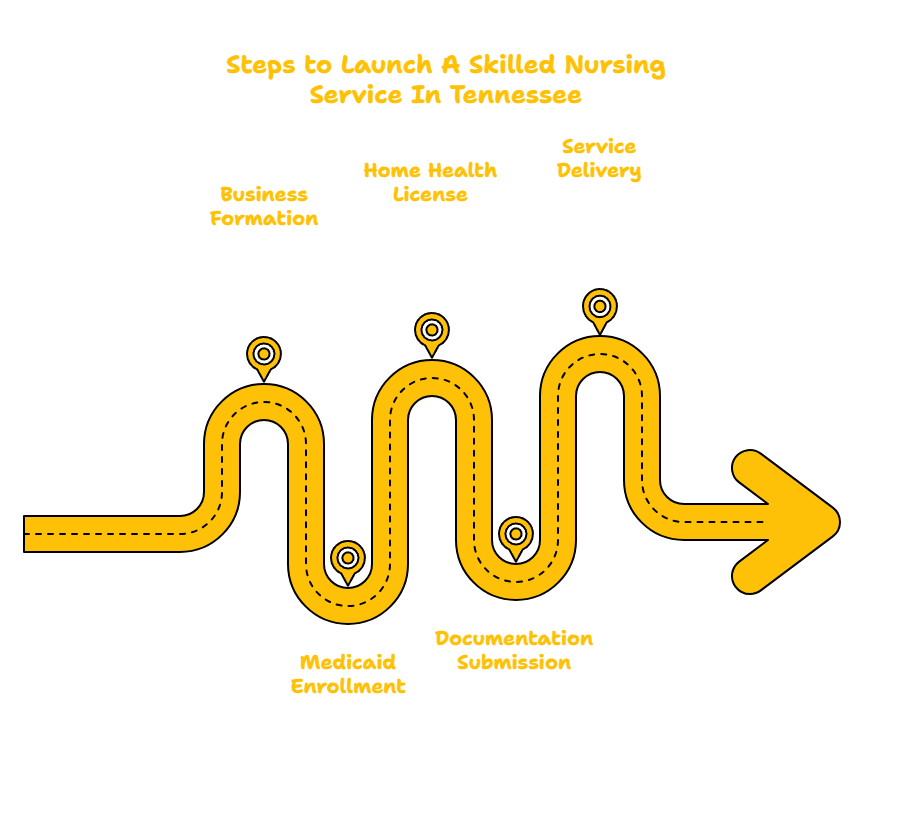
Entering the Tennessee market as a skilled nursing provider requires strict adherence to business and clinical registration protocols. Before billing for services, an entity must establish a formal business structure with the Tennessee Secretary of State and obtain the necessary federal identifiers, including an Employer Identification Number (EIN) and a Type 2 National Provider Identifier (NPI). This foundational step is required for any organization interacting with the Medicaid system.
Beyond basic business registration, specific clinical credentials are mandatory. Organizations operating under a home health model must secure a license from the Tennessee Department of Health. For those focusing on waiver programs, formal registration with the DIDD is required to serve participants within the ECF CHOICES or 1915(c) waiver systems. Maintaining professional liability and general business insurance is a prerequisite for these designations to protect both the agency and the participants served.
4. Navigating the Provider Enrollment Process
The enrollment process is a multi-phased endeavor that requires meticulous attention to detail. Initially, providers must ensure their administrative setup is complete, transitioning into the application phase for TennCare’s State Plan or the DIDD’s waiver program. If the agency provides services that fall under the home health classification, obtaining the DOH license occurs in parallel with these enrollment steps to ensure that the facility meets all state-mandated standards for care.
Once the legal and licensure foundations are set, the focus shifts to the submission of internal agency documentation. This involves preparing staffing rosters, verifying the credentials of all clinical personnel, and detailing the scope of services provided. Enrollment is finalized upon the review of the agency’s policy manuals, after which the agency can begin accepting referrals and delivering services once an Individualized Service Plan has been officially authorized for a participant.
5. Essential Staffing and Clinical Compliance
Qualified staffing is the backbone of any skilled nursing operation. The agency must employ Registered Nurses (RNs) and Licensed Practical Nurses (LPNs) who hold valid Tennessee licenses. RNs are responsible for the oversight of care planning and quality assurance, ensuring that all clinical interventions are performed safely. LPNs may carry out delegated tasks under the supervision of an RN, provided that all actions remain within the scope of practice and follow established agency protocols.
In addition to active licensure and CPR/BLS certification, all clinical staff must undergo ongoing training to maintain compliance. This includes mandatory instruction on HIPAA privacy, infection control, and emergency response procedures. Agency administrators are also responsible for the annual verification of licenses and the tracking of Continuing Education Units (CEUs) for all staff members, ensuring that the team remains equipped to handle the evolving medical needs of their participants.
6. Frequently Asked Questions
What is the difference between State Plan services and waiver services?
State Plan Home Health services are typically designed for acute or chronic medical needs as ordered by a physician. Conversely, ECF CHOICES and 1915(c) waiver programs provide long-term support for individuals with disabilities or complex medical needs, often incorporating skilled nursing tasks directly into the participant’s Individualized Service Plan.
Are there special provisions for children under Medicaid?
Yes, the Early and Periodic Screening, Diagnostic, and Treatment (EPSDT) program provides benefits for individuals under 21, which may include extended skilled care for medically fragile youth. Additionally, the Katie Beckett Program offers a pathway for children with complex medical needs who do not meet standard Medicaid eligibility requirements to receive necessary home-based services.
What documentation is required in the agency’s policy manual?
The policy manual must address all critical operational areas, including the process for obtaining physician orders, medication administration protocols, infection control, emergency procedures, documentation and billing logs, participant rights, and protocols for LPN delegation and RN supervision.
Key Takeaway
Establishing a successful Skilled Nursing Services provider in Tennessee requires a balanced approach that combines rigorous administrative compliance with high-quality clinical oversight. By maintaining strict adherence to TennCare, DOH, and DIDD regulations—and by ensuring that staffing meets all state licensure and credentialing standards—providers can deliver essential care that effectively supports the health and independence of Medicaid participants throughout the state.
Last verified: October 2023. Disclaimer: This article is for informational purposes only and does not constitute legal or professional advice. Always consult directly with the Tennessee Department of Health, TennCare, and the Department of Intellectual and Developmental Disabilities for the most current rules and regulations.