SKILLED NURSING SERVICES PROVIDER IN SOUTH DAKOTA
By Fatumata Kaba · 2025-10-15 · 6 min read
Skilled nursing services in South Dakota provide essential, physician-ordered clinical interventions for individuals with complex medical needs, allowing them to receive professional care within their own homes or community settings. By leveraging Medicaid State Plan benefits and various Home and Community-Based Services (HCBS) waivers, provider agencies play a critical role in delivering high-quality, medically necessary nursing care to vulnerable populations across the state.
What Are the Governing Agencies and Regulatory Frameworks?
The delivery of skilled nursing services in South Dakota is governed by a collaboration between state departments and federal oversight bodies. These agencies work in tandem to ensure that clinical services meet strict safety, quality, and ethical standards, protecting the health of Medicaid beneficiaries while ensuring consistent, professional delivery of care.
The South Dakota Department of Social Services (DSS), specifically the Division of Long-Term Services and Supports (LTSS), is the primary administrator for the Medicaid State Plan Home Health benefit and various LTSS waiver programs. Simultaneously, the Department of Human Services (DHS) and its Division of Developmental Disabilities (DDD) oversee nursing services provided under the CHOICES Waiver. Provider agencies must also maintain strict compliance with the South Dakota Board of Nursing, which governs the licensure of Registered Nurses (RNs) and Licensed Practical Nurses (LPNs), and the Centers for Medicare & Medicaid Services (CMS), which sets the federal foundation for all Medicaid-funded clinical programs.
- South Dakota Department of Social Services (DSS) – Division of LTSS: Oversees State Plan Home Health and LTSS Waiver clinical services.
- South Dakota Department of Human Services (DHS) – Division of Developmental Disabilities (DDD): Manages nursing services for participants in the CHOICES Waiver.
- South Dakota Board of Nursing: Monitors nursing practice standards and practitioner licensure.
- Centers for Medicare & Medicaid Services (CMS): Provides federal oversight for the entire Medicaid program.
What Services Fall Under Skilled Nursing in South Dakota?
Skilled nursing services are defined by their status as "medically necessary" care, meaning they require the clinical expertise of a licensed professional and must be delivered under the direction of a physician or other authorized provider. These services are intended to stabilize chronic conditions, prevent hospitalizations, and manage complex health tasks that a layperson or family caregiver cannot safely perform.
Approved providers are authorized to deliver a broad spectrum of medical interventions. This includes high-acuity care such as intravenous (IV) therapy, tracheostomy maintenance, and tube feeding, as well as routine yet vital clinical management such as medication administration, wound care, and chronic disease monitoring. Additionally, the role of the nurse extends to documentation and health status reporting, ensuring that the physician is kept informed of any changes in the participant’s clinical trajectory.
- Medication Administration: Including injections, oral medications, and IV therapy.
- Clinical Interventions: Wound care, dressing changes, tube feedings, and tracheostomy care.
- Health Monitoring: Chronic disease management, vital signs, and symptom reporting.
- Administrative Clinical Support: Care plan development, nursing documentation, and health status reporting.
How Do You Become an Authorized Provider?
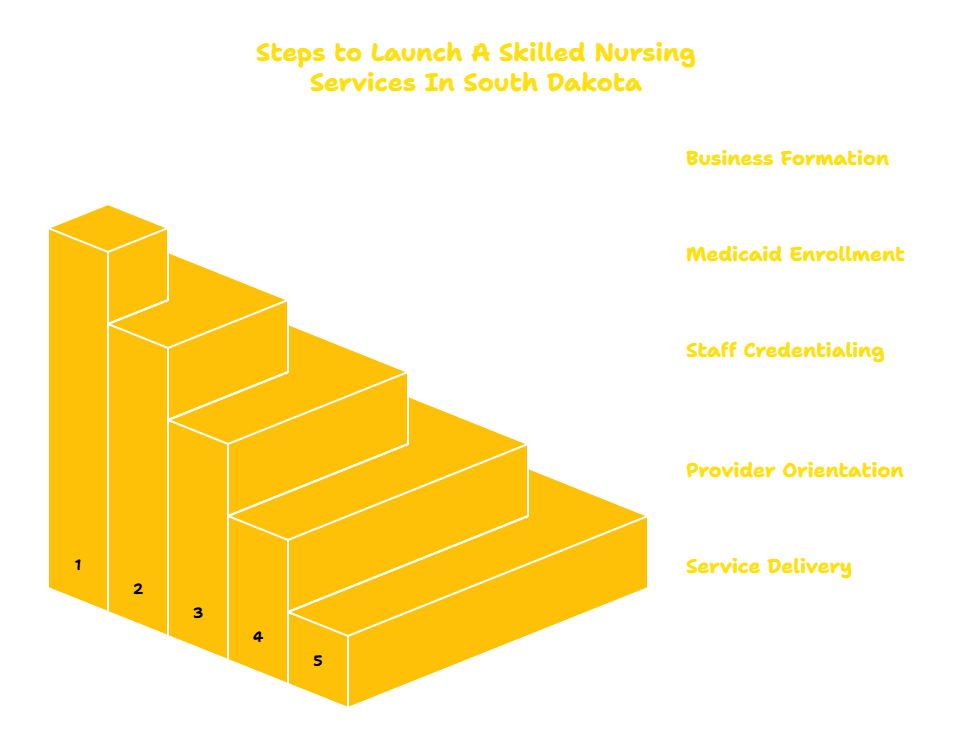
Becoming an approved Medicaid skilled nursing provider in South Dakota requires a rigorous, multi-step administrative and clinical setup process. Agencies must move through several phases, beginning with the legal formation of the business entity and ending with the formal provider enrollment approval through the state’s designated agencies. Failure to properly align with these requirements can lead to delayed approvals or the inability to bill for rendered services.
Prospective providers must first secure their legal standing by registering with the South Dakota Secretary of State and obtaining a unique EIN and Type 2 NPI. Once the business foundation is laid, the agency must develop a comprehensive Skilled Nursing Policy & Procedure Manual. This document serves as the regulatory backbone of the agency, outlining clinical oversight, infection control, HIPAA compliance, and internal audit procedures. Once documentation is complete, the agency applies through the appropriate division of the DSS or DHS, depending on the specific program they intend to serve.
- Business Formation: Registering as a legal entity and obtaining necessary federal identifiers.
- Policy Development: Creating a robust policy manual covering all aspects of clinical care and administration.
- Credentialing: Employing or contracting with licensed RNs and LPNs who hold active South Dakota status.
- Enrollment: Applying for Medicaid enrollment through the DSS or DHS, followed by readiness reviews.
What Are the Essential Staffing and Clinical Requirements?
Staffing requirements are strictly regulated to prioritize patient safety and the quality of clinical outcomes. An agency-based model requires clear lines of authority, where Registered Nurses are typically responsible for case management, clinical decision-making, and the supervision of Licensed Practical Nurses. Every nursing professional must maintain an active, unencumbered license in South Dakota to practice.
In addition to active licensure, staff must demonstrate ongoing competency. Agencies are expected to conduct regular skills assessments, provide training on HIPAA privacy requirements, and ensure that all staff members are proficient in emergency protocols and infection control. The nursing supervisor, in particular, plays a vital role by ensuring that all nursing notes, progress reports, and care plan modifications are accurate, timely, and compliant with state Medicaid regulations.
- Registered Nurses (RN): Responsible for comprehensive care plans, complex interventions, and LPN supervision.
- Licensed Practical Nurses (LPN): Provide services within their scope of practice under RN supervision.
- Nursing Supervisor: Oversees clinical quality assurance, case reviews, and regulatory compliance.
- Mandatory Training: HIPAA compliance, infection control, emergency preparedness, and documentation accuracy.
How Are Skilled Nursing Services Authorized Across Programs?
Skilled nursing is not a singular service; it is authorized across several different Medicaid programs based on the age and medical profile of the participant. The Medically Fragile Waiver is specifically tailored for individuals with high-acuity medical needs, whereas the CHOICES Waiver serves individuals with developmental disabilities who require ongoing medical oversight. For aging adults, the Long-Term Services and Supports (LTSS) Waiver provides the mechanism for intermittent nursing care.
Furthermore, the Medicaid State Plan Home Health Benefit remains the foundation for many physician-ordered, home-based services. Children under the age of 21 also have access to skilled nursing through Early and Periodic Screening, Diagnostic, and Treatment (EPSDT) services, provided the care is deemed medically necessary. Understanding the nuances of each program is critical for providers, as billing codes and documentation requirements may vary between waiver types and State Plan benefits.
Frequently Asked Questions
What is the typical timeline to launch a skilled nursing agency?
The process generally spans 4 to 7 months. This includes 1–2 months for business formation and licensing, 2–3 months for Medicaid enrollment and credential submission, and 1–2 months for staff hiring, training, and final documentation preparation.
Do I need to maintain specific policies for my nursing staff?
Yes. Every agency must maintain a comprehensive Skilled Nursing Policy & Procedure Manual. This must include protocols for care plan development, medication administration, emergency procedures, infection control, HIPAA compliance, and participant rights.
Are LPNs allowed to practice independently in South Dakota?
No. Under the state’s nursing and Medicaid regulations, LPNs must provide services under the supervision of a licensed RN. The RN is responsible for the overall plan of care and clinical oversight of the patient.
Key Takeaway
Establishing a successful skilled nursing agency in South Dakota requires a meticulous approach to clinical documentation, regulatory compliance, and staff management. By aligning your operational procedures with the requirements set forth by the South Dakota DSS, DHS, and the Board of Nursing, you ensure that your agency is positioned to provide vital, medically necessary services to participants while maintaining full compliance with state and federal Medicaid standards.
Waiver Consulting Group provides specialized assistance for licensed clinicians and agency founders, focusing on Medicaid enrollment, policy development, and documentation support to streamline the path to service delivery.
Last verified: 2024. This information is intended for educational purposes and should not be considered legal or medical advice. Consult official state and federal websites for the most current regulatory updates.