SKILLED NURSING SERVICES PROVIDER IN RHODE ISLAND
By Fatumata Kaba · 2025-10-09 · 5 min read
Skilled Nursing Services in Rhode Island provide essential, medically necessary clinical support to individuals with complex health needs within the comfort of their own homes and community-based settings. These Medicaid-reimbursed services are governed by a robust regulatory framework overseen by the Executive Office of Health and Human Services (EOHHS) and the Department of Health (RIDOH) to ensure that medically fragile children and adults with disabilities receive high-quality, professional nursing care.
What Are the Governing Agencies and Regulatory Frameworks?
The delivery of skilled nursing care in Rhode Island is subject to oversight from several key state and federal bodies. The Executive Office of Health and Human Services (EOHHS) maintains primary responsibility for Medicaid eligibility, reimbursement models, and the clinical authorization process. Simultaneously, the Rhode Island Department of Health (RIDOH) serves as the regulatory authority for licensing home care and nursing service agencies, ensuring that all providers adhere to strict professional nursing standards.
For specialized populations, such as individuals with intellectual or developmental disabilities (IDD), the Department of Behavioral Healthcare, Developmental Disabilities & Hospitals (BHDDH) provides additional oversight for the approval of nursing services within specific waiver programs. Furthermore, all state-level programs must remain in strict compliance with federal regulations set forth by the Centers for Medicare & Medicaid Services (CMS) to maintain the integrity of the Medicaid Home and Community-Based Services (HCBS) framework.
- EOHHS: Manages Medicaid eligibility, reimbursement, and service authorization.
- RIDOH: Licenses home nursing agencies and regulates professional standards.
- BHDDH: Approves nursing services for IDD waiver participants.
- CMS: Ensures federal compliance with Medicaid and HCBS regulations.
What Constitutes Skilled Nursing Services for Medicaid Beneficiaries?
Skilled nursing services encompass a broad spectrum of clinical activities designed to support individuals who require consistent medical oversight. These services must be deemed medically necessary and supported by an order from a physician or a licensed healthcare provider. The primary objective is to enable individuals to remain in their homes rather than transitioning to institutional care settings by providing direct clinical support for chronic and acute conditions.
Providers authorized to deliver these services often perform complex medical tasks, including medication administration, such as injections and intravenous therapies, as well as comprehensive wound care and infection control. For individuals with chronic diseases, providers monitor vital signs, manage blood glucose levels for diabetic clients, and provide respiratory support. In cases involving high-needs individuals, such as those who are ventilator-dependent, shift nursing provides continuous or hourly oversight to ensure patient safety and stability.
- Medication Management: Administration of complex regimens, IVs, and injections.
- Clinical Oversight: Vital sign monitoring, seizure tracking, and respiratory support.
- Specialized Care: Catheter, ostomy, and wound care management.
- Patient Support: Education for families and coordination with primary care teams.
- Direct Care: Shift nursing for high-acuity needs.
What Are the Steps to Obtain Licensure and Become a Medicaid Provider?
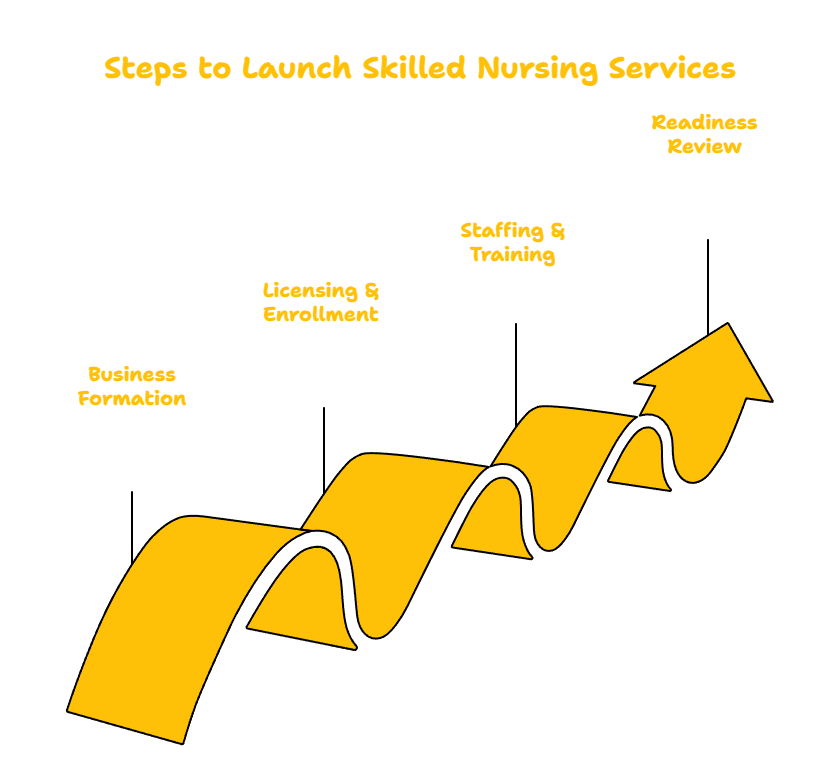
Launching a skilled nursing agency requires a systematic approach to business formation, licensure, and enrollment. Founders must first establish a legal business entity and register with the Rhode Island Secretary of State. Once the entity is formed, the organization must secure an Employer Identification Number (EIN) and a Type 2 National Provider Identifier (NPI). This foundational work is essential before applying for a Home Nursing Care Provider license through the Rhode Island Department of Health.
Following the receipt of state licensure, the provider must enroll in the Rhode Island Medicaid program via the official provider portal. During this phase, it is critical to secure comprehensive professional liability and malpractice insurance. Agencies must also develop a robust internal Policy & Procedure Manual that explicitly details the scope of nursing practice, clinical documentation requirements, medication error reporting protocols, and infection control procedures, all of which are subject to review during the state's enrollment process.
How Do Agencies Manage Staffing and Clinical Documentation?
Successful agencies prioritize rigorous staff credentialing and consistent clinical documentation. Staffing typically involves a team of Registered Nurses (RNs) and Licensed Practical Nurses (LPNs). While RNs often lead the clinical oversight and care plan development, LPNs work under the supervision of an RN to deliver daily care. All nursing staff must maintain active Rhode Island licenses, current CPR certification, and relevant experience in home-based clinical management.
Beyond clinical skills, every staff member must complete mandated training modules, including HIPAA compliance, abuse prevention, and emergency preparedness. Clinical documentation acts as the backbone of the Medicaid reimbursement process; therefore, agencies must ensure that all shift notes, medication administration records, and care plan updates are meticulous. A Director of Nursing or Clinical Supervisor is typically tasked with overseeing these documentation standards to ensure compliance with both EOHHS and RIDOH requirements.
Which Medicaid Waiver Programs Support Skilled Nursing?
Skilled nursing services are integrated into several Medicaid programs, each tailored to specific beneficiary populations. The Rhode Island Medicaid State Plan provides services for children through Early and Periodic Screening, Diagnostic, and Treatment (EPSDT) services, as well as PCA and HCBS services for eligible adults. Additionally, the Katie Beckett/TEFRA program serves medically fragile children who require home-based care due to complex medical needs.
For adults with developmental disabilities, services are often authorized through the BHDDH DD Waivers, ensuring those with intellectual disabilities receive necessary clinical support. The 1115 Global Waiver remains a critical vehicle for providing home-based long-term care, and in certain instances, skilled nursing is provided through hospice or end-of-life care waivers. Understanding the specific program requirements for each waiver is essential for providers to secure the appropriate authorizations for their participants.
Frequently Asked Questions
How long does the provider enrollment process typically take?
The timeline varies by agency readiness, but generally, business formation and manual development take 1–2 months, followed by 2–3 months for RIDOH licensing and Medicaid enrollment. Hiring and training staff usually requires an additional 30–60 days.
What documentation is required to enroll as a provider?
Providers must submit proof of legal business registration, RIDOH nursing agency licensure, EIN/NPI documentation, insurance certificates, and a comprehensive Policy & Procedure Manual covering everything from infection control to participant rights.
Where can I find the official resources for Rhode Island Medicaid?
You can access official information through the Rhode Island Executive Office of Health and Human Services (EOHHS) website, the Rhode Island Department of Health (RIDOH) for licensing, the Rhode Island Medicaid Provider Portal for enrollment, and the BHDDH website for disability-related services.
Key Takeaway
Establishing a successful Skilled Nursing Services agency in Rhode Island requires strict adherence to state-mandated licensing, comprehensive clinical documentation, and a deep understanding of the various Medicaid waiver programs. By ensuring all internal policies align with EOHHS, RIDOH, and BHDDH regulations, providers can deliver essential, compliant, and high-quality care to the state's most vulnerable populations while maintaining eligibility for ongoing Medicaid reimbursement.
Last verified: October 2023. Disclaimer: This information is for educational purposes and does not constitute legal or professional medical advice. Always consult with the Rhode Island Executive Office of Health and Human Services (EOHHS) and legal counsel for current regulations and specific compliance requirements.