SKILLED NURSING SERVICES PROVIDER IN NORTH DAKOTA
By Fatumata Kaba · 2025-09-18 · 5 min read
Skilled Nursing Services in North Dakota provide essential, specialized medical care delivered by licensed clinicians to individuals residing in their own homes or community-based settings. These services are vital for participants with complex medical needs, chronic conditions, or disability-related health challenges, ensuring that high-acuity care is managed safely outside of institutional environments under North Dakota Medicaid Home and Community-Based Services (HCBS) waiver programs.
By integrating professional clinical oversight—such as wound care, medication management, and chronic disease monitoring—into the home environment, these services allow North Dakotans to maintain their independence while receiving the high-quality medical support they require. Providers authorized to deliver these services play a critical role in the state's healthcare infrastructure by bridging the gap between hospital care and daily living.
What Are the Governing Bodies and Regulatory Requirements for Skilled Nursing Providers?
The delivery of Skilled Nursing Services in North Dakota is governed by a multi-layered regulatory framework designed to ensure patient safety and program integrity. The North Dakota Department of Human Services (NDDHS) serves as the primary entity responsible for administering Medicaid waiver funding, overseeing the enrollment of providers, and managing the authorization of specific services. Their work ensures that the financial and clinical components of the program remain aligned with state and federal standards.
Supporting these efforts are the North Dakota Medical Services Division (MSD), which manages broad Medicaid waiver services and provider participation, and the North Dakota Division of Aging Services, which provides oversight for programs specifically targeting elderly individuals and adults with disabilities. At the federal level, the Centers for Medicare & Medicaid Services (CMS) maintains oversight to guarantee that all Medicaid-funded care adheres to person-centered standards, rigorous safety benchmarks, and high-quality clinical outcomes.
Which Services Fall Under the Scope of Skilled Nursing Care?
Skilled Nursing Services are defined by their medical necessity and are performed exclusively by Registered Nurses (RNs) or Licensed Practical Nurses (LPNs). These professionals provide a wide array of interventions tailored to the unique health profile of each individual. The primary goal is to stabilize health conditions, prevent complications, and educate both the patient and their family on effective self-care techniques.
Providers are authorized to deliver a diverse range of interventions, including but not limited to the following:
- Chronic Disease Management: Proactive monitoring of diabetes, hypertension, and complex cardiac conditions.
- Wound Care: Specialized dressing changes, clinical wound assessment, and infection prevention strategies.
- Medication Administration: Professional oversight of IV therapy, injections, and complex oral medication regimens.
- Post-Surgical Care: Monitoring of healing surgical sites, pain management, and rehabilitative support.
- Health Monitoring: Routine recording of vital signs, blood glucose levels, and other critical clinical metrics.
- Catheter and Ostomy Care: Maintenance, cleaning, and routine monitoring to prevent complications.
- Respiratory Care: Professional management of ventilators, oxygen therapy, and specialized breathing exercises.
- Therapeutic Interventions: Execution of physical, occupational, or speech therapy protocols as prescribed.
- Patient and Family Education: Teaching self-care techniques and strategies for managing long-term chronic conditions.
- Documentation: Maintaining meticulous records of care plans, clinical progress notes, and patient outcomes.
How Do Providers Obtain Licensure and Medicaid Enrollment?
Launching a Skilled Nursing agency requires a systematic approach to business and healthcare regulation. Before applying for Medicaid participation, an entity must establish its legal foundation by registering with the North Dakota Secretary of State and obtaining an EIN from the IRS. Furthermore, obtaining a Type 2 NPI is mandatory for institutional billing purposes. Beyond these general business requirements, providers must secure formal licensure as a Home Health Agency from the North Dakota Department of Health.
Once the business is legally formed and licensed, the enrollment process moves into the North Dakota Medicaid Management Information System (MMIS). This system is the portal through which providers must submit their credentials. The process involves a thorough program readiness review by the NDDHS and MSD, during which auditors evaluate clinical protocols, safety measures, staff qualifications, and the integrity of the agency’s insurance coverage, including both general and professional liability policies.
What Documentation and Staffing Standards Must Be Maintained?
Maintaining compliance requires a comprehensive Policy & Procedure Manual. This document must explicitly detail clinical care protocols, medication administration procedures, and staff credentialing standards. Agencies are expected to uphold stringent documentation standards for care tracking and Medicaid billing, as well as ensure full adherence to HIPAA regulations, patient rights, and grievance procedures. Infection control, emergency response, and crisis management protocols must also be clearly defined and regularly updated.
Staffing requirements are equally precise to ensure the highest standard of care:
- Skilled Nursing Program Director: Must hold an RN license and a Bachelor’s or Master’s degree in Nursing or Healthcare Administration, with documented experience in clinical supervision and home healthcare management.
- Registered Nurses (RNs): Must maintain an active RN license, demonstrate experience in chronic disease management, and hold current CPR and BLS certifications.
- Licensed Practical Nurses (LPNs): Must hold valid state licensure and possess experience in patient care and medication administration.
- Nurse Aides: Must be certified as a Nurse Aide (CNA) with experience in personal care and direct support.
- Staff Training: All personnel must undergo training in skilled nursing procedures, patient safety, HIPAA compliance, and infection control, with mandatory annual competency evaluations.
Frequently Asked Questions
Which Medicaid waivers currently support Skilled Nursing Services in North Dakota?
Skilled Nursing Services are available under several North Dakota Medicaid waiver programs, including the Aged and Disabled Waiver, the Technology Dependent Waiver, the Developmental Disabilities Waiver, and the standard Home and Community-Based Services (HCBS) Waiver.
What is the typical timeline for launching a new agency?
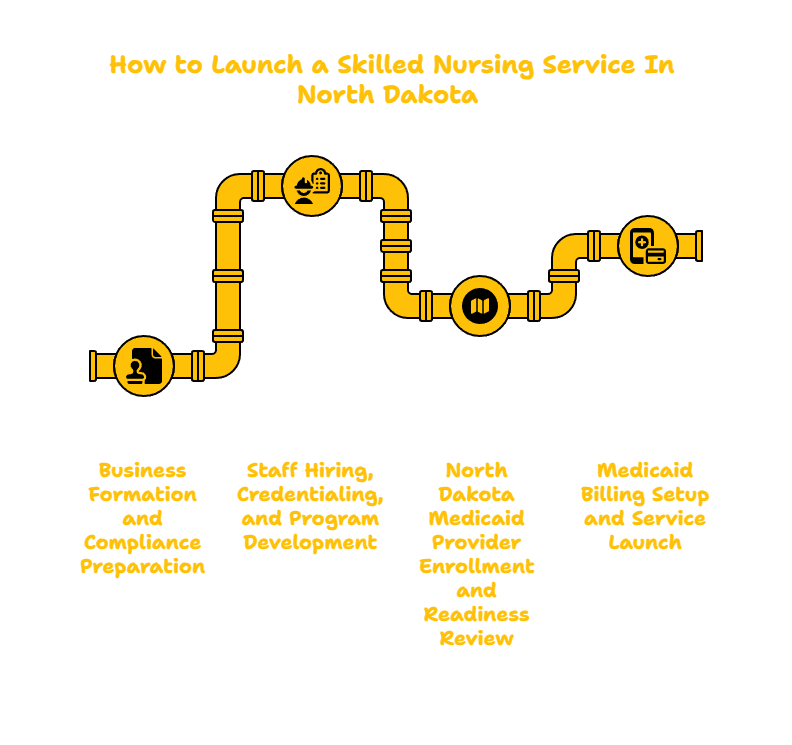
The timeline involves several distinct phases. Business formation and compliance preparation typically take 1–2 months, followed by 2–3 months for staff hiring and program development. The Medicaid provider enrollment and readiness review process generally requires 60–90 days, with an additional 30–45 days needed for billing setup and service launch.
What are the primary responsibilities of the Skilled Nursing Program Director?
The Director is responsible for overseeing the clinical direction of the agency, ensuring staff qualifications meet state standards, managing the quality assurance system, and verifying that all clinical protocols align with NDDHS and CMS requirements.
WCG Assistance for Providers
Waiver Consulting Group (WCG) provides comprehensive support for agencies aiming to launch Medicaid-compliant Skilled Nursing Services in North Dakota. Our services include assistance with business registration, Medicaid enrollment, and state licensing. We also support the development of professional policy manuals, staff credentialing and training templates, and the setup of audit-prepared financial management systems. WCG further provides guidance on clinical quality assurance systems, patient safety protocols, and the development of effective client outreach and branding strategies to ensure the agency is well-positioned for long-term success.
Key Takeaway: Successfully operating as a Skilled Nursing provider in North Dakota requires a strict adherence to NDDHS and MSD regulatory protocols, the maintenance of high-caliber clinical staffing, and the implementation of robust documentation and quality assurance systems to remain in compliance with both state and federal Medicaid requirements.
Last verified: June 2024. This information is provided for educational purposes only and does not constitute legal or professional advice. Requirements for Medicaid provider enrollment and clinical services are subject to change. Consult the North Dakota Department of Human Services and the North Dakota Medical Services Division for the most current regulations and official state guidelines.