SKILLED NURSING SERVICES PROVIDER IN NEW YORK
By Fatumata Kaba · 2025-09-04 · 5 min read
Skilled Nursing Services in New York provide essential clinical, rehabilitative, and health-monitoring care to individuals with complex medical needs in their own homes and community settings. Authorized under various New York Medicaid Home and Community-Based Services (HCBS) waivers, these services are designed to support long-term medical stability, post-hospitalization recovery, and the proactive management of chronic conditions.
For healthcare entrepreneurs and agency administrators, establishing a Skilled Nursing service provider in New York requires strict adherence to regulatory standards set by the New York State Department of Health (NYSDOH), the Office for People With Developmental Disabilities (OPWDD), and the Office of Mental Health (OMH). This guide outlines the operational, clinical, and administrative requirements necessary to launch and maintain a compliant, high-quality nursing service provider in the New York Medicaid landscape.
What Are the Governing Agencies and Regulatory Frameworks?
The regulatory environment for skilled nursing in New York is multifaceted, involving both state and federal oversight to ensure patient safety and fiscal accountability. The New York State Department of Health (NYSDOH) serves as the primary administrator, overseeing Medicaid waiver funding, provider enrollment, and the critical processes of service authorization and reimbursement.
In addition to the NYSDOH, specialized state agencies provide oversight based on the specific populations served. The New York State Office for People With Developmental Disabilities (OPWDD) regulates skilled nursing services provided to individuals with developmental disabilities, while the New York State Office of Mental Health (OMH) ensures that agencies providing care to those with behavioral health needs maintain strict compliance with mental health regulations. Finally, the Centers for Medicare & Medicaid Services (CMS) provides the overarching federal framework, ensuring all Medicaid-funded services adhere to national standards for quality, person-centered care, and patient rights.
What Scope of Care Can a Skilled Nursing Provider Deliver?
Approved providers are responsible for delivering a wide range of clinical interventions performed by licensed professionals. These services are vital for maintaining patient health, preventing hospital readmissions, and supporting rehabilitation in a community-based environment. The scope of care must be documented in a person-centered service plan that aligns with the individual's specific medical needs.
Key clinical services that providers typically deliver include:
- Wound Care: Professional monitoring and management of healing for pressure ulcers and surgical sites.
- Medication Administration: Safe delivery of medications, including complex injections and infusions.
- Chronic Disease Management: Ongoing clinical support for conditions such as diabetes, hypertension, and respiratory disorders.
- Health Assessments: Routine physical exams and systematic evaluations of health status.
- Vital Sign Monitoring: Tracking blood pressure, glucose levels, heart rate, and respiratory function to identify early warning signs.
- End-of-Life Care: Providing palliative and hospice support to ensure comfort and dignity.
What Are the Essential Licensing and Administrative Prerequisites?
Before an agency can begin delivering services, it must establish a formal business structure and obtain necessary federal and state identifiers. The process begins with registering the business entity with the New York Department of State and securing an Employer Identification Number (EIN) from the IRS. Furthermore, obtaining a Type 2 National Provider Identifier (NPI) is a mandatory step for healthcare organizations to process Medicaid billing.
Beyond basic business formation, providers must secure general and professional liability insurance to protect against clinical and operational risks. A critical component of success is the development of robust, written policies and procedures. These internal documents must cover clinical care protocols, medication management, infection control, and patient safety. Furthermore, the agency must implement a system for verifying the licensure of all nursing staff and conducting rigorous background checks prior to hiring.
How Do You Navigate the New York Provider Enrollment Process?
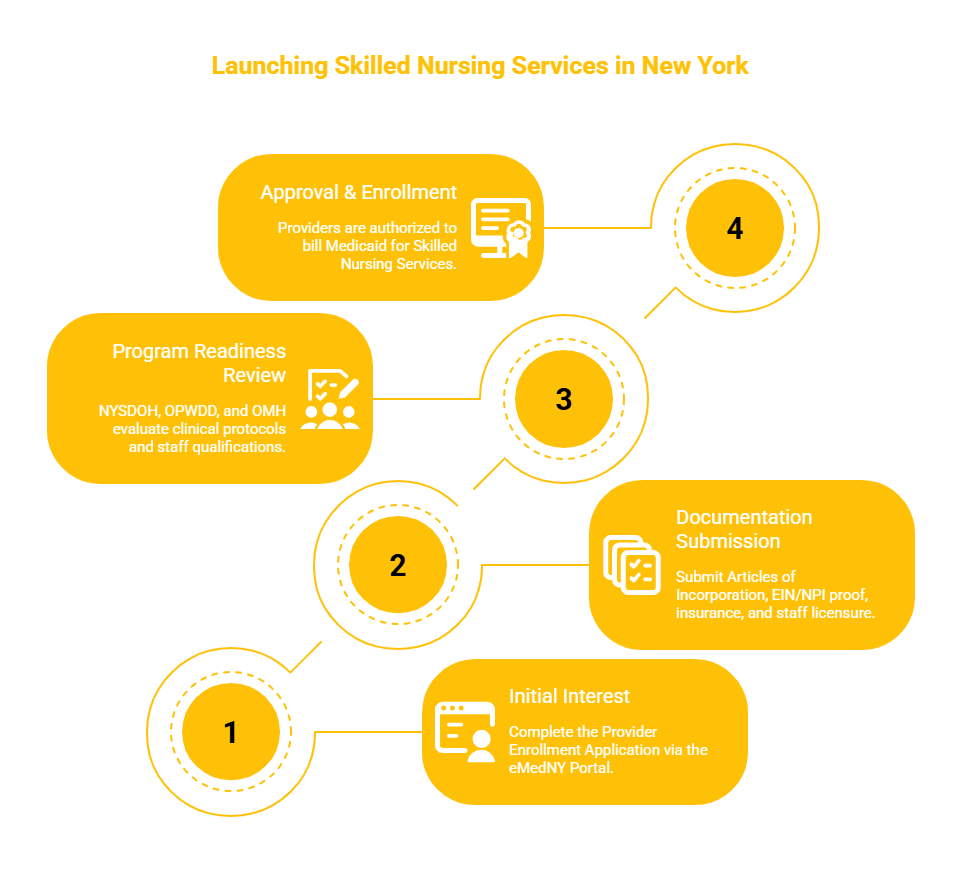
The enrollment process is a sequential journey that begins with the submission of an application via the eMedNY Provider Enrollment Portal. Providers must specifically identify the HCBS waivers under which they intend to operate. This application requires the submission of foundational documents, including Articles of Incorporation, proof of NPI/EIN, and evidence of professional liability insurance coverage.
Once the initial application is submitted, the relevant agencies—such as the NYSDOH, OPWDD, or OMH—conduct a Program Readiness Review. This phase involves a detailed evaluation of the provider's clinical protocols, patient safety measures, and the qualifications of their administrative and nursing leadership. Only after this rigorous review is completed and the provider demonstrates full compliance with state requirements is the agency officially approved to bill Medicaid using designated service codes.
What Are the Staffing and Documentation Requirements?
The quality of a Skilled Nursing service is entirely dependent on its staff. Agencies must employ a Nursing Director who holds an active Registered Nurse (RN) license and a Bachelor’s or Master’s in Nursing, alongside verifiable experience in clinical supervision. Direct care staff, including RNs and Licensed Practical Nurses (LPNs), must maintain active state licensure and hold current CPR and Basic Life Support (BLS) certifications.
For all staff, agencies are required to maintain detailed records documenting annual competency evaluations, training in infection control, HIPAA compliance, and patient rights education. Comprehensive documentation is also required for the services themselves. This includes maintaining accurate health records and care plans that meet Medicaid billing standards. The agency's Policy & Procedure Manual must be updated regularly to reflect changes in clinical standards and state-mandated documentation requirements.
Frequently Asked Questions
Which Medicaid Waivers include Skilled Nursing Services?
Skilled Nursing Services are currently available under the OPWDD Comprehensive Waiver, the Nursing Home Transition and Diversion (NHTD) Waiver, the Traumatic Brain Injury (TBI) Waiver, and other relevant Home and Community-Based Services (HCBS) waivers in New York.
What is the typical timeline for launching a Skilled Nursing agency?
The launch process generally takes between 6 to 10 months. This includes 1–2 months for business formation, 2–3 months for staff hiring and program development, 60–90 days for the enrollment and readiness review, and 30–45 days for final billing setup.
What role does the Nursing Director play in compliance?
The Nursing Director is responsible for overseeing the clinical integrity of the agency, ensuring staff remain credentialed and trained, maintaining clinical protocols that meet state standards, and conducting quality assurance reviews to ensure that patient care consistently aligns with Medicaid regulatory requirements.
WCG supports agencies in launching Medicaid-compliant Skilled Nursing Services in New York by offering assistance with business registration, Medicaid enrollment, licensing, clinical protocol development, and the creation of staff training and quality assurance systems. Our comprehensive support ensures that new providers are audit-prepared and positioned to deliver high-quality care to vulnerable populations from day one.
Key Takeaway: Successfully launching a Skilled Nursing provider in New York requires a precise balance of clinical expertise and regulatory adherence. By focusing on rigorous staff credentialing, comprehensive policy development, and a proactive approach to the eMedNY enrollment and readiness review process, providers can ensure long-term sustainability and compliance within the Medicaid HCBS framework.
Last verified: October 2023. Disclaimer: This information is for educational purposes only and does not constitute legal or professional advice. Regulatory requirements in New York are subject to change. Always consult with the New York State Department of Health or the relevant oversight agency, as well as qualified legal counsel, before making business decisions or submitting applications for licensure and provider enrollment.