SKILLED NURSING SERVICES PROVIDER IN NEW JERSEY
By Fatumata Kaba · 2025-09-05 · 6 min read
Skilled Nursing Services in New Jersey represent a critical component of the state’s Home and Community-Based Services (HCBS) ecosystem, providing essential clinical support to individuals living with chronic health conditions or complex medical needs. By facilitating high-level medical care directly in the participant’s home, these services prevent unnecessary institutionalization and promote autonomy, ensuring that vulnerable populations receive professional health monitoring, medication management, and specialized nursing interventions under authorized Medicaid waiver programs.
What Regulatory Bodies Govern Skilled Nursing in New Jersey?
The delivery of Skilled Nursing Services in New Jersey is governed by a multi-tiered regulatory framework designed to ensure participant safety and the integrity of Medicaid funding. At the state level, the New Jersey Department of Human Services (DHS) serves as the primary administrator, managing the allocation of waiver funding, facilitating provider enrollment, and overseeing the critical service authorization and reimbursement processes. Their oversight ensures that provider operations remain aligned with the budgetary and programmatic requirements of the state’s HCBS initiatives.
In addition to the DHS, the Division of Medical Assistance and Health Services (DMAHS) plays a central role in maintaining quality standards. DMAHS is responsible for the direct supervision of service delivery, compliance auditing, and ensuring that providers adhere to the rigorous clinical standards required under HCBS waiver programs. Federally, the Centers for Medicare & Medicaid Services (CMS) provides the overarching regulatory structure, mandating that all Medicaid-funded services uphold person-centered planning, participant rights, and federal safety standards. Compliance with all three entities is mandatory for any agency seeking to operate and bill for services successfully.
What Scope of Care Do Skilled Nursing Providers Deliver?
Skilled Nursing Services are distinct from non-medical personal care, as they require the specialized training of licensed nursing professionals to address complex physiological needs. These services are delivered strictly in accordance with an Individualized Service Plan (ISP), which dictates the specific clinical interventions necessary to stabilize or improve the participant’s health status within their home or community environment. Providers must be equipped to handle a wide range of medical tasks, ensuring that both patients and their families are adequately educated on condition management.
The clinical scope of these services is comprehensive and requires rigorous professional oversight. Approved providers generally deliver the following key services:
- Health Assessments: Routine monitoring of vital signs, alongside comprehensive physical and mental health evaluations.
- Medication Management: Precise administration of medications and the oversight of complex pharmacological schedules.
- Specialized Clinical Care: Management of wound care, infection monitoring, tube feeding, IV therapy, and the maintenance of catheters and ostomies.
- Chronic Disease Support: Ongoing intervention for conditions such as diabetes and hypertension, as well as respiratory therapy support.
- Post-Surgical and Crisis Management: Recovery monitoring and the execution of emergency care protocols when clinical symptoms fluctuate.
What Are the Licensing and Provider Approval Requirements?
The pathway to becoming a Medicaid-approved Skilled Nursing provider is intensive, requiring both business infrastructure and clinical compliance. Before engaging with the Medicaid enrollment portal, an agency must formally register as a legal business entity with the New Jersey Division of Revenue and Enterprise Services and secure both an IRS Employer Identification Number (EIN) and a Type 2 National Provider Identifier (NPI). These foundational steps establish the agency’s legitimacy as a provider of healthcare services.
Beyond standard business registration, providers must meet specific healthcare-related mandates, including obtaining a Home Health Agency license from the New Jersey Department of Health (NJDOH). Insurance is a critical prerequisite, as agencies must maintain both general liability and professional liability coverage to protect against clinical risks. Finally, providers must curate a comprehensive policy manual that outlines clinical care protocols, medication administration safety, HIPAA privacy standards, and robust staff credentialing procedures, all of which are subject to review during the state’s readiness assessment.
How Does the Enrollment and Readiness Process Function?
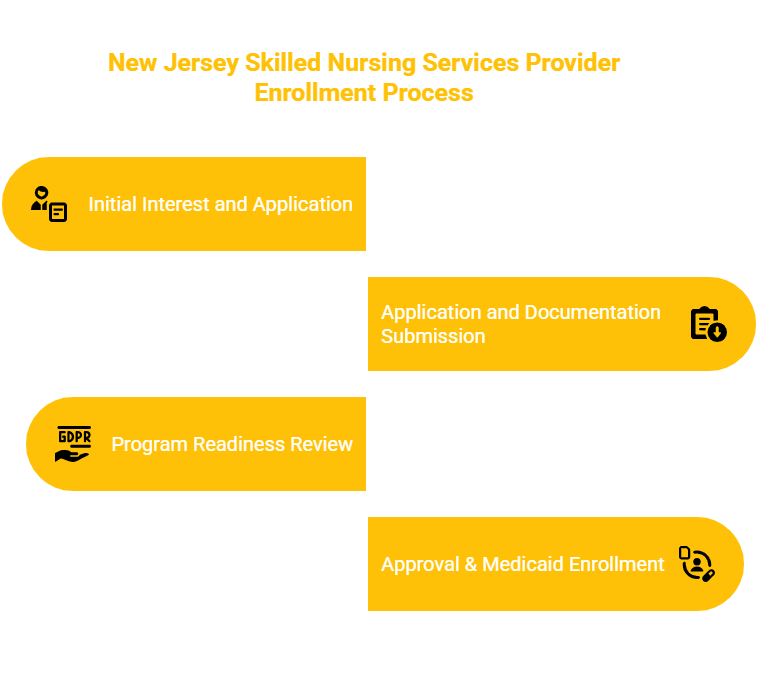
The provider enrollment process is a structured, multi-phase sequence that requires meticulous documentation and proactive coordination with state agencies. Initially, applicants must submit an enrollment request through the New Jersey Medicaid Provider Enrollment Portal, specifically identifying as a Skilled Nursing provider under the relevant HCBS waivers. During this phase, the applicant must demonstrate that their operational infrastructure is fully prepared to handle the clinical and billing demands of the Medicaid program.
Once the initial application and supporting documents—such as Articles of Incorporation, proof of insurance, and detailed policy manuals—are submitted, the DHS and DMAHS conduct a rigorous program readiness review. This review evaluates the provider’s clinical protocols, emergency response planning, and the qualifications of the nursing staff. If the agency meets all state and federal standards, they receive approval to participate in the Medicaid program, at which point they are authorized to utilize designated billing codes to request reimbursement for delivered services.
What Are the Mandatory Staffing and Training Standards?
Quality of care is heavily dependent on the caliber of the nursing team, which is why New Jersey mandates strict credentialing for all staff members. A Skilled Nursing Program Director is required to oversee clinical operations, possessing a Bachelor’s or Master’s degree in nursing, an active New Jersey RN license, and documented supervisory experience. This director is responsible for ensuring that all Registered Nurses (RNs) and Licensed Practical Nurses (LPNs) providing direct care are fully licensed, background-checked, and current on all necessary clinical certifications like CPR and First Aid.
In addition to initial credentials, agencies are responsible for the ongoing professional development of their nursing staff. This includes recurring training on clinical protocols, HIPAA compliance, and updated infection control procedures. Agencies must maintain evidence of annual competency evaluations and professional development logs, as these are frequently audited to ensure that the level of care delivered to waiver participants meets the standard required by state and federal regulators.
Frequently Asked Questions
Which Medicaid waivers currently authorize Skilled Nursing Services?
Skilled Nursing Services are authorized under several key New Jersey programs, including the Community Care Program for the Elderly and Disabled (CCPED), the Supports Program Waiver, the Acquired Brain Injury (ABI) Waiver, the Personal Care Assistant (PCA) Waiver, and the broader Home and Community-Based Services (HCBS) Waiver.
What is the typical timeline for launching a skilled nursing agency?
The launch process generally spans several months: 1–2 months for business formation, 2–3 months for staff hiring and policy development, 60–90 days for the Medicaid enrollment and readiness review, and 30–45 days for final billing system setup and service initiation.
What documentation is essential for the provider enrollment portal?
Applicants must provide their Articles of Incorporation, IRS EIN confirmation, Type 2 NPI, Home Health Agency license, proof of insurance, and a comprehensive Policy and Procedure Manual covering clinical care, billing, HIPAA compliance, and staff training protocols.
WCG Support for Agency Development
Waiver Consulting Group (WCG) assists agencies in navigating the complexities of launching Medicaid-compliant Skilled Nursing Services in New Jersey. Support services include the formalization of business structures, Medicaid enrollment guidance, and the development of clinical policy manuals tailored to state requirements. WCG also provides expertise in establishing staff credentialing systems, audit-ready financial management practices, and quality assurance programs designed to maintain ongoing compliance with DHS and DMAHS standards.
Key takeaway: Success in the New Jersey Skilled Nursing market requires a rigorous adherence to state-specific licensing requirements, a robust clinical policy framework, and a commitment to ongoing staff training to ensure compliance with Medicaid waiver standards. By meticulously following the established enrollment timeline and maintaining documentation integrity, providers can effectively deliver essential nursing services to vulnerable populations within the community.
Last verified: 2024. This information is provided for educational purposes and does not constitute legal or professional advice. Requirements and policies are subject to change by state and federal authorities; providers should consult official Medicaid program manuals and state regulations for the most current guidance.