SKILLED NURSING SERVICES PROVIDER IN MISSOURI
By Fatumata Kaba · 2025-08-07 · 5 min read
What Are Skilled Nursing Services in the Missouri HCBS Framework?
Skilled Nursing Services in Missouri represent a critical component of the state’s Home and Community-Based Services (HCBS) landscape, providing clinical, medical, and health-related support directly in a participant’s home. These services are delivered by licensed healthcare professionals—typically Registered Nurses (RNs) or Licensed Practical Nurses (LPNs)—who act under the specific orders of a primary care physician to manage complex health needs that cannot be addressed by personal care aides alone. By bringing professional medical oversight into the home, these services empower individuals to maintain their health, manage chronic conditions effectively, and avoid the necessity of hospitalization or institutional placement.
For healthcare entrepreneurs and agency founders, understanding the scope of these services is essential for building a compliant delivery model. Skilled Nursing is not a one-size-fits-all offering; it is a highly regulated service tailored to the unique Individual Service Plan (ISP) or Person-Centered Plan (PCP) of each Medicaid beneficiary. These services often serve as a bridge between acute hospital care and independent living, ensuring that patients recovering from surgery or those managing persistent conditions like diabetes or COPD receive the professional monitoring required to thrive in their own community.
Who Regulates Skilled Nursing Services in Missouri?
The regulatory structure for Skilled Nursing in Missouri is a multi-agency framework designed to ensure patient safety and program integrity. The primary regulatory body is the Missouri Department of Health and Senior Services (DHSS), which holds the authority to oversee Home Health Agency licensure and clinical standards. This department ensures that the clinical environment, staff credentials, and care protocols meet state-mandated benchmarks for medical support.
Beyond DHSS, the Missouri Department of Social Services (DSS) manages the intersection of clinical care and financial reimbursement. DSS is responsible for the Medicaid provider enrollment process and service authorization, acting as the gateway for agencies wishing to bill for services provided to waiver participants. Finally, the Centers for Medicare & Medicaid Services (CMS) provides federal oversight, setting the baseline requirements for waiver compliance and ensuring that Missouri’s programs align with national standards for home-based care. Navigating this three-tiered system requires meticulous attention to administrative detail and constant alignment with state and federal guidelines.
What Are the Clinical Responsibilities of a Skilled Nursing Provider?
The core of a Skilled Nursing program lies in its clinical application. Providers are tasked with delivering sophisticated medical care that adheres strictly to the physician-approved Person-Centered Plan. This includes high-level interventions such as wound care, dressing changes, IV therapy, and the administration of specialized injections. Each clinical task must be documented with precision to ensure continuity of care and to satisfy audit requirements set forth by state agencies.
In addition to active treatments, Skilled Nursing providers play a vital role in patient education and chronic disease management. Nurses are expected to provide instruction to patients and their family caregivers, fostering a safer home environment. This includes tracking vital signs, monitoring health trends, and coordinating closely with primary care providers to adjust treatment strategies as the participant's health status evolves. The following list outlines the primary service areas generally encompassed by these programs:
- Wound care and complex dressing changes.
- Medication administration, management, and reconciliation.
- IV therapy and clinical injections.
- Chronic disease management (e.g., diabetes, COPD, cardiovascular care).
- Ongoing health monitoring and vital sign tracking.
- Patient and family caregiver education for disease self-management.
- Seamless coordination with primary care providers and specialists.
How Do Agencies Meet Licensing and Enrollment Requirements?
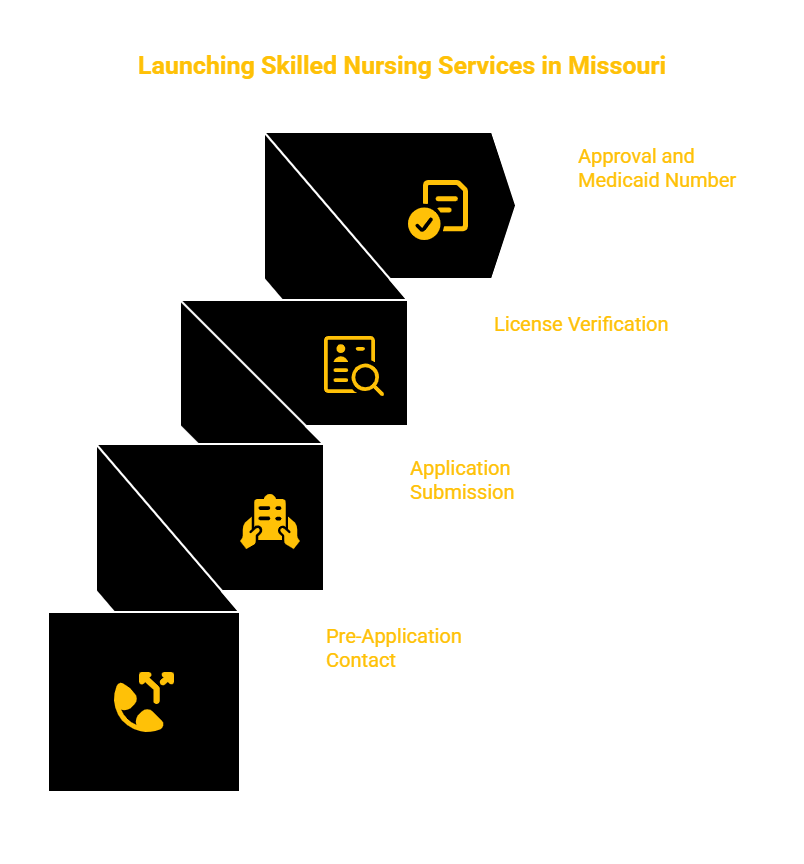
Transitioning from a business concept to an active Medicaid provider is a structured process that requires specific legal and operational prerequisites. Founders must first ensure the business is legally formed with the Missouri Secretary of State and has obtained a federal Employer Identification Number (EIN) and a Type 2 National Provider Identifier (NPI). These foundational steps provide the legal and organizational identity required for all subsequent applications.
Once the business entity is established, the agency must secure a Home Health Agency License from the Missouri Department of Health and Senior Services. This licensure process is the most rigorous stage of the startup phase, requiring comprehensive evidence of clinical policies, infection control procedures, and patient safety protocols. After the license is obtained, the agency must successfully navigate the Missouri Department of Social Services provider enrollment portal to receive a Medicaid provider number. This number is the final key that grants the agency the authority to submit claims for services delivered to participants in the Aged and Disabled Waiver (ADW), Independent Living Waiver, or Medically Fragile Adult Waiver.
What Are the Critical Staffing and Compliance Standards?
An agency is only as effective as its clinical team. The program must be led by a Skilled Nursing Program Manager, who is typically required to be a licensed Registered Nurse (RN) with demonstrated experience in home healthcare management. This individual is responsible for overseeing the clinical rigor of the agency, ensuring that all nursing care meets state regulations and the specific goals outlined in the participant's ISP.
Staffing requirements extend to all direct-care personnel, including RNs and LPNs. All clinical staff must possess a valid nursing degree, an active license in good standing, and current CPR/First Aid certification. Furthermore, the agency must maintain a culture of ongoing competency. This involves implementing robust training programs that cover infection control, emergency response, and detailed documentation techniques. By maintaining thorough background checks and TB clearance records for every staff member, an agency establishes the administrative foundation necessary to sustain compliance over the long term.
Frequently Asked Questions
How long does the full startup process take for a Skilled Nursing Agency in Missouri?
The timeline varies based on operational readiness, but generally, business formation takes 1–2 weeks, Medicaid provider enrollment takes 60–90 days, staffing and training require 30–45 days, and clinical safety compliance setup takes 2–4 weeks.
Which Medicaid waivers allow for Skilled Nursing Services?
Skilled Nursing Services are currently available through the Aged and Disabled Waiver (ADW), the Independent Living Waiver, and the Medically Fragile Adult Waiver.
What documentation is essential for initial compliance?
Agencies must maintain articles of incorporation, an IRS EIN letter, NPI confirmation, a valid Home Health Agency License, proof of liability insurance, and a comprehensive policy and procedure manual covering clinical care, medication management, and staff competency records.
Key Takeaway
Launching a Skilled Nursing Services provider in Missouri requires a strategic focus on clinical compliance, rigorous staff credentialing, and a deep understanding of the regulatory relationship between the Missouri Department of Health and Senior Services and the Department of Social Services. By prioritizing these administrative and clinical foundations, agencies can effectively support the independence of waiver participants while maintaining the high standards of care demanded by state and federal regulators.
Last verified: 2024. This information is intended for educational purposes and does not constitute legal or professional consulting advice. Requirements are subject to change by the Missouri Department of Health and Senior Services (DHSS) and the Centers for Medicare & Medicaid Services (CMS). Always verify the most current regulations directly with the respective state agencies before initiating provider enrollment.