SKILLED NURSING SERVICES PROVIDER IN MICHIGAN
By Fatumata Kaba · 2025-07-27 · 5 min read
Skilled nursing services in Michigan are essential clinical interventions delivered to individuals with complex health needs in their home or community, helping to prevent institutionalization and support recovery. These services are authorized through the Michigan Department of Health and Human Services (MDHHS) and funded via Medicaid State Plan services, the MI Choice Waiver, and other Home and Community-Based Services (HCBS) programs. To provide these services, agencies must meet rigorous regulatory standards enforced by both the state of Michigan and federal oversight bodies.
What Regulatory Agencies Govern Skilled Nursing in Michigan?
The delivery of skilled nursing services is subject to strict oversight to ensure patient safety and program integrity. At the federal level, the Centers for Medicare & Medicaid Services (CMS) provides the framework and funding for 1915(c) waivers and Medicaid state plan provisions. These federal regulations set the baseline for care quality and financial accountability that all participating Michigan providers must satisfy.
State-level regulation is primarily managed by the Michigan Department of Licensing and Regulatory Affairs (LARA), which is responsible for issuing home health agency licenses. Additionally, the Michigan Board of Nursing oversees the professional conduct and licensure of all Registered Nurses (RNs) and Licensed Practical Nurses (LPNs). Finally, local Area Agencies on Aging (AAA) play a critical role in coordinating these services specifically for the MI Choice Waiver population, ensuring that care plans align with the unique needs of seniors and adults with disabilities.
What Does the Scope of Skilled Nursing Care Include?
Skilled nursing involves specialized clinical care performed by licensed medical professionals. These services must be physician-ordered and documented within a comprehensive Plan of Care (POC). The focus is on managing chronic conditions, facilitating post-surgical recovery, and preventing the escalation of medical issues that might otherwise necessitate hospital admission.
- Medication administration and complex intravenous therapy.
- Wound care, dressing changes, and pressure ulcer management.
- Catheter care, ostomy maintenance, and enteral feeding assistance.
- Pain management and palliative care support.
- Chronic disease monitoring, including diabetes and hypertension management.
- Comprehensive health assessments and ongoing vital sign monitoring.
- Clinical coordination between physicians, specialists, and the patient.
- Client and caregiver education regarding medical management and safety.
How Do Providers Obtain Necessary Licensing and Enrollment?
The path to becoming an approved provider begins with establishing a legitimate business structure and securing the necessary state-issued licenses. Founders must register their organization with LARA and obtain both an IRS EIN and a Type 2 NPI. Because skilled nursing is a highly regulated clinical service, agencies are required to carry adequate general liability and professional malpractice insurance to protect both the entity and the patients served.
Once the business is legally established, providers must apply for a Home Health Agency License through the LARA licensing portal. Following licensure, the agency must enroll in the Michigan Medicaid program via the CHAMPS system. For providers intending to serve participants in waiver programs, additional credentialing steps are required through local AAAs and the MDHHS. This process is time-intensive and requires meticulous attention to detail to ensure that all documentation meets state and federal audit standards.
What Documentation Is Essential for Compliance?
A successful audit from the state depends on the provider’s ability to maintain a comprehensive and organized clinical record. Beyond standard business documents such as Articles of Incorporation and NPI confirmations, agencies must develop a robust Skilled Nursing Services Policy & Procedure Manual. This manual serves as the operational blueprint for the organization and must be readily available for review during state inspections.
- Physician order templates and evidence-based care planning documentation.
- Clinical progress notes and standardized patient assessment forms.
- Accurate Medication Administration Records (MARs) and treatment logs.
- Infection control protocols, disaster preparedness, and emergency plans.
- Strict HIPAA compliance measures and data security policies.
- Staff training logs, credential verification records, and performance evaluations.
- Transparent billing records that correlate directly with the services documented in the POC.
What Are the Staffing and Training Mandates?
Staffing requirements are designed to guarantee that every patient receives care from qualified and vetted professionals. Registered Nurses (RNs) must hold an active, clean license in Michigan, maintain current CPR certification, and pass a comprehensive background check. While LPNs may provide direct care, they must function under the appropriate clinical supervision of an RN.
Agencies are also required to appoint a Director of Nursing (DON) who holds an RN license and possesses the leadership experience necessary to oversee quality assurance and clinical policy adherence. Training is not optional; all staff members must participate in regular, documented education on infection control, universal precautions, HIPAA regulations, and mandatory reporting of abuse or neglect. These training mandates ensure a consistent standard of care across the organization.
Frequently Asked Questions
What is the typical timeline for launching a skilled nursing agency?
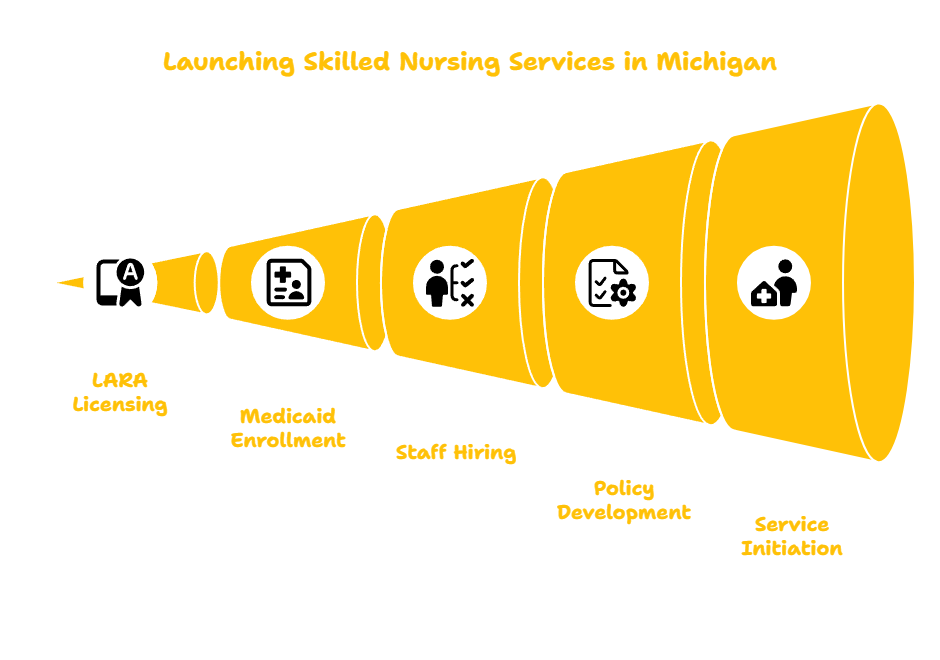
The launch process generally spans 4 to 8 months, depending on the phase. Business registration and insurance setup take 2–3 weeks, while LARA licensing and Medicaid enrollment typically require 2–4 months. Staffing and policy development usually run concurrently or follow in the final 1–2 months before client intake begins.
Is skilled nursing the same as personal care assistance?
No. Skilled nursing involves medical interventions performed by licensed nurses (RNs or LPNs) based on a physician’s order. Personal care assistance is generally non-medical in nature, focusing on activities of daily living like bathing, dressing, and meal preparation, which may be performed by direct care workers or home health aides.
How do I enroll in the MI Choice Waiver program?
Providers must register as a waiver provider through their local Area Agency on Aging (AAA) and the MDHHS. This involves specific credentialing to demonstrate that the agency meets the specialized standards required for serving the aging and disability population within that specific waiver program.
Key Takeaway
Launching a skilled nursing provider agency in Michigan requires a structured approach to clinical compliance, rigorous staff credentialing, and seamless integration with the CHAMPS and LARA systems. By maintaining strict adherence to physician-led care plans and documentation protocols, agencies can successfully navigate the Medicaid and HCBS waiver landscape to provide essential medical support to vulnerable populations.
WCG assists healthcare professionals, home health agencies, and community organizations in launching licensed, Medicaid-approved skilled nursing services across Michigan. Our scope of work includes business setup, LARA licensing guidance, Medicaid and MI Choice waiver enrollment support, policy manual development, and clinical staffing model implementation. Last verified: 2024. The information provided here is for general educational purposes only and does not constitute legal or professional advice. Always consult with the appropriate state regulatory agencies and legal counsel to ensure full compliance with current Michigan and federal regulations.