SKILLED NURSING SERVICES PROVIDER IN MASSACHUSETTS
By Fatumata Kaba · 2025-08-08 · 5 min read
Delivering licensed medical care in the home or community for individuals with complex health needs.
Skilled Nursing Services in Massachusetts represent a critical link in the continuum of care, providing essential clinical support to individuals navigating chronic illnesses, disabilities, or post-hospitalization recovery. As a central component of the MassHealth state plan and various Home and Community-Based Services (HCBS) waivers, these services allow patients to remain in their preferred home settings while receiving professional medical oversight authorized by their physician.
What Are the Governing Agencies for Massachusetts Skilled Nursing?
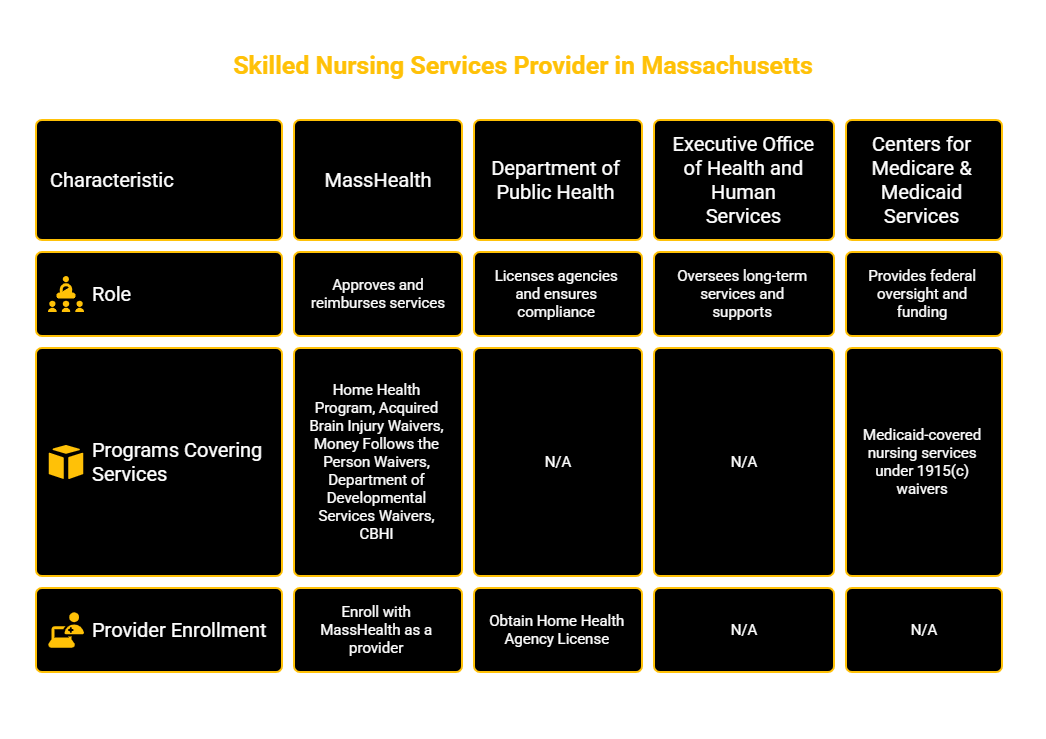
The regulatory landscape for home-based skilled nursing in Massachusetts is multi-layered, involving state and federal authorities that ensure high standards of patient safety and fiscal accountability. Understanding these entities is the first step for any provider agency seeking to enter the Medicaid market. MassHealth serves as the primary administrator for Medicaid benefits, determining reimbursement structures and eligibility for services under both state plan and HCBS waiver programs.
Operational oversight and licensure are managed by the Department of Public Health (DPH) via the Division of Health Care Facility Licensure and Certification, which confirms that agencies adhere to clinical compliance standards. Furthermore, the Executive Office of Health and Human Services (EOHHS) coordinates long-term services and supports (LTSS), while the Centers for Medicare & Medicaid Services (CMS) provides federal oversight and necessary funding mechanisms for 1915(c) waivers.
- MassHealth: Oversees reimbursement and state-level Medicaid policy.
- Department of Public Health (DPH): Manages agency licensure and clinical regulatory compliance.
- Executive Office of Health and Human Services (EOHHS): Coordinates long-term care strategy.
- Centers for Medicare & Medicaid Services (CMS): Regulates federal funding for waiver-based services.
How Do Providers Define the Scope of Skilled Nursing Services?
Skilled nursing services are distinguished by their clinical necessity and the requirement for a licensed professional—either a Registered Nurse (RN) or a Licensed Practical Nurse (LPN)—to perform tasks that cannot be safely delegated to non-clinical staff. All services must be explicitly ordered by a physician and formalized within a Plan of Care (POC) or an Individual Service Plan (ISP) to remain eligible for Medicaid reimbursement.
The scope of these services is broad, covering everything from complex infusion therapies to routine monitoring of stable chronic conditions. Providers must maintain meticulous documentation to demonstrate medical necessity, ensuring that each visit aligns with the patient’s documented clinical needs and physician-directed goals.
- Medication administration and intravenous (IV) therapy.
- Wound care, dressing changes, and pressure ulcer management.
- Catheter care, ostomy maintenance, and enteral tube feeding.
- Monitoring of chronic conditions such as diabetes, Congestive Heart Failure (CHF), and COPD.
- Clinical health assessments, vital sign monitoring, and caregiver training.
What Are the Prerequisites for Licensing and Provider Approval?
Launching a skilled nursing agency requires strict adherence to both business and clinical prerequisites. Before an agency can accept patients, it must be legally established within the Commonwealth of Massachusetts and possess the necessary federal identifiers. This includes registering with the Secretary of the Commonwealth and obtaining an IRS EIN and a Type 2 National Provider Identifier (NPI).
Clinical infrastructure is equally paramount. An agency must obtain a Home Health Agency license from the DPH and demonstrate that it carries sufficient professional liability and malpractice insurance. Staffing must be comprised of RNs and LPNs who maintain current credentials from the Massachusetts Board of Registration in Nursing. Furthermore, clinical policies must be robust enough to satisfy the CMS Conditions of Participation (CoPs), which govern the delivery of safe and effective home health care.
What Is the Sequence of the Provider Enrollment Process?
The road to enrollment is a multi-step journey that requires precision and patience. The process begins with securing the DPH Home Health Agency license through the official licensure portal. Once licensed, the provider must enroll with MassHealth via the Provider Online Service Center (POSC) to become an authorized billing entity. This step creates the connection between the agency and the state’s payment system.
After achieving baseline enrollment, providers seeking to serve specific populations must apply to HCBS waiver programs, such as those administered by the Department of Developmental Services (DDS) or the Acquired Brain Injury (ABI) program. During this stage, providers must submit detailed staffing plans and clinical protocols. Finally, the agency must prepare for the DPH survey, which evaluates the implementation of Quality Assurance Performance Improvement (QAPI) systems and verifies that clinical oversight is functioning according to state mandates.
What Documentation Is Essential for Compliance?
Compliance is the backbone of any successful skilled nursing operation. Providers must maintain a comprehensive Policy & Procedure Manual that serves as the agency’s "source of truth." This manual must contain clear templates for physician orders, clinical progress notes, and medication administration records (MARs). Maintaining these records in a standardized format ensures that the agency is audit-ready at all times.
Beyond clinical forms, administrative documentation is vital. This includes proof of corporate registration, insurance certificates, and records showing that all nurses have completed required trainings, such as infection control and HIPAA compliance. Agencies must also demonstrate the existence of internal systems for nurse supervision, billing integrity, and emergency preparedness to ensure that every aspect of the agency meets regulatory expectations.
Frequently Asked Questions
What qualifications must a Director of Nursing possess in Massachusetts?
A Director of Nursing must hold a valid Massachusetts Registered Nurse (RN) license and possess proven leadership experience. This role is responsible for the oversight of all clinical policies, the implementation of QAPI programs, and the direct supervision of nursing staff to ensure regulatory compliance.
Are providers required to use Electronic Visit Verification (EVV)?
Yes, providers may be required to utilize EVV systems depending on the specific program or waiver under which services are delivered. EVV is a critical tool for documenting the delivery of care and ensuring that Medicaid funds are applied correctly to authorized services.
How does an agency manage physician coordination?
Physician coordination is documented through the initial Plan of Care and subsequent periodic updates. Agencies are required to facilitate communication between the patient's primary physician and the nursing staff, ensuring that all clinical interventions are ordered, monitored, and modified as the patient's condition evolves.
Key Takeaway
Successfully establishing a skilled nursing provider agency in Massachusetts requires a disciplined approach to both clinical licensure and administrative credentialing. By aligning internal quality assurance systems with the requirements of MassHealth, the DPH, and federal oversight bodies, agencies can build a sustainable model that provides high-quality, essential care to individuals within the home and community.
Waiver Consulting Group’s Start-Up Assistance Service provides comprehensive support for nurse entrepreneurs and healthcare organizations, including business setup, policy manual creation, credentialing for DDS and MFP programs, and clinical staffing models. Our tools ensure that your agency remains compliant with all state and federal regulations, from the initial license application through ongoing audit preparedness.
Last verified: 2024. This information is for educational purposes only and does not constitute legal or professional medical advice. Always refer to official MassHealth bulletins and the DPH licensure website for the most current regulatory updates.